Transylvania. The name alone sends a shiver down the spine. It conjures images of fog-choked forests, jagged mountain peaks, and the fictional castles of blood-drinking counts. But forget the movies for a second. Forget the Victorian ghost stories. The real history buried beneath the Romanian soil is stranger, older, and far more mysterious than any vampire myth.
We are talking about a time lost to the gray mists of history. A time before Rome marched across the world. A time before money existed. A time when metal was magic, and the gods demanded payment in blood and bronze.

The Accidental Discovery That Changed Everything
It always happens when we aren’t looking. We think we have the map figured out. We think we know what lies beneath our feet. Then, a bulldozer hits something hard, and the timeline shatters.
That is exactly what happened in the spring of 2012. Construction crews were tearing up the earth to build a new motorway in southern Transylvania. It was supposed to be routine. Move the dirt, pour the concrete, pave the road. But the earth had other plans. In a small, unassuming ravine near a site called Tartaria–Podu Tartariei vest, the heavy machinery scraped against history.
They didn’t just find a few arrowheads. They didn’t find a broken pot or two. They stumbled upon a massive, chaotic, and confusing “mega-hoard” of ancient weaponry and jewelry that has left archaeologists scratching their heads for over a decade.
We are looking at two distinct stashes. Two time capsules packed with over 350 individual objects. They date back to the 8th Century B.C. Let that sink in. That is nearly 3,000 years ago. This treasure sat in the dark, waiting, while empires rose and fell above it. While the Romans came, while the Mongols rode through, while the modern world was built—this bronze secret waited in the mud.
A Treasure Trove of War and Beauty
What did they find? It wasn’t a coin collection. Remember, this was a world before minted currency. You couldn’t walk into a market and buy bread with a stamped piece of silver. Wealth was weight. Wealth was utility. Wealth was something you could kill with or wear to show you were a god among men.
The stash is a bizarre mix of violence and vanity. On one hand, you have the tools of death:
- Double Axes: These aren’t just for chopping wood. The double axe, or labrys, is a heavy symbol of power across ancient Europe.
- Short Swords: Brutal, close-quarters weapons designed for a world where combat was personal.
- Spears: The primary weapon of the ancient soldier.
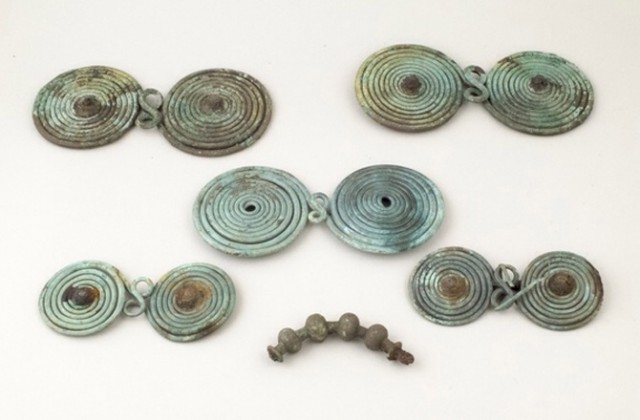
But then, right next to the blades, researchers found things that speak of immense beauty and status. They found foot bracelets. Arm bracelets. Pendants. Beads. Hairpins. They even found “torques”—heavy, solid neck rings that were the ultimate status symbol of the barbarian elite in ancient Europe.
Everything was made of bronze. The glint of that copper-tin alloy would have been blinding when it was new. Today, it’s green with oxidation, but imagine it 2,800 years ago. It would have looked like liquid fire.
The Iron Anomaly
Here is where it gets weird. Here is where the “standard model” of history gets a little shaky. Corina Bors, a senior archaeologist with the National History Museum of Romania, dropped a bombshell during her presentation in Glasgow.
She noted that while the majority of the stash was bronze, there were also weapons and tools made of iron. Why does this matter? Because the 8th Century B.C. was the twilight of the Bronze Age and the violent dawn of the Iron Age. finding these two metals mixed together is like finding a cassette tape inside a smartphone box. It represents the exact moment technology shifted.
Iron was the new “super-weapon.” It was harder, sharper, and held an edge longer than bronze. Whoever buried this hoard wasn’t just rich; they were on the cutting edge of military technology. They were early adopters of the tech that would eventually allow armies to conquer the known world.
The Mystery of the Ravine
Location is everything. If you want to hide your money today, you put it in a bank. If you wanted to hide it 3,000 years ago, you buried it. But where you buried it tells a story.
These hoards weren’t found in a fortress. They weren’t found under the floorboards of a king’s palace. They were found in a small ravine dotted with natural springs. This is crucial.
In the ancient mind, springs were not just water sources. They were portals. They were the thin places where the world of the living touched the world of the spirits. Water coming from the ground was seen as a gift from the Underworld. To give something back, you threw your most valuable possessions into the water.
The site itself, Tartaria–Podu Tartariei vest, is massive. It covers 25 acres (10 hectares). This wasn’t a lonely outpost. It was a bustling hub. The archaeological investigation revealed offering pits filled with broken pottery (ritual smashing, perhaps?) and a burial site containing several bodies. This place was charged with spiritual energy.
Theory One: The Panic Hoard
So, why bury 350 priceless items? Let’s look at the “Panic Theory.”
The 8th Century B.C. was not a peaceful time. The geopolitical landscape of the Carpathian Basin was shifting. New tribes were moving in. The Scythians—nomadic horse archers from the steppes—were beginning to push westward. They were terrifying. They drank blood, scalped their enemies, and struck with lightning speed.
Imagine you are a local chieftain in Transylvania. You hear the thunder of hooves. You see the smoke rising from the neighboring village. You have a stockpile of bronze and iron—the wealth of your entire clan. You can’t run with it. It’s too heavy. And you certainly can’t let the invaders take it.
So, what do you do?
You run to the ravine. You dig a hole near the springs—a marker you will remember. You dump the axes, the swords, the torques. You cover it up, sweating, looking over your shoulder. You promise yourself you will come back for it when the danger passes.
But you never come back.
Maybe the Scythians found you. Maybe you died in battle. The secret of the ravine died with you, leaving the treasure to sit in the wet earth for three millennia until a highway crew dug it up.
Theory Two: A Bribe for the Gods
There is another possibility. One that is perhaps darker. What if this wasn’t a bank deposit? What if it was a payment?
Archaeologist Corina Bors leans toward this theory. “Such bronze hoards might be seen as votive depositions, or, in other words, gifts to the deities of that time,” she told Live Science.
Think about the horse harnesses found in the hoard. Horses were sacred. They were the tanks of the ancient world, but also symbols of the sun. Think about the broken pottery found nearby. In many ancient cultures, you had to “kill” an object to send it to the other side. You broke the sword, smashed the pot, or bent the spear before throwing it into the bog or spring.
Was there a famine? A plague? An eclipse that terrified the people? Did the priests declare that the gods were angry and demanded the clan’s most precious metal to stop the suffering? Imagine the ceremony. Torchlight reflecting off the bronze. The chanting. The splash of heavy metal hitting the mud of the spring. They walked away empty-handed, hoping their sacrifice bought them another year of life.
The Deep History: Who Were These People?
We need to talk about the “Basarabi Culture.” This is the name archaeologists give to the people living in this region during the transition from the Bronze to Iron ages. They are a ghost culture. We don’t know what they called themselves. They left no written records. No tablets. No scrolls.
We only know them by their trash and their treasures. They were master craftsmen. The intricate designs on the bronze jewelry show a society that appreciated art, geometry, and beauty. They were traders, too. Bronze requires copper and tin—tin that often had to be imported from thousands of miles away. These weren’t isolated savages living in mud huts. They were part of a vast, complex European trade network that stretched from the Baltic Sea to the Mediterranean.
And yet, they vanished. Absorbed into the rising Dacian kingdoms or wiped out by invaders. All that remains is the metal.
The “Double Axe” Mystery
One specific item in the hoard keeps researchers up at night: the double axe. In the ancient Minoan civilization (on the island of Crete, far to the south), the double axe was the supreme religious symbol. It represented the Mother Goddess. It was associated with the labyrinth and the bull.
Why are these axes showing up in a ravine in Transylvania? Was there a connection? A shared religion? Or was the symbol simply appropriated, its original meaning lost, turned into a mere weapon of war?
It suggests that ideas and beliefs were flowing across the continent much faster than we give them credit for. The ancient world was smaller than we think.
Why This Discovery Matters Today
It is easy to look at a museum display and just see “stuff.” Old metal. Rusty swords. But discoveries like the Tartaria hoard force us to confront the reality of the past. These items were held by real hands. That necklace was warm against a woman’s skin. That sword handle was slick with sweat during a practice duel.
The accidental nature of the find is a wake-up call. The site covered 25 acres. We only looked at a sliver of it because of a road project. How many other ravines in Transylvania are filled with gold and bronze? How many other histories are waiting inches beneath the grass?
We are walking over the bones of giants. Every time we dig a foundation for a mall or grade a road for a highway, we are playing a game of roulette with history.
The Unanswered Questions
As the artifacts are cleaned and cataloged in museums, the mystery only deepens. We still don’t know the exact reason for the burial. Was it war? Worship? Or something else entirely?
Some alternative historians propose that areas like Transylvania were “power centers” where magnetic or telluric energies congregated. They argue that burying conductive metals like bronze and iron in specific spots (like springs) was a form of geo-acupuncture—a way to manipulate the energy of the land itself.
Far-fetched? Maybe. But when you look at the specific placement of these hoards—always in liminal spaces, always near water, always in huge quantities—you have to wonder if they knew something about the earth that we have forgotten.
For now, the Tartaria hoard stands as a silent sentinel. A testament to a lost people who lived, fought, loved, and feared the dark just like we do. They tried to buy their safety with bronze. We can only hope it worked.
The next time you drive down a highway, look out the window at the ravines and the fields. Wonder what lies beneath. The earth keeps its secrets, but occasionally—just occasionally—it gives one up.
Originally posted 2015-10-16 12:41:50. Republished by Blog Post Promoter