The Walton Enigma: The Night the Sky Caught Fire
You think you know stories. You think you’ve heard every campfire tale about little green men and lights in the sky. But forget everything you think you know. This isn’t just a story. It’s the gold standard. It is the absolute heavyweight champion of close encounters.
We are talking about the Travis Walton case.
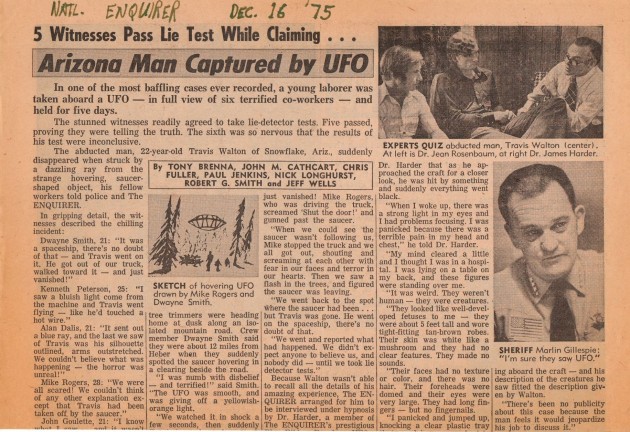
November 5, 1975. A cold Wednesday in Arizona. Seven men went up into the Apache-Sitgreaves National Forest. Only six came back down. The seventh man? He didn’t just walk home. He didn’t get lost. He was gone. Vanished. Erased from the face of the earth for five agonizing days.
When he finally reappeared, he was broken, confused, and terrified. He brought back a story that would tear his small town apart, baffle law enforcement, and challenge our understanding of reality itself. This wasn’t a fuzzy photograph of a hubcap thrown into the air. This was a mass-witness event involving a police investigation, polygraph tests, and physical evidence.
Buckle up. We are going way past the surface level here. We are digging into the dirt, the fear, and the impossible physics of what happened that night in the woods.
The Crew and the Contract
To understand the terror, you have to understand the setting. Snowflake, Arizona. 1975. No cell phones. No GPS. Just rugged terrain and hard work.
Travis Walton was 22 years old. Young. Strong. He was part of a seven-man logging crew headed by his best friend, Mike Rogers. They had a contract with the Forest Service to thin out the underbrush at a site called Turkey Springs. It was backbreaking labor. Chainsaws roaring, sawdust in your lungs, sweat freezing on your skin as the sun went down.
The crew was a mixed bag. You had Mike Rogers, the boss. Ken Peterson. Allen Dallis. Dwayne Smith. John Goulette. Steve Pierce. And Travis. They were running behind schedule. Money was tight. The pressure was on to finish the job before the contract expired. They worked until the light died. That’s an important detail. They weren’t out there hunting for UFOs. They were tired men wanting to go home, eat dinner, and sleep.
At 6:00 p.m., the sun had dipped below the rim. The forest was pitch black.
They piled into Mike Rogers’ 1965 International Harvester pickup truck. It was a beast of a vehicle, rattling and bumping over the old logging roads. The mood was probably light. Work was done. But as they crested a ridge, the chatter stopped dead.
The Light in the Trees
Through the thick pines, they saw it. A glow. Not the orange flicker of a forest fire. Not the harsh white of a spotlight. This was a yellowish, luminous gold. It was alive.
Mike Rogers hit the brakes. The truck skidded to a halt. The air was electric. Literally. Some of the men later reported feeling a static charge, a heaviness in the atmosphere that made the hair on their arms stand up.
Less than a hundred feet away, hovering silently above a clearing, was a craft. It wasn’t a saucer, exactly. It was a flat disc, glowing with an internal energy, smooth as polished glass. It defied gravity. It defied logic. It sat there, humming with a low, throbbing sound that vibrated right through the truck’s chassis.
Panic? Yes. But curiosity is a dangerous thing.
Travis, sitting in the passenger seat, didn’t think. He reacted. He threw the door open. “Travis, no!” someone yelled. It didn’t matter. He was already out. He walked toward the light. He later said he didn’t intend to go all the way; he just wanted a better look. He was mesmerized.
He got close. Too close. He stood nearly underneath the rim of the hovering object. The machine reacted.
It began to wobble. The hum grew into a roar. The men in the truck were screaming at him to get back. Travis froze. He looked up. And then, the universe snapped.
The Strike
This is where the story separates from every other “lights in the sky” report. A beam didn’t just shine on him. It struck him.
Witnesses described a bolt of blue-green energy shooting from the bottom of the craft. It hit Travis square in the chest. It wasn’t a tractor beam pulling him up gently. It was a concussive blast. It lifted him a foot into the air and threw him backward ten feet like a ragdoll. His back hit the rocky ground with a sickening crunch.
Mike Rogers saw the flash. He saw his friend fly through the air. He saw Travis land and lie motionless.
Terror took the wheel. “Go! Go! Go!” screaming filled the cab. Rogers slammed the gas pedal. The truck peeled out, tires spinning in the dirt, fishtailing wildly as they sped away from the clearing. They were grown men, tough loggers, but they were fleeing for their lives. They thought the thing was going to kill them all.
The Longest Drive Home
They drove like maniacs for maybe ten minutes. The silence in the cab must have been suffocating. The adrenaline began to fade, replaced by a cold, hard realization: They had left Travis.
Guilt is a powerful force. Rogers stopped the truck. They argued. Some wanted to keep running. Others knew they couldn’t leave him there. They had to go back. If he was hurt, he needed help. If he was… dead… they couldn’t leave him in the woods.
They turned around. They crept back toward the clearing, headlights cutting through the dark. They expected to see the glow. They expected the hum.
Nothing.
The forest was silent. The craft was gone. But more terrifyingly, Travis was gone. No body. No footprints leading away. Just the smell of ozone and the quiet wind in the trees. They searched for a while, screaming his name into the void. But the fear was still there. What if it came back?
They headed to town to report the impossible.
The Murder Investigation
Imagine being Sheriff Marlin Gillespie. It’s late. You’re tired. And six hysterical men burst into your office claiming a flying saucer zapped their friend.
You wouldn’t believe it. You’d think exactly what he thought: Cover story.
The police theory was simple and brutal. The crew had gotten into a fight. Maybe over money. Maybe over a personal grudge. They killed Travis, buried his body in the vast woods, and cooked up this insane story to cover their tracks. It makes sense, right? It’s logical.
The town turned on them. Snowflake is a small place. People talk. The loggers were pariahs. Whispers followed them everywhere. “Murderers.” “Liars.”
The police launched a massive manhunt. Helicopters, dogs, volunteers on horseback. They combed every inch of Turkey Springs. They found nothing. No blood. No shredded clothing. No disturbed earth indicating a shallow grave.
The Polygraph That Shocked the World
Enter the Arizona Department of Public Safety. They wanted answers. They brought in Cy Gilson, a top-tier polygraph examiner. These weren’t the cheap lie detector tests you see on daytime TV. These were state-of-the-art examinations.
The deal was high stakes. If they failed, they would likely face murder charges.
One by one, the men were strapped in.
“Did you cause harm to Travis Walton?”
“Did you see a UFO?”
“Did you see a beam of light hit Travis?”
The results? Five of the men passed with flying colors. The machine indicated they were being 100% truthful. The sixth man? The result was inconclusive (he was too terrified to get a reading), but he later passed a second test.
Gilson, the examiner, was stunned. He told the sheriff, “These men are not lying. They saw something.”
The murder theory was crumbling. But if they didn’t kill him… where was he?
Five Days inside the Nightmare
While the town was searching for a corpse, Travis Walton was living a horror movie.
He remembers waking up. He felt pain. Thirst. A metallic taste in his mouth. He was lying on a table in a room with low light. The air was heavy, wet, and hot. He thought he was in a hospital. He thought, “Thank God, the guys brought me to the hospital.”
He tried to sit up. He saw a shape standing over him. A doctor? In a weird suit?
His vision cleared. The adrenaline hit his heart like a sledgehammer. It wasn’t a doctor. It wasn’t human.
Walton describes three creatures. Short. Maybe four or five feet tall. Bald. Chalk-white skin. Enormous, wrap-around eyes that looked like liquid gold or black glass. No nose, just slits. No ears.
This wasn’t the movies. This was visceral. Travis panicked. He grabbed a glass-like instrument from a shelf and lashed out. He swung it at the creatures. They didn’t scream. They didn’t attack. They just backed away, raising their hands in a weirdly passive gesture, and left the room.
He was alone.
The Star Map and the Humans
Travis ran. He scrambled out of the room and into a hallway. The floor was curved. The walls were metal. He found a room with a chair in the center. As he approached it, the walls became transparent. He could see stars. Galaxies. A navigation map?
He started pushing buttons on the chair arm (bad idea, Travis). The stars moved. Terrified he was going to crash the ship, he stopped.
Then, he heard footsteps. Human footsteps.
A tall man walked in. He looked perfectly human. Blonde hair. Blue eyes. Muscular. He was wearing a blue jumpsuit. Travis ran to him, babbling, asking questions. “Where am I? Who are those things?”
The man didn’t speak. He just smiled—a strange, knowing smile—and gently led Travis out of the room. They walked through a hangar bay where Travis saw other saucer-shaped craft parked. They met more “humans”—two men and a woman. They all looked similar. Perfect features. Silent.
They put a mask over Travis’s face. Everything went black.
The Return
Five days after he disappeared, the phone rang at the Grant Neff house (Travis’s brother-in-law). It was just after midnight.
A voice on the other end, weak and rasping: “It’s Travis. I’m at the gas station.”
They thought it was a prank. But Grant drove out there anyway. Just in case.
He found Travis slumped in a phone booth in Heber, Arizona. He was wearing the same clothes he had on five days earlier. But they were hanging off him. He was dehydrated. He had lost weight. He was shivering in the cold night air, traumatized.
Travis looked at the lights of the car and asked, “How long was I gone?”
“Five days, Travis.”
“No,” Travis said. “I was only gone a couple of hours.”
The lost time. The classic signature of abduction.
Modern Theories and The “Debunking” Attempt
Of course, the skeptics came. The loudest was Philip Klass, a famous UFO debunker. Klass hated this case. He tried everything to tear it down. He claimed it was a hoax for money (The National Enquirer had a reward out for proof of aliens). He claimed Travis had a history of pranks.
But the “hoax” theory has huge holes.
First, the money. They barely got any. The stress destroyed the logging contract, so they actually lost money. The crew broke up. Friendships ended. If it was a scam, it was the worst scam in history.
Second, the polygraphs. Skeptics try to say polygraphs are unreliable. Sure. But for five men to beat the box on the same specific questions about a murder? The odds are astronomical.
Third, the physical evidence. Decades later, scientists have analyzed the tree growth at the abduction site. Guess what? The trees closest to where the craft hovered show accelerated growth rates—a known side effect of radiation or intense electromagnetic exposure. Something cooked those trees.
The “Fire in the Sky” Problem
You might have seen the movie Fire in the Sky. Great movie. Terrifying. But Travis hates the ending. The movie studio thought his actual experience—running around the ship, seeing the star map, meeting the human-looking aliens—wasn’t “scary enough.” So they invented the scenes where he’s dragged through slime tunnels and covered in latex sheets.
The reality was cleaner, stranger, and more clinical. And in many ways, that makes it more believable. It wasn’t a monster movie script. It was a confused young man waking up in a place he didn’t belong.
Why This Case Won’t Die
Almost 50 years later, Travis Walton sticks to his story. He’s appeared on Joe Rogan. He travels the world. He looks you in the eye and tells you exactly what happened. He doesn’t add new flair. He doesn’t change the details. It is consistent.
The other men? They are old now. Some have passed away. But right up to the end, none of them recanted. Not one. They were ridiculed, laughed at, and harassed, but they never said, “We made it up.”
Why?
Maybe because you can’t lie about a nightmare you lived through.
Did a logging crew in Arizona stumble upon a surveillance mission by an advanced intelligence? Did Travis touch the third rail of galactic technology? We may never have the physical smoking gun. But we have seven men who looked into the abyss, and the abyss looked back.
Whatever happened in those woods, it left a mark that time cannot erase. It remains the most compelling, multi-witness close encounter of the third kind in history.
Originally posted 2016-04-21 17:47:15. Republished by Blog Post Promoter