The Glitch in the Matrix: Did Two Time Travelers Witness History?
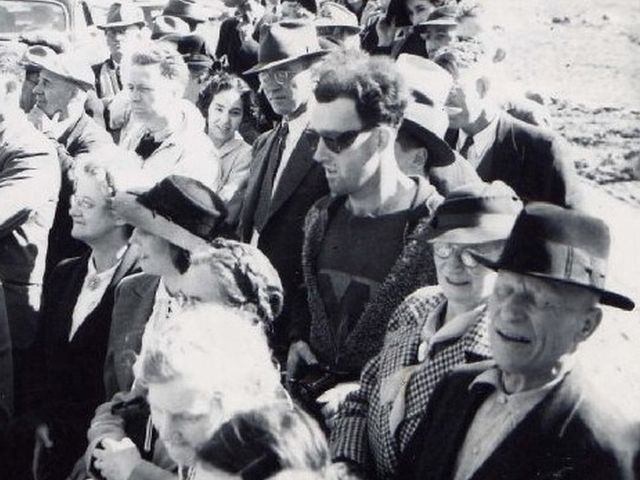
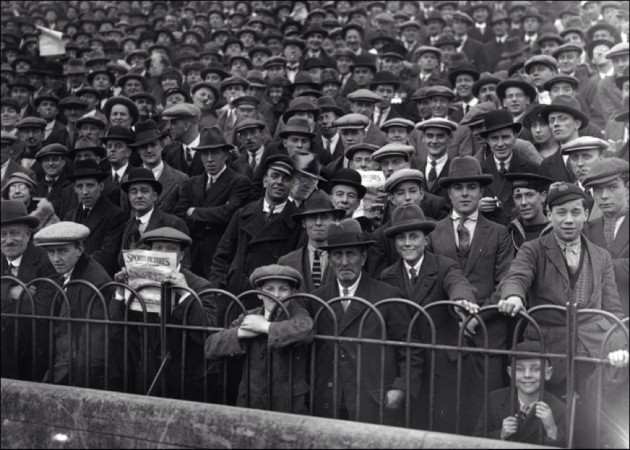
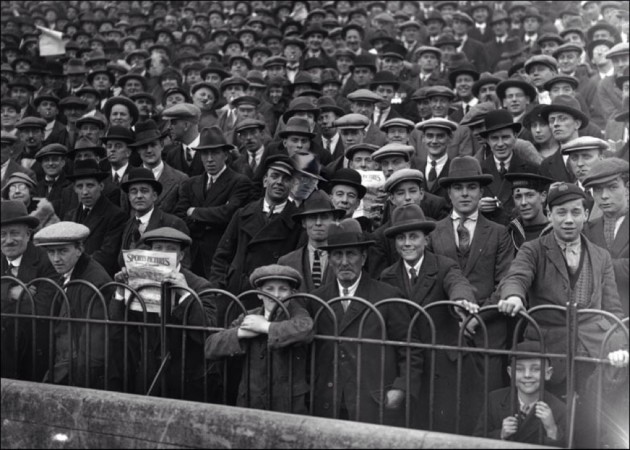
Take a long, hard look at the photograph below. Drink it in. It seems normal enough, right? A crowd of people in hats and coats, gathered for an event. The year is 1941. The place is the reopening of the South Fork Bridge in Gold Bridge, British Columbia. But something is wrong. Terribly wrong.
Stare into the crowd. Let your eyes adjust. Do you see him?

Amongst the sea of fedoras and period-appropriate clothing stands a man who is catastrophically out of place. He’s been dubbed the “Time-Traveling Hipster,” and for good reason. His sunglasses are sleek and modern. He’s wearing a zipped-up hoodie over what looks like a printed t-shirt. And in his hands, he’s holding a portable camera that seems decades ahead of its time.
He sticks out like a sore thumb. A glitch in the historical code. For years, this image has been the poster child for time travel theorists. A smoking gun. Proof that someone, or something, is moving through our timeline.
But that’s not the whole story. It’s not even the most disturbing part. Everyone focuses on the hipster. They point. They debate. They miss the second anomaly hiding in plain sight.
Look again. Closer this time.

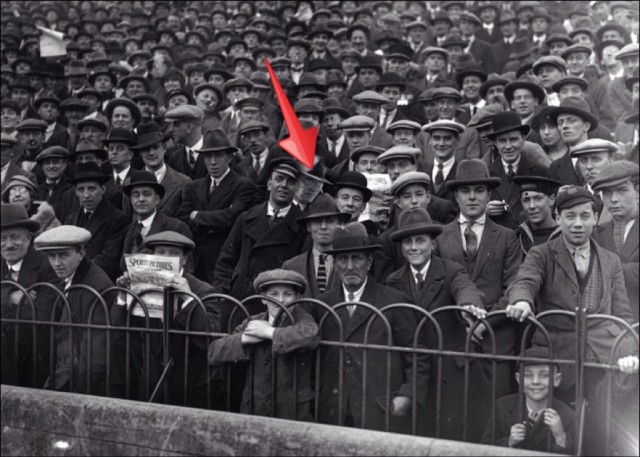
Just a few feet away from our famous time traveler is another man. A man with perfectly round glasses, a slightly unnerving stare, and a posture that suggests he isn’t just there for the bridge opening. He is watching.
And here is where your blood should run cold. He is also in the crowd. Look at the original photo. Then look at the second man. Two figures, side-by-side, both seeming to break the rules of their era.

How is this possible? Is it a coincidence? Or did we just stumble upon a two-man temporal insertion team? Was the “hipster” the operative, and was the man in the round glasses his handler? His backup? A rival? The questions pile up, twisting the known facts into a pretzel of chronological impossibility. This single, dusty photograph might not just show one time traveler. It might show an entire operation.
And if they were there, in 1941… where else have they been?
This rabbit hole goes deeper than you can possibly imagine. Because this isn’t the only time a phantom figure has appeared at a pivotal moment in history, holding a camera, and watching the world change forever.
The Ultimate Enigma: The Phantom of Dealey Plaza
Fast forward twenty-two years. The date is November 22, 1963. The location is Dealey Plaza, Dallas, Texas. The air is electric. President John F. Kennedy’s motorcade is making its way through a cheering crowd. It’s a moment of American hope and optimism, captured on film from a hundred different angles.
And then the shots ring out.
Chaos. Screaming. Panic erupts as a nation’s dream turns into a nightmare in a matter of seconds. People dive for cover, they run, they weep. The world shatters. In the frantic aftermath, FBI and CIA agents swarm the scene, desperately trying to piece together what just happened. They collect every photograph, every home movie, every eyewitness statement they can find. They need answers.
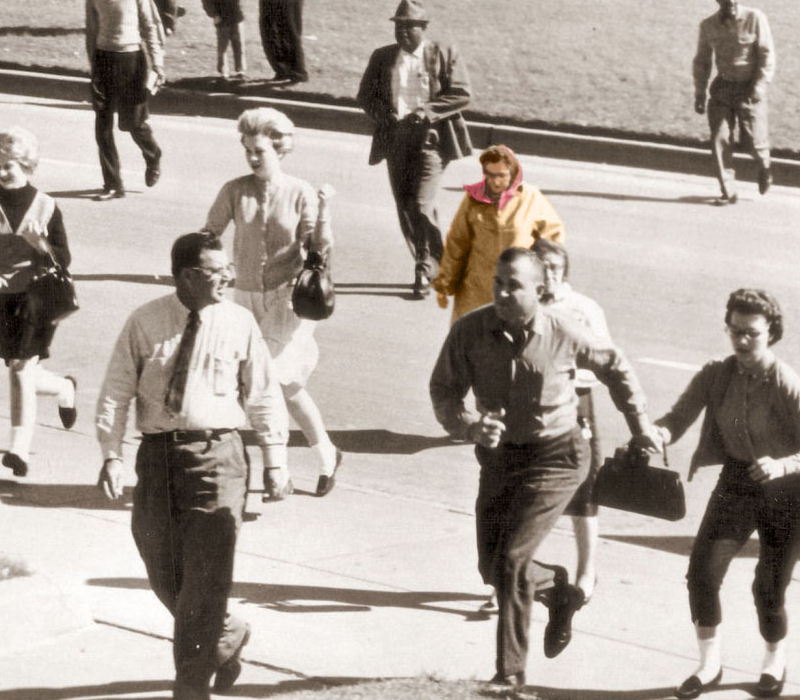
The evidence they gathered was a mess. A jumble of conflicting stories and blurry images. But as they examined the footage, frame by agonizing frame, a strange figure began to emerge from the chaos. A woman. An anchor of calm in a hurricane of terror.
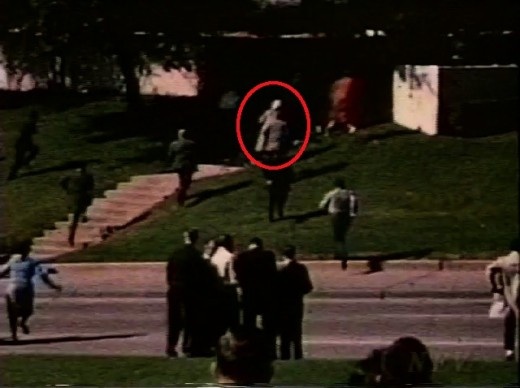
She stood near the infamous grassy knoll, close to the street, with a perfect view of the presidential limousine. And while everyone else around her was reacting to the horror, she just stood there. Still. Filming.
They called her the Babushka Lady.

A Ghost on Film
Her nickname came from the tan or light brown headscarf she wore, tied under her chin in the style of an elderly Russian woman, a “babushka.” In every piece of footage she appears in—most notably the film shot by Marie Muchmore—she is a statue. While bullets tear through the air and a president is assassinated before her eyes, she raises what looks like a camera to her face and continues to document the event.
She doesn’t flinch. She doesn’t run. She doesn’t even look away.
This is the first massive red flag. Her behavior is profoundly unnatural. It’s the reaction of someone who is not surprised. The reaction of someone who knew what was coming. The reaction of an observer.
Investigators were immediately captivated by her. Her position was perfect. She was one of the closest spectators to the fatal headshot. The film she was shooting could be the Rosetta Stone of the Kennedy assassination. It could have shown the trajectory of the bullets. It could have captured a second shooter on the grassy knoll. It could have answered every question that has haunted us for over half a century.
The FBI put out a public appeal. They begged for anyone with photos or film to come forward. Hundreds did. But the Babushka Lady? She vanished. Poof. Gone. As if she had simply dissolved back into the timeline from which she came.

The Desperate Search and the Web of Lies
The hunt for the Babushka Lady became an obsession. One tantalizing clue surfaced when a film developer in Dallas contacted the FBI. He claimed an unknown woman had brought in a single color slide for him to process. He described the image as blurry, but taken from the exact vantage point where the Babushka Lady had been standing. But the woman never returned to pick it up. The trail went cold.
Then, in 1970, a woman named Beverly Oliver stepped into the spotlight, proclaiming, “I am the Babushka Lady.” For a moment, it seemed the mystery was solved. Oliver spun a detailed story, claiming she was a 17-year-old nightclub singer at the time and that FBI agents had confiscated her camera and film on the day of the shooting, never to return them.
But her story quickly fell apart under the slightest scrutiny. It was a lie. A fabrication.
Oliver identified the camera she supposedly used as a Yashica Super-8 model. The problem? That model wasn’t manufactured until 1969, six years *after* the assassination. Furthermore, witnesses who were standing near the Babushka Lady confirmed that Oliver was not the woman they saw. Photographic analysis also suggested the mystery woman was older and heavier than the slim, 17-year-old Oliver.
So who was Beverly Oliver? A simple attention-seeker? Or was her story something more sinister? Was she a deliberate piece of disinformation, a “red herring” planted to discredit the entire search and muddy the waters forever? If you want to hide something, you don’t destroy the evidence; you bury it under a mountain of false evidence. It’s a classic intelligence agency tactic.
Connecting the Dots: The Unthinkable Theories
So why did the real Babushka Lady never come forward? Why would she hide evidence of one of the most important crimes in American history? The simple answers—fear of getting involved, distrust of authorities—don’t quite fit her bizarrely calm demeanor. This is where we have to start thinking outside the box. Way outside.
Theory 1: The Temporal Observer
What if the Babushka Lady was exactly what she looked like: an observer? A historian from the future, sent back to document a “fixed point in time.” An event so critical to the timeline that it cannot be changed, only recorded. This would explain everything. Her calmness wasn’t cold or unfeeling; it was professional detachment. She knew what was going to happen, and her mission was simply to get it on film for the archives of tomorrow. Her “camera” might have been a piece of technology far beyond our comprehension, capable of capturing data we can’t even imagine. Her disappearance was easy—she just returned to her own time, her mission complete.
Theory 2: The Covert Operative
Let’s flip the script. What if she wasn’t just a passive observer? What if she was an active participant? Her calm demeanor takes on a chilling new meaning if she was part of the plot. Perhaps her “camera” wasn’t a camera at all. Could it have been a weapon? A targeting device? A signaling tool to coordinate the shooters? In this scenario, she didn’t come forward because she was one of the conspirators, a ghost who performed her duty and then melted away, her identity protected by the shadowy organization she worked for. An organization, perhaps, not of this time.
Theory 3: The Extraterrestrial Connection
For decades, fringe researchers have linked the JFK assassination to a larger cosmic cover-up, suggesting Kennedy was killed because he was about to reveal the truth about UFOs and alien contact. Is it so crazy to think that an off-world intelligence might have an interest in such a world-changing event? In this mind-bending scenario, the Babushka Lady could have been a non-human entity, disguised in plain sight, using advanced technology to record the moment humanity took a dark turn. It sounds wild. Insane, even. But is it any more insane than a lone woman calmly filming a presidential assassination and then vanishing from the face of the Earth?
The Echoes Remain
So what are we left with? Two photographs, taken 22 years apart, both capturing pivotal moments in history. And in both, there are figures who just don’t belong. The Hipster and his companion on a bridge in 1941. The Babushka Lady on a grassy knoll in 1963.
Are they connected? Are they part of the same mysterious group of observers, chronicling our history from the shadows? Why is she the only person not to react to the shooting?

The problem is, the Babushka Lady and her film vanished from history. The film she shot, which could offer invaluable evidence and potentially rewrite the official record, is gone. Or is it? Perhaps it isn’t lost. Perhaps it’s exactly where it’s supposed to be: in an archive, hundreds of years in the future.
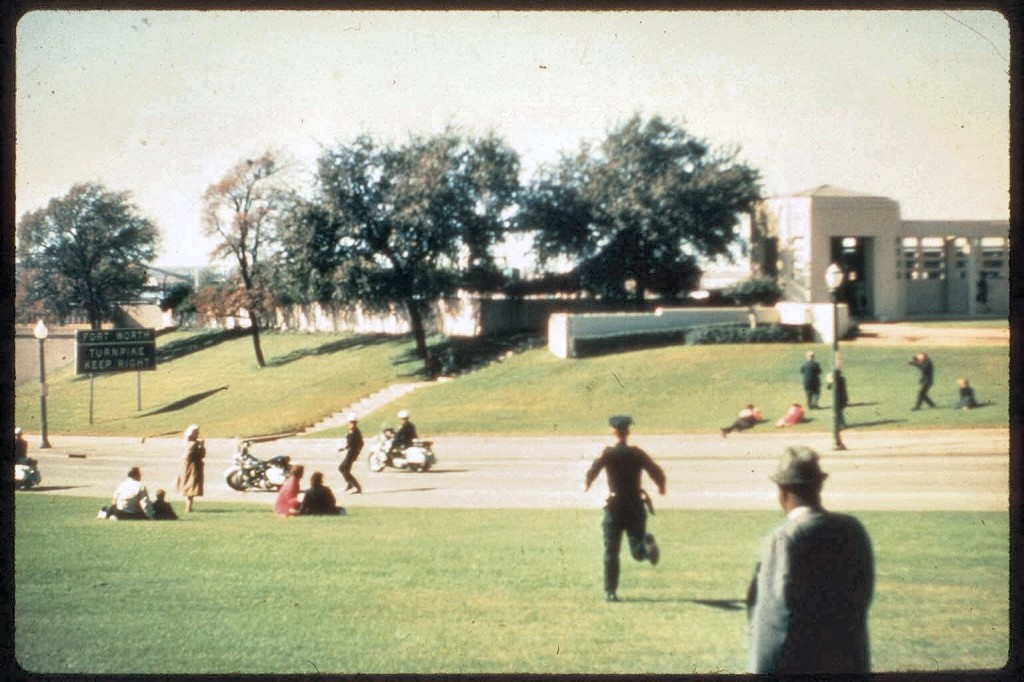
These images are more than just historical oddities. They are cracks in the facade of reality. They suggest that the linear flow of time we take for granted might be an illusion. They hint that we are not alone in our own history. The truth is still out there, hiding in the grainy frames of old photographs, waiting for us to look close enough to see the people who shouldn’t exist.