Home Weird World Strange Stories The Loch Ness monster has finally been caught on camera?

The Loch Ness monster has finally been caught on camera?

0
67

The Photo That Was Supposed to End the Loch Ness Mystery Forever

The water is black. Not just dark, but an ancient, peat-stained black that swallows light whole. It’s a chilling, primordial soup holding secrets older than Scotland itself. For centuries, whispers have slithered from its depths. Tales of a long-necked beast, a relic from a lost time, patrolling the abyss. Most people come to Loch Ness for a quick photo, a souvenir, a cheap thrill. They snap a picture of the castle, buy a plush toy, and leave.

But not George Edwards.

For George, the loch wasn’t a tourist trap. It was his life’s work. His obsession. For 26 grueling years, he dedicated himself to one singular, all-consuming quest: to prove the monster was real. We’re not talking about a weekend hobbyist. We’re talking about 60 hours a week, every week, out on the cold, unforgiving water in his boat, the aptly named Nessie Hunter IV. He’d seen shadows. He’d tracked anomalies on his sonar. He’d heard the stories from grizzled old fishermen, their voices low and serious.

And then, one fateful morning, after 9,490 days of searching… it happened.

He saw it. And he got the picture.

A photograph he claimed wasn’t just another blurry smudge. This, he declared, was it. The definitive proof. The “best picture ever” taken of the Loch Ness Monster.

A Man Possessed: 26 Years on the Hunt

Can you even imagine that kind of dedication? Think about it. Over two and a half decades. Presidents came and went. The internet was born. Technology reshaped the entire world. And George Edwards was still there, day in and day out, chugging along on his boat, eyes glued to the horizon.

His skin was weathered by the harsh Highland winds. His hands were calloused from rope and throttle. He knew every cove, every current, every trick of the light on the loch. He wasn’t just a tour guide, though he did take tourists out to pay the bills. He was a sentinel. A watchman waiting for a glimpse of the impossible.

He’d seen it all. The hoaxes. The fakes. The mistaken logs and the swimming deer. He was a hardened skeptic in his own right, dismissing 99% of what people claimed to see. But the belief never wavered. Something was down there. Something big. And he was going to be the one to show it to the world.

The Moment of Truth: A Routine Day Turns Legendary

It was November 2nd, 2011. The air had a familiar Scottish bite to it. The sky was a moody grey canvas. For George, it was just another day at the office. He was on the Nessie Hunter IV, heading back towards Temple Pier in Drumnadrochit after a tour.

He described the moment with the quiet clarity of a man who has replayed it in his mind a thousand times. “I was just about to return to Temple Pier and I went to the back of the boat which was facing the pier and that’s when I saw it,” he said.

There. In the distance.

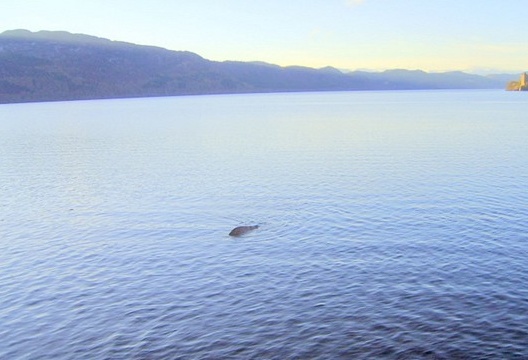
A dark shape had broken the surface. It wasn’t a boat. It wasn’t a log. It was moving. Slowly. Deliberately. It was heading up the loch, on a direct course towards the ancient, brooding ruins of Urquhart Castle. The classic Nessie patrol route.

“It was a dark grey colour,” Edwards recalled. “It was quite a fair way from the boat, probably about half a mile away.”

His heart must have been pounding. The culmination of a lifetime’s search. He grabbed his camera. This couldn’t be another fleeting glimpse, another ‘one that got away’ story to tell at the pub. This had to be the one. He raised the camera, focused, and clicked the shutter. The sound echoed across the water, sealing the moment in digital amber.

For five, maybe ten minutes, he watched it. A single, solid, animate hump, moving with purpose before sinking, without a splash, back into the blackness. And then, it was gone. As if it had never been there at all. But George Edwards had the proof.

The “Best Ever” Photo: Analyzing the Evidence

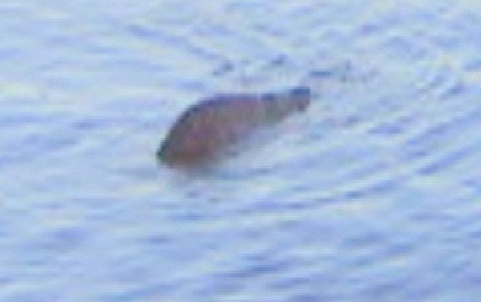
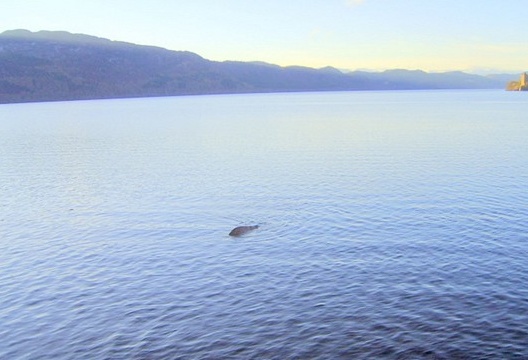
What did he capture? Look at the photo. At first glance, it’s compelling. The water is vast and empty, drawing your eye to the solitary object breaking the surface. It’s not the classic long-necked plesiosaur shape. It’s a solid, rounded hump. Or maybe two humps. It’s hard to tell. It has a texture that doesn’t quite look like a rock, and a wake that suggests slow, steady movement.

The scale is immense. Given its distance from the shore and Urquhart Castle, the object has to be of a significant size. Much larger than any known fish in the loch. Too solid to be a wave.

Edwards didn’t just release the photo immediately. He knew the world was full of skeptics. He claimed he sent it to experts. He even mentioned sending it to “US military monster experts” for analysis before going public. He wanted validation. And, according to him, he got it. They couldn’t explain it away.

best ever loch ness picture

The close-up seems to add more questions than answers. The shape is organic, yet strangely uniform. Is that a shadow? A second hump just behind the first? The low resolution, a hallmark of so many cryptid photos, works both for and against it. It hides the details that could confirm its identity, but also hides the details that could expose a fraud.

For a brief, shining moment, the cryptozoology world was buzzing. Had George Edwards, the steadfast hunter, finally done it?

Deep Dive: A Troubled History of Nessie “Proof”

To understand the excitement—and the immediate suspicion—surrounding the Edwards photo, you have to understand the ghosts it was competing with. Loch Ness has a long and sordid history of photographic trickery.

The Surgeon’s Photograph (1934)

This is the big one. The icon. The photo that put Nessie on the global map. Taken by Colonel Robert Wilson, a London surgeon, it shows the creature’s elegant, swan-like neck and head rising from the water. For 60 years, it was the gold standard of Nessie evidence. Believers pointed to it as irrefutable proof. Skeptics tried, and failed, to convincingly debunk it.

Then, in 1994, the truth came out. It was a complete fake. A deathbed confession from Christian Spurling revealed the whole sordid affair. He had been part of a conspiracy to get revenge on the Daily Mail newspaper, which had publicly humiliated his father-in-law, a big-game hunter named Marmaduke Wetherell, for faking Nessie footprints. The “monster” was a sculpted head attached to a toy submarine. The world’s most famous monster photo was a childish prank that spiraled out of control.

The Dinsdale Film (1960)

Then there’s the Dinsdale film. Aeronautical engineer Tim Dinsdale shot 16mm footage of a dark hump moving across the loch, leaving a powerful wake. The footage was analyzed by Britain’s Royal Air Force, whose photo-intelligence unit concluded it was “probably an animate object.” It was compelling. It was motion. For many, this was far better evidence than a still photo. Yet, it remains controversial. Skeptics argue it’s simply a man in a boat, the details obscured by distance and film quality. A Rorschach test on the water.

This history of hoaxes and ambiguity is the baggage every new piece of evidence carries. The Edwards photo was stepping into a minefield of past failures. Was it another Surgeon’s Photograph? Or was it the real Dinsdale film?

The Shocking Twist: The Truth Behind the “Best Ever” Photo

For about a year, the George Edwards photo was a top-tier contender. It was celebrated. It was debated. It was hailed as the best evidence in a generation. And then the story took a turn so sharp it gave the entire community whiplash.

The truth came out.

The “monster” in George Edwards’s photograph… was a prop. A fiberglass hump built for a National Geographic documentary, “Loch Ness: The Truth.”

The crushing irony is baked right into the title. Steve Feltham, another full-time Nessie hunter and a rival of Edwards, was the one who blew the whistle. He recognized the hump instantly. He’d seen it before. The very documentary that object was made for had aimed to debunk Nessie myths.

So, the photo that was supposed to be the “best ever” proof was, in fact, a picture of a prop from a documentary *disproving* the monster’s existence. You couldn’t make this stuff up.

George Edwards, the man who spent 26 years on the water, who dedicated his life to the search, had faked it. Confronted with the evidence, he confessed. He admitted he knew what it was and had taken the photo, holding onto it for a while before releasing it to the world as genuine.

Why? The Motive Behind the Monster

The question isn’t *what* anymore. We know what it was. The real mystery now is *why*. Why would a man who sacrificed so much for a legend deliberately sabotage it with a cheap hoax?

Was it for fame? For money? A desperate bid to keep the tourist money flowing into his business, the Nessie Hunter IV? It’s the simplest explanation. The legend is a billion-dollar industry. A new, compelling photo is great for business.

Or was it something deeper? Was it the act of a man broken by decades of fruitless searching? A man so desperate to believe, and so desperate for the world to believe with him, that he was willing to create the proof he could never find? A sort of pious fraud, a lie told in service of what he felt was a greater truth?

Some internet theories suggest an even stranger motive. What if he was trying to prove a point about belief itself? To show how easily people could be fooled, to flush out the fake experts from the real ones. A grand, cynical experiment. It seems unlikely, but in the world of Loch Ness, anything is possible.

Whatever the reason, the confession sent a shockwave through the community. The “best picture ever” was now the most infamous lie.

Is Anything Down There? The Search After the Scandal

So, does one man’s lie kill a centuries-old legend? Absolutely not. The mystery of Loch Ness is bigger than any single photograph, real or fake.

The search for truth continues, now armed with more advanced technology. In 2018, a massive scientific expedition took environmental DNA (eDNA) samples from all over the loch. They were searching for traces of any large, unknown creatures. What they found poured cold water on the plesiosaur theory—not a single shred of reptile DNA. But they did find a massive, almost unbelievable amount of eel DNA. Everywhere. At every depth.

This has given rise to the most plausible scientific theory yet: the Giant Eel Theory. Could the Loch Ness Monster be a gargantuan, sterile eel that grew far beyond its species’ normal size in the unique, isolated environment of the loch? An eel 15, 20, even 30 feet long would certainly look like a sea serpent to the terrified eyewitness on the shore.

The story of George Edwards and his photo is no longer about proving the monster exists. It’s a cautionary tale. A story about obsession, belief, and how badly we want the world to hold onto its mysteries. Even when a hoax is exposed, the shadow of the beast remains. The black water of the loch still holds its secrets close.

People will still visit. They will still stare out at the water, hoping to see a ripple that isn’t from the wind. Because the legend of Nessie isn’t just about a monster anymore. It’s about the thrilling, terrifying, and wonderful possibility that we haven’t discovered everything. That there are still dragons in the deep, waiting in the dark.

Originally posted 2016-03-18 04:28:08. Republished by Blog Post Promoter