Home Unexplained Mysteries Crime Mysteries The unsolved crime mystery of Marilyn Sheppard

The unsolved crime mystery of Marilyn Sheppard

0
59

The Sheppard Murder: Was a Famous Doctor a Cunning Killer or the Victim of a Twisted Conspiracy?

Picture it. The Fourth of July, 1954. Bay Village, Ohio, a sleepy, affluent suburb nestled on the shore of Lake Erie. The American dream in full, glorious Technicolor. White picket fences. Barbecues sizzling in the backyard. And in a picturesque lakefront home, a prominent family seems to have it all.

Dr. Sam Sheppard, a handsome and successful osteopathic surgeon. His wife, Marilyn, four months pregnant with their second child. Their seven-year-old son, “Chip,” asleep in his room. They were the envy of the neighborhood. The pinnacle of post-war prosperity.

But by the next morning, that perfect picture would be shattered. Smashed into a million pieces by a brutal, bloody act that would ignite a media firestorm, challenge the very foundations of the American justice system, and leave a stain on the town—and the country—that has never truly washed away.

Marilyn was dead. And the only other adult in the house, her husband, the good doctor, had a story so bizarre, so unbelievable, that it either had to be the absolute truth… or the most audacious lie ever told.

Marilyn Sheppard Mystery

A Nightmare on Lake Road

Here’s the story Dr. Sam Sheppard told police, a story he would stick to until his dying day.

He claimed he’d been exhausted after a long day at the hospital. He fell asleep on a daybed in the downstairs living room while his wife went up to bed. Sometime in the dead of night, he was jolted awake. By what? A scream. His wife’s scream.

He bolted up the stairs and into the darkened bedroom. In the dim light, he made out a form standing over his wife’s bed. He lunged. The next thing he knew, a powerful blow to the back of his head sent him crashing to the floor, unconscious.

When he came to, disoriented and groggy, he checked on his wife. It was a horror show. But through his daze, he thought he heard a noise downstairs. He stumbled down the steps and saw a figure fleeing out the back door leading to the lake. He gave chase. A man. A large man with a full head of bushy hair.

Sheppard pursued him across the lawn, down to the beach, tackling the intruder at the water’s edge. But he was no match. The man turned, a whirlwind of violence, and choked the doctor into blackness once more. Sam woke up hours later, soaked, his face in the sand, the morning sun rising over a placid Lake Erie that held a terrible secret. He staggered back to the house, a house now silent, and called for help.

A Crime Scene That Screamed Foul Play

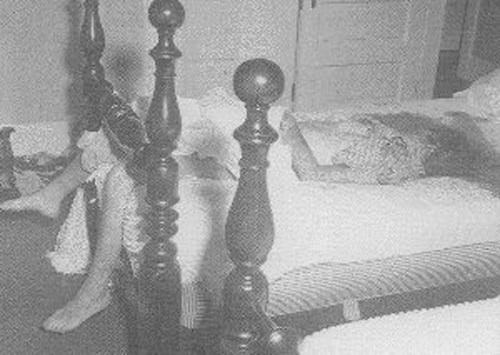
When police and the coroner arrived, they found a scene of shocking brutality. Marilyn Sheppard had been bludgeoned to death in her own bed, struck more than thirty times. The walls were sprayed with blood. But as the investigators started looking around, Sam’s story started to unravel. Fast.

Something felt off. Terribly off.

The Telltale Signs of a Stage

The house was supposedly ransacked during a robbery-gone-wrong. But it was the neatest ransacking anyone had ever seen. Desk drawers were pulled out, but their contents were undisturbed. A medical bag was dumped on the floor, but the instruments inside were still neatly arranged. Nothing of significant value was even missing, except for Sam’s watch and Marilyn’s ring, which were later found in a bag in the bushes.

It looked… fake. Contrived. Like someone had tried to make it *look* like a robbery after the fact.

Then there was the doctor himself. His wife had been beaten into oblivion, a fight had clearly taken place. Yet Sam Sheppard had only minor injuries. A few bruises, a swollen eye, some vague neck pain. He claimed he was knocked unconscious twice by a powerful intruder, yet he bore few marks of such a violent struggle. Investigators whispered among themselves. It just didn’t add up.

And the murder weapon? Never found. The police searched everywhere. Nothing. The prosecution would later theorize that Sam, the skilled surgeon, had used a surgical instrument to commit the murder and had disposed of it in the lake. Convenient.

From the moment they stepped inside, the police had their man. They weren’t looking for a bushy-haired intruder. They were looking at Dr. Sam Sheppard.

Deep Dive: The Trial by Media That Sealed His Fate

Before Sam Sheppard ever set foot in a courtroom, he was tried and convicted on the front pages of the newspapers. This wasn’t just a trial; it was a public spectacle, a media circus whipped into a frenzy by sensationalist headlines and a public hungry for a villain.

The *Cleveland Press*, led by its powerful editor Louis B. Seltzer, took the lead. Day after day, the paper published front-page editorials demanding answers, questioning Sam’s story, and painting him as a cold, cheating husband. “WHY ISN’T SAM SHEPPARD IN JAIL?” one headline screamed. “QUIT STALLING AND BRING HIM IN!”

The motive, they claimed, was his infidelity. The police uncovered evidence of Sam’s affair with a former hospital nurse named Susan Hayes. Suddenly, the perfect family man was a philandering monster who wanted to get rid of his pregnant wife to be with his mistress. It was a simple, ugly story. And the public ate it up.

The trial itself was chaos. The courtroom was packed with reporters. Cameras flashed constantly. The judge, Edward Blythin, made little effort to control the mayhem. In a stunning breach of judicial ethics, he was later reported to have told a journalist *before the trial began* that Sheppard was “guilty as hell.” The jury wasn’t sequestered. They went home every night, free to read the damning headlines and watch the biased television reports. How could Sam Sheppard possibly get a fair trial?

He couldn’t.

In December 1954, after a trial that had become a national obsession, the jury found him guilty of second-degree murder. He was sentenced to life in prison. The good doctor was a convicted killer.

Freedom, a Legendary Lawyer, and a Supreme Court Showdown

Sam Sheppard always maintained his innocence. For ten long years, he sat in a prison cell while his family fought tirelessly on the outside. His life, and the lives of those around him, was in ruins. While he was incarcerated, his mother died of a heart attack. Just weeks later, his father took his own life. Later, Marilyn’s own father would also die by suicide. The tragedy was a poison that spread through two families.

Then, a new player entered the game. A brilliant, brash, and ambitious young lawyer who would become a legal legend: F. Lee Bailey.

Bailey saw the Sheppard case for what it was: a catastrophic miscarriage of justice fueled by a rabid press. He took on the case and began a relentless appeals process. He argued that the “carnival atmosphere” of the original trial had made a fair verdict impossible. The constant, prejudicial media coverage had poisoned the jury pool and turned the entire process into a witch hunt.

The case went all the way to the highest court in the land. In 1966, in the landmark case *Sheppard v. Maxwell*, the U.S. Supreme Court agreed with Bailey. In a powerful 8-1 decision, the court overturned Sam Sheppard’s conviction, ruling that the intense and pervasive pretrial publicity had denied him his constitutional right to a fair trial. It was a monumental decision that would change the way courts handled high-profile cases forever.

Sam Sheppard was a free man. But he still had to face a new trial.

In the 1966 retrial, F. Lee Bailey put on a masterclass. He dismantled the prosecution’s original case piece by piece. He highlighted the sloppy police work. He introduced early blood-spatter analysis that suggested the killer was left-handed. Sam Sheppard was right-handed. He painted a picture of a botched investigation where police, pressured by the media, zeroed in on the most convenient suspect and ignored all other possibilities.

This time, the verdict was different. Not guilty.

The Broken Man and “The Killer”

Sam Sheppard walked out of the courtroom a legally innocent man. But his life was destroyed. The public was still divided. To many, he was simply the killer who got off on a technicality. He tried to return to medicine, but the shadow of the trial followed him everywhere. The Ohio medical board eventually restored his license, but his surgical practice never recovered.

The man who emerged from prison was not the same man who went in. He was broken. He drank. Heavily. He married the woman who had corresponded with him in prison, but the marriage quickly fell apart.

In a final, bizarre, and deeply tragic chapter of his life, Sam Sheppard tried to cash in on his infamy. He became a professional wrestler. In a twisted, almost unbelievable turn, he fought under the ring name “The Killer” Sam Sheppard. He would enter the ring, a paunchy, sad figure, and apply his “mandible claw” submission hold on his opponents—a move supposedly inspired by his knowledge of anatomy.

It was a pathetic spectacle. A man who had lost everything, now reduced to a parody of the monster the public believed him to be. He died in 1970 at the age of 46 from liver failure, a consequence of his severe alcoholism. A free man who was never truly free.

What If? The Bushy-Haired Man Finally Gets a Name

For decades, the story seemed to end there. A tragedy with no clear answers. But the Sheppard family, particularly his son, Sam Reese “Chip” Sheppard, never gave up the hunt for the bushy-haired man.

And then, a name emerged from the shadows: Richard Eberling.

Eberling was a window washer who had worked at the Sheppard home in the days leading up to the murder. He was a known petty thief and a deeply disturbed individual. He fit the description. And over the years, a mountain of circumstantial evidence started piling up against him.

Here’s what modern internet sleuths and investigators uncovered:

  • A ring belonging to Marilyn Sheppard was found in Eberling’s possession years later. He claimed he found it, but the story was suspicious.
  • Eberling’s blood was found at the crime scene. In 1959, an investigator found a drop of blood on a closet door in the bedroom that didn’t match Sam or Marilyn. It was Type O. Eberling was Type O.
  • In the 1990s, with the advent of DNA technology, the case was revisited. DNA testing on a seminal stain found on Marilyn’s panties excluded Sam Sheppard. More damningly, DNA testing of that blood spot from the closet door pointed overwhelmingly toward Richard Eberling.
  • Eberling himself gave conflicting stories and even allegedly confessed to the murder to fellow inmates while serving time for an unrelated murder of an elderly woman.

Armed with this new evidence, Chip Sheppard sued the state of Ohio in 2000 for his father’s wrongful imprisonment, hoping to clear his name once and for all. It was a final attempt at justice. But the state’s lawyers fought back, arguing the decades-old DNA evidence was contaminated and unreliable. The jury, perhaps unwilling to rewrite such a famous chapter of history, sided with the state. The Sheppard family lost the case.

Richard Eberling died in prison in 1998, taking his secrets with him to the grave.

The Fugitive’s Ghost

You can’t talk about the Sam Sheppard case without mentioning *The Fugitive*. The massively popular 1960s TV series and the blockbuster 1993 movie starring Harrison Ford tell the story of Dr. Richard Kimble, a surgeon wrongly convicted of murdering his wife, who escapes custody to hunt down the real killer—a “one-armed man.”

The creators have always publicly denied any direct connection. But come on. A doctor. His wife murdered. He claims an intruder did it. He’s wrongly convicted. The parallels are so obvious they’re impossible to ignore. For millions of people, the story of Dr. Richard Kimble *is* the story of Dr. Sam Sheppard, a narrative that has cemented the idea of his innocence in pop culture far more effectively than any court case ever could.

So where does that leave us?

The bloodstains on the wall are long gone. The key players are all dead. The house on Lake Road has been demolished. But the questions remain, hanging in the humid Ohio air like ghosts.

Was Dr. Sam Sheppard a brilliant sociopath who murdered his pregnant wife and concocted an elaborate story, only to be freed by a legal technicality? Or was he the victim of one of the most horrifying injustices in American history—a man who lost his wife to a violent intruder, only to then lose his freedom, his reputation, and his life to a corrupt system and a bloodthirsty press?

The courts gave their answers. The newspapers gave theirs. But the truth? The real, unvarnished truth of what happened in that bedroom on the Fourth of July, 1954, may be a mystery that will never be solved.

Originally posted 2015-07-20 15:55:03. Republished by Blog Post Promoter