Crime Pays? The Dark, Twisted Truth of the Man of a Thousand Faces
You think you know gangsters? Think again. Sit down. We need to talk.
In the United States, we have an obsession. We worship the “bad boy” image. We obsess over Jesse James, Al Capone, and John Dillinger. We make blockbuster movies about them. We glorify the Tommy guns, the pinstripe suits, and the fedoras. We turn psychopaths into folk heroes because they stuck it to the banks during the Depression. But across the Atlantic, France had a criminal mastermind who made those guys look like absolute amateurs. He made Capone look like a schoolyard bully stealing lunch money.
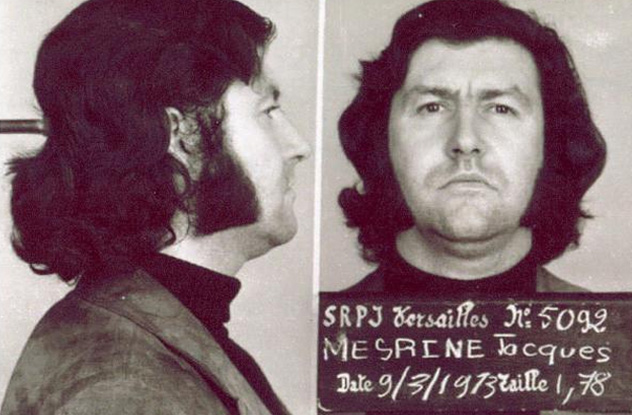
His name was Jacques Mesrine.
This wasn’t just a thug. This wasn’t some street-corner hustler. This was a rockstar. A legitimate celebrity. A man who treated bank robbery like high-stakes performance art. During a crime spree that feels more like a fever dream or a rejected Hollywood script than real life, Mesrine robbed countless banks, broke out of four maximum-security prisons (yes, four), and was officially declared “Public Enemy Number One” in both France and Canada.
And here is the kicker: he did it all while dating supermodels, sipping expensive champagne, and giving exclusive interviews to major magazines while actively on the run from thousands of police officers. He was a ghost. He was a monster. And for a wild, bloody stretch of the 1970s, he was completely untouchable.
The Making of a Monster: It Didn’t Start in the Gutter
How do you build a Public Enemy Number One? Where does a man like this come from? You don’t start in the gutter. You don’t start as a starving orphan stealing bread.
You start in the army.
Before he was the most wanted man in Europe, Mesrine was a soldier. He served in the French Army during the Algerian War. Now, if you don’t know your history, you might think, “So what? Lots of people serve in the military.” But you have to understand what the Algerian War was. This wasn’t standard combat. This was dirty. This was a war of shadows, torture, and guerilla tactics.
Mesrine served in a special commando unit. This is where the story gets dark.
Deep Dive: The School of Torture
The Algerian War (1954–1962) was a brutal conflict for independence. It is the Vietnam of French history. Both sides committed atrocities. The French military needed information, and they didn’t ask nicely. They used electricity. They used water. They made people disappear.
Mesrine didn’t just witness the violence; he participated in it. He was right there in the thick of it. Historians and psychologists have argued for decades that this is exactly where the switch flipped inside his brain. He saw that the government—the “good guys”—were capable of unspeakable horror. He saw that rules were just suggestions for people who didn’t have guns.
He returned to Paris in 1962, but he didn’t come back as a normal civilian. He came back broken. Or maybe, he came back “fixed,” depending on how you look at it. He possessed a specific set of skills. He knew how to interrogate. He knew how to handle high-stress situations. Most importantly, he knew how to kill without blinking. He had a “license to kill” mentality that he couldn’t just turn off because the peace treaty was signed.
He tried. For a split second, he actually tried the normal life. He got married. He had kids. He tried to hold down an architectural job. He wore the suit. He took the train. But the adrenaline was gone. The rush was missing. He was bored out of his mind. So, he went looking for the chaos.
The Descent into Chaos: Crossing the Line
It started small. A burglary here. A scam there. But Mesrine was too smart for petty theft. He wasn’t going to snatch purses. He escalated quickly. He hit bank after bank, moving with military precision. He treated the bank staff not as victims, but as extras in his movie.
But then, he made a mistake. A big one. He didn’t just steal from the banks; he stole from the wrong people. We aren’t talking about the cops here; we are talking about organized crime. The real underworld.
With heat coming from the police and the mafia, the gangster was forced to flee Europe. He packed his bags and ran to Quebec, Canada. You might think he’d lay low. Maybe get a cabin in the woods? Learn to fish? Grow a beard and disappear?
No. That wasn’t his style. That was too quiet.
Mesrine spent his “free time” in Canada kidnapping a billionaire fashion designer named Georges Deslauriers. This wasn’t a quick grab. He held the man for ransom, demanding a fortune. He played mind games with the victim. But the cracks were starting to show. He was sloppy. He was caught.
The Canadian authorities weren’t taking chances. They threw him into the SCU (Special Correction Unit) at the Saint-Vincent-de-Paul penitentiary. This place was legendary. It was supposed to be escape-proof. It was a concrete tomb designed for the worst of the worst. They thought they had him.
They were wrong.
The Impossible Escape (And the Insane Return)
This is the moment. This is the part of the story where Mesrine stops being a criminal and starts being a legend.
Mesrine looked at the “inescapable” prison and laughed. On August 21, 1972, he did the impossible. Along with another inmate, Jean-Paul Mercier, he cut through the perimeter fencing. How? With a pair of wire cutters they had hidden in the yard. It sounds simple, right? It sounds like a cartoon.
But the timing had to be perfect. They had to map the guard rotations. They had to know exactly when the tower lookouts were lighting a cigarette or looking the other way. They slipped through the perimeter, flagged down a car, and vanished into the Canadian wilderness.
Now, stop and think. What would you do? You just broke out of a supermax prison. You run. You drive until the gas runs out. You head for Mexico. You head for the North Pole. You go anywhere but back.
Not Mesrine. This is where the story gets absolutely bonkers. He didn’t just want freedom; he wanted revenge. He wanted to humiliate the system.
The Attack on the Prison
Weeks later, in broad daylight, Mesrine drove back to the prison. He returned! He brought a friend and a trunk full of sawed-off shotguns and rifles. He drove up to the gates of the maximum-security facility he had just escaped from and opened fire.
Why? Was he crazy? Yes. But he also had a code. He wanted to initiate a mass breakout. He wanted to free the 56 other prisoners in his wing. He felt he owed them.
The scene was total chaos. Imagine the guards’ faces. They are looking out the window and seeing the guy who escaped two weeks ago, standing there with a machine gun, blasting the guard towers. It was a war zone. Ultimately, the rescue attempt failed—the other prisoners couldn’t get out in time, and the police response was too fast. But let’s give the man points for audacity. It remains one of the craziest acts in criminal history. Who breaks into prison?
The Bank Robbery Spree: “Which Bank is Next?”
After that, Canada was too hot. He had killed two forest rangers who intercepted him in the woods—a grim reminder that Mesrine was a cold-blooded killer, not just a folk hero. That is a detail his fans often forget. He murdered two innocent men just to keep his freedom.
He fled back to France. And he declared war on the country’s bankers.
This period, roughly 1973 to 1978, is the stuff of legend. He treated bank robbery like a sport. Sometimes, he robbed two banks a day. This was his signature move.
Here is how he did it: He would hit one bank. The alarms would trip. The police sirens would start wailing in the distance. Chaos would erupt. Most robbers would be sweating, driving 100 miles per hour to get out of the city.
Mesrine? He would drive three blocks over. He would park. And he would rob a second bank.
His logic was genius and twisted: all the police were busy at the first crime scene. Every cop car in Paris was racing to Bank A. That meant Bank B was wide open. It was a tactical masterclass. He just loved it when the cops showed up at the wrong place. He mocked them. He left notes. He would sometimes offer the bank tellers a glass of water if they looked faint. He was building a brand.
Master of Disguise!
How did he stay free for so long? How do you rob two banks a day and not get recognized? Mesrine was a master of disguise. He earned the nickname “The Man of a Thousand Faces.”
He didn’t just put on a hat and sunglasses. He transformed. He had a vast collection of wigs, fake beards, glasses, and uniforms. He used theatrical makeup. He changed his gait. He altered his voice.
- One day he was a sophisticated architect in a three-piece suit.
- The next day he was a grubby plumber with a toolbox (filled with guns).
- The next he was a police officer.
He never left home without a plan. He was paranoid, sure, but his paranoia kept him alive. He studied blueprints. He monitored police radio frequencies. He lived his life on a razor’s edge.
The Toilet Gun & The Judge
In 1973, the law finally caught up with him. He was arrested and thrown into a French prison. The authorities breathed a sigh of relief. “We got him,” they said. He was facing decades behind bars. The trial began. Security was tight. Metal detectors. Armed guards. Everything.
But Mesrine had a plan that would make Michael Scofield from Prison Break look like a toddler playing with Legos.
During his trial, right in the middle of proceedings, Mesrine started groaning. He grabbed his stomach. He doubled over. He faked a severe bout of diarrhea. He begged the judge to let him use the bathroom. The guards, disgusted and not wanting a mess in the courtroom, rolled their eyes and escorted him to the toilet.
They checked the stall. It was empty. They let him go in.
What they didn’t know was that a friend of Mesrine—or perhaps a corrupt cop, the theories still rage today—had visited the courthouse days earlier. They had taped a loaded revolver inside the toilet tank.
Mesrine went in a prisoner. He came out an armed gunman.
He burst out of the bathroom, weapon drawn. He didn’t run for the door. He ran for the bench. He grabbed the judge and took him hostage. Picture this: The most famous criminal in France, holding a gun to a judge’s head, walking backward out of the courthouse while hundreds of police officers stand frozen, unable to shoot. He jumped into a waiting car and sped off.
He was gone. Again.
Publicity Hound: The First “Influencer” of Crime?
This is where the modern parallels get spooky. If Mesrine were alive today, he wouldn’t be hiding in a hole. He would have ten million followers on TikTok. He would be live-streaming his getaways.
He understood the power of the media better than any politician. After his 1978 prison escape (yes, he escaped again from another high-security prison called La Santé), he didn’t hide in a sewer. He went on a press tour.
He contacted journalists. He set up secret meetings in Paris apartments. He posed for photos wearing his disguises, holding his machine guns, smoking cigars. He gave interviews explaining his philosophy.
He claimed he was a political revolutionary. He said he was fighting against the “system,” against the inhumane high-security wings (QHS) of French prisons. He published a book, L’Instinct de Mort (The Death Instinct), while he was still on the run! The government tried to ban it, which only made it a bestseller.
The public ate it up. Mesrine was a superstar. In polls conducted at the time, he was consistently voted the most popular man in France. He was more popular than the President. He was a symbol of rebellion in a rigid society. But the fame went to his head.
The Dark Turn: When the Hero Became the Villain
The “Robin Hood” image was a lie. We have to be clear about this. Mesrine wasn’t giving money to the poor. He was buying BMWs and custom suits.
His popularity began to fade rapidly when his true nature surfaced. The turning point was a man named Jacques Tillier.
Tillier was a journalist—and a former policeman—who wrote a negative story about Mesrine. He called Mesrine a fake, a thug without honor. He insulted him. Mesrine didn’t take criticism well. His ego was too fragile.
He lured Tillier to a meeting under the pretense of an exclusive interview. He took him to a dark, damp cave outside of Paris. But instead of talking, Mesrine tortured him. He stripped him naked. He beat him. He shot him three times (leaving him for dead, though Tillier miraculously survived). And then, the worst part: he took photos.
He photographed the bloody, broken journalist and sent the pictures to the newspapers. He thought the public would applaud his “justice.”
They didn’t. They recoiled. The photos were horrifying. This wasn’t a fun bank robber anymore; this was a sadist. This was a monster. Soon after, he tried to kidnap another judge who’d sentenced him to prison. He captured another rich businessman. The atmosphere in France changed. The laughter stopped.
The President of France, Valéry Giscard d’Estaing, had seen enough. He made it clear to the police forces: The gangster had to go. No more escapes. No more trials. He wanted the problem solved. Permanently.
The Execution at Porte de Clignancourt
The end came on November 2, 1979. It was a gray, overcast day in Paris.
Mesrine was driving his metallic gold BMW near the Porte de Clignancourt, a busy intersection on the edge of the city. He was with his girlfriend, Sylvia Jeanjacquot. He felt safe. He was wearing a disguise. He thought he was invisible. He had beaten the police so many times, he thought he was immortal.
He wasn’t.
The police had been tracking him for days. They had located his hideout. They knew exactly where he was. Mesrine stopped his car at a red light. A large, canvas-covered truck pulled up right in front of him. It looked like a delivery truck. A tarpaulin covered the back.
Suddenly, the tarp was yanked back. There was no warning. No sirens. No bullhorn shouting “Step out of the car with your hands up!”
Inside the truck was a small army of police sharpshooters armed with automatic rifles. At the same time, officers swarmed from the rear.
They opened fire. It wasn’t a shootout; it was an execution. It was a firing squad in the middle of traffic.
Twenty bullets tore through the windshield. Mesrine was hit fifteen times. The damage was catastrophic. He died instantly, his body slumped over the wheel. The safety catch was still on his rifle, which lay across his lap. He never even had time to lift it. His girlfriend was severely wounded, losing an eye, but she survived.
The gangster went out like Bonnie and Clyde, which is probably how he wanted to go—in style, violently, on the front page.
His body was left in the car for over an hour, a gruesome trophy for the press photographers who swarmed the scene. The police wanted the world to see: The beast was dead. They wanted the photo on every breakfast table in France the next morning.
Conspiracy or Justice? The Lingering Questions
Decades later, the questions still swirl. The internet loves this part.
Was it a lawful killing? Or was it a state-sponsored assassination? Under French law, police must issue a warning before firing unless they are being fired upon. No warning was given. The officers claimed they saw him reach for his gun. Witnesses disagreed. They said the police just opened up.
Some theories suggest Mesrine knew too much. There are persistent rumors he had connections to far-right paramilitary groups from his army days. There are whispers that he had dirt on top-level politicians, documents he had stolen during his burglaries. Did they silence him to keep the secrets buried? Why not use tear gas? Why not shoot the tires?
We may never know the full truth.
What we do know is that Jacques Mesrine was the last of his kind. We don’t have criminals like this anymore. Surveillance cameras, DNA technology, and digital tracking have made this kind of “on the run” lifestyle impossible. He was a dinosaur. A violent, charismatic, terrifying dinosaur.
He was a killer, yes. He was a narcissist, absolutely. But for a few wild years in the 1970s, he held an entire nation captivated by his madness. He was the king of the Paris streets. And in the end, he got exactly what he predicted in his book: a violent death at the hands of the society he hated.