Saturday, June 6, 2026
HomeWeird WorldStrange StoriesThe strange Patterson-Gimlin Massacre Story

The strange Patterson-Gimlin Massacre Story

The Patterson-Gimlin Film You Were Never Meant to See: A Bigfoot Massacre?

You know the film. Everyone does. Even if you don’t know its name, you know the image.

A clearing in a dense forest. A creek bed, scarred by a recent flood. And a figure. A hulking, hairy, bipedal creature striding away from the camera with a strangely fluid, powerful gait. It turns its head, its torso, its whole upper body in one smooth, impossible motion. It looks back. Just for a second. An inscrutable glance. Then it disappears into the treeline, and into legend.

Frame 352.

It’s the most famous, most debated, and most analyzed piece of paranormal footage in history. The Patterson-Gimlin film, shot on October 20, 1967, is the bedrock of Bigfoot belief. For over half a century, it has been the smoking gun, the tantalizing proof that something ancient and unknown walks the deep woods of North America. A fleeting glimpse into another world.

But what if it’s not a glimpse?

What if it’s a cover-up?

What if that iconic footage isn’t the beginning of the story, but the horrifying end? A carefully edited snippet from a much longer, much darker film. A film that doesn’t document a chance encounter, but the brutal, bloody aftermath of a planned massacre.

The Story They Sold the World

The official account is a modern American folktale. Roger Patterson, a former rodeo rider with a passion for the Sasquatch mythos, and his friend Robert “Bob” Gimlin, were out on horseback in the Six Rivers National Forest near Bluff Creek, California. They were searching for the beast, hoping to capture the creature on film and prove its existence to a skeptical world.

And then, it happened.

Rounding a bend in the creek, their horses suddenly reared in panic. There, on the other side of the water, was the very thing they were looking for. A massive, female Sasquatch. Patterson’s horse threw him, but in a chaotic scramble, he managed to grab his rented 16mm Cine-Kodak camera and run toward the creature, firing off a shaky, one-minute burst of film that would change everything.

The creature, later nicknamed “Patty,” walked away, seemingly unbothered, casting that one legendary look over her shoulder before vanishing forever. Patterson and Gimlin became instant celebrities, and their footage became a holy relic in the world of cryptozoology.

For decades, the debate raged along predictable lines. Was it real? Or was it a man in a suit? Experts in biomechanics argued its gait was impossible to fake. Hollywood special effects artists claimed they could do better. The film was stabilized, color-corrected, and blown up until every grainy frame was scrutinized. But the core story remained the same: two men, one camera, and one incredible, peaceful encounter.

Until the whispers started.

Whispers that grew into a roar, suggesting the film everyone knew was a lie. Not a hoax in the traditional sense, but a chilling deception hiding a violent truth.

The M.K. Davis Bombshell: A Tale of Blood on the Sandbar

The official narrative began to fracture in the mid-2000s. A new theory, championed and popularized by a Bigfoot researcher named M. K. Davis, clawed its way out of the depths of internet forums and into the community’s consciousness. Davis, a specialist in video and audio analysis, claimed to have access to a higher-quality, less-edited version of the famous film. And what he saw, he claimed, was not a chance encounter. It was a crime scene.

The “Massacre Theory” is as simple as it is horrifying. It alleges that Patterson and Gimlin weren’t alone that day. They were part of a larger party, a hunting posse of up to eight men. Their goal wasn’t just to film a Bigfoot. It was to capture or kill one.

According to this dark retelling, the full, unedited film begins with a scene of unsettling peace. Three Sasquatch—not one—are seen by the creek. Possibly a family. They are digging in the sand, foraging for roots or small animals. Then, without warning, the idyllic scene is shattered by an eruption of gunfire from the treeline.

One Bigfoot drops instantly, shot dead. Another, in a blind panic, bolts for the safety of the woods. And the third? The third is Patty.

The creature in the famous footage, the one walking with that unforgettable swagger, wasn’t just walking away. She was wounded. Terrified. The men continued to fire at her as she retreated. That famous backward glance, immortalized in Frame 352, wasn’t a look of curiosity or mild annoyance. It was a look of fear and confusion from a creature watching her world be destroyed, her family slaughtered, as she herself was hunted.

Suddenly, the film is transformed. It’s no longer a minute of wonder. It’s the final, tragic walk of a dying survivor.

Analyzing the “Proof”: What Did Davis Actually Find?

A story that explosive needs evidence. M.K. Davis and his supporters claim to have it, hidden in the very frames of the original film and in forgotten photographs from the time. They point to several key pieces of a gruesome puzzle.

Deep Dive: The Corpse in the Pit

Davis claims that in the very first, shakiest frames of the Patterson-Gimlin film—frames most people ignore as Patterson fumbled with his camera—lies the proof. Using digital stabilization and contrast enhancement, he points to a specific spot on the sandbar. There, in a shallow depression, he claims you can see a dark, crumpled shape. A pile of hair and limbs.

Is it the body of the first Sasquatch, shot down before the famous sequence begins? Davis presents his stabilized footage, outlining a form he says is clearly a corpse, matted with blood and half-buried in the churned-up sand. Skeptics, of course, cry foul. They see shadows. A pile of debris from the flood. A classic case of pareidolia, where the brain sees patterns in random noise. But to believers of the massacre theory, it’s Exhibit A: the body of Patty’s slain family member, right there in plain sight, hidden by the camera’s chaotic motion.

Deep Dive: The Titmus Photo and the White Dog

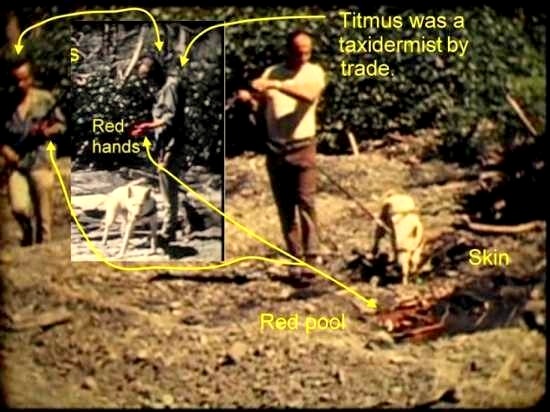
Another piece of supposed evidence is a strange, grainy photograph taken sometime after the 1967 incident. It shows Bob Titmus, another famous Bigfoot hunter of the era who was not officially at the Bluff Creek site, alongside another man named Dale Moffit. Between them lies a large, lumpy pile of dark reddish material. Next to it sits a white dog, identified as “White Lady.”

To an outsider, it could be anything. A butchered deer or bear. A pile of camping equipment. A simple tarp. But M.K. Davis offers a more sinister interpretation. He speculates that this is a piece of one of the slain Sasquatch, being prepared for transport or dissection. The red, he argues, is gore and tissue. He connects this photo to the hunting party, suggesting Titmus was involved in the “clean-up” operation. It’s a photograph that asks more questions than it answers, a cryptic clue in a decades-old cold case.

Deep Dive: Patty’s Wounded Gait

For years, the most compelling evidence for the film’s authenticity was Patty’s walk. The compliance in her gait, the flexion of her foot, the powerful muscle movement visible under her coat—experts claimed no man in a suit could replicate it. But the massacre theory reframes this evidence entirely.

Davis alleges that Patty had been shot, likely in the upper thigh. He points to a spot on her right leg where the fur appears matted and a dark patch is visible in enhanced frames. Her powerful, lurching stride, he argues, isn’t her natural walk. It’s the pained limp of a seriously injured animal desperately trying to reach safety. The slight lean, the way her arms swing—is it the natural motion of an unknown primate, or the compensated movement of a creature trying to keep weight off a gunshot wound?

This theory adds a layer of absolute tragedy to the film. The very movements that have fascinated scientists for 50 years might not be a display of power, but a portrait of agony.

Money, Fame, or Fear? Unpacking the Motive

If the massacre theory is true, one question eclipses all others: why? Why would a group of men commit such an act and then cover it up with a single, misleading piece of film?

The potential motives are as dark and tangled as the woods at Bluff Creek.

Perhaps it was an encounter that went horribly wrong. Maybe the plan was just to get footage, but someone got spooked. A shot was fired in panic, and the situation spiraled out of control into a full-blown firefight. In the aftermath, faced with an unspeakable act and multiple Sasquatch bodies, the men concocted a simpler story. They edited the film down to its most “palatable” minute, creating a narrative of a peaceful encounter to escape prosecution and public outrage.

Or maybe the motive was far more calculated. The theory of a trophy hunt is a popular one in conspiracy circles. Were Patterson, Gimlin, and the others hired hands? Was there a wealthy, eccentric collector who wanted the ultimate prize—not a picture, but a body? In this scenario, the film was never the primary goal. It was merely a convenient piece of “proof” they could release to the public, a distraction to satisfy curiosity while the real prizes—the corpses—were spirited away for private study or display.

There’s even a third, more mind-bending possibility. What if the massacre story itself is a “disinformation” campaign? A second-level hoax designed to create so much confusion and infighting within the Bigfoot community that the truth, whatever it may be, is lost forever in the noise. It’s a rabbit hole within a rabbit hole.

The Bigfoot Community Divided: A Legend Redefined

The emergence of the Bigfoot Massacre theory tore through the cryptozoology world like a wildfire. It created deep divisions. Many old-school researchers dismissed it outright as a baseless, reputation-smearing fantasy. They defended the integrity of Patterson and Gimlin (both of whom are now deceased) and insisted the film is exactly what it appears to be.

But for a new generation of investigators, raised on the internet and accustomed to conspiracy, the theory was electrifying. It answered questions that had always lingered around the film. It explained the frantic energy. It offered a reason for Patty’s strange walk. On countless forums, Reddit threads, and late-night YouTube documentaries, the debate continues to rage with incredible passion.

The theory fundamentally alters the legacy of the Patterson-Gimlin film. If it’s just a chance encounter, it remains a symbol of mystery, wonder, and the untamed wilderness. It represents the possibility that we do not have a monopoly on this planet. It is a hopeful film.

But if the massacre theory is true, the film becomes a monument to human arrogance and cruelty. It is an indictment. A recording of the exact moment our world violently collided with theirs, ending in tragedy. It is a ghost story, a one-minute horror film hiding in plain sight.

So the next time you see that grainy image of a dark figure against the trees, that iconic Frame 352… stop and ask yourself what you’re really seeing.

Is she looking back in simple curiosity?

Or is she looking back in terror, the last survivor of a silent slaughter, her final moments captured for a world that would never be told the whole, awful truth?

Amit Ghosh
Amit Ghoshhttps://coolinterestingnews.com
Aloha, I'm Amit Ghosh, a web entrepreneur and avid blogger. Bitten by entrepreneurial bug, I got kicked out from college and ended up being millionaire and running a digital media company named Aeron7 headquartered at Lithuania.
RELATED ARTICLES
- Advertisment -

Most Popular

Recent Comments

Warren Pan Abbott on The legend of the Devil Monkey !
chris davies on The McPherson Tape Mystery
Reed Reedly on ET has Internet!
Bea Houseoffashion on Proof Of Time Travellers – Gallery
Marcus2012 on ET has Internet!
Reed Reedly on ET has Internet!
LaughsAtConspiracyNuts on The 9/11 Conspiracy – Myths and Facts
Alex Sliverman on Did the ancients fly?
Doctor Wholigan on Time Traveler in 1938 film
chris davies on The McPherson Tape Mystery
Archie1954 on 10 secret UFO hideouts
chris davies on Ghosts of flight 401
Marcus2012 on ET has Internet!
jason Macdonald on Proof of Time Travel? – China
chris davies on Long-Lost Pyramids Found?
Reed Reedly on ET has Internet!
Milkman on Connected Universe
Tenmiles on Baigong Pipes Mystery
Simon Foster on Sirius – The Documentary
From the 1st April on 2013 – Alien Contact date ?
SkyWatcher on Is ET ignoring us?
I Come From The Future on Obama to make UFO Alien disclouser soon ?
ÛñK?øWn on 2013 – Alien Contact date ?
Just another person on 2013 – Alien Contact date ?
Malcolm Windowcleaner on The strange case of Rudolph Fentz
Mason Servio on Strange Things on Mars
Marke Wisdom Seeker on What will we find as arctic melts?
Andrea A Elisabeth Levyne on Aliens Captured in Varginha, Brazil
Mitch Grouyeki on Amazing Space Shuttle pictures