The Judas Paradox: Was History’s Greatest Villain Actually a Hero?
He is the ultimate traitor. The name itself is poison. Judas Iscariot.
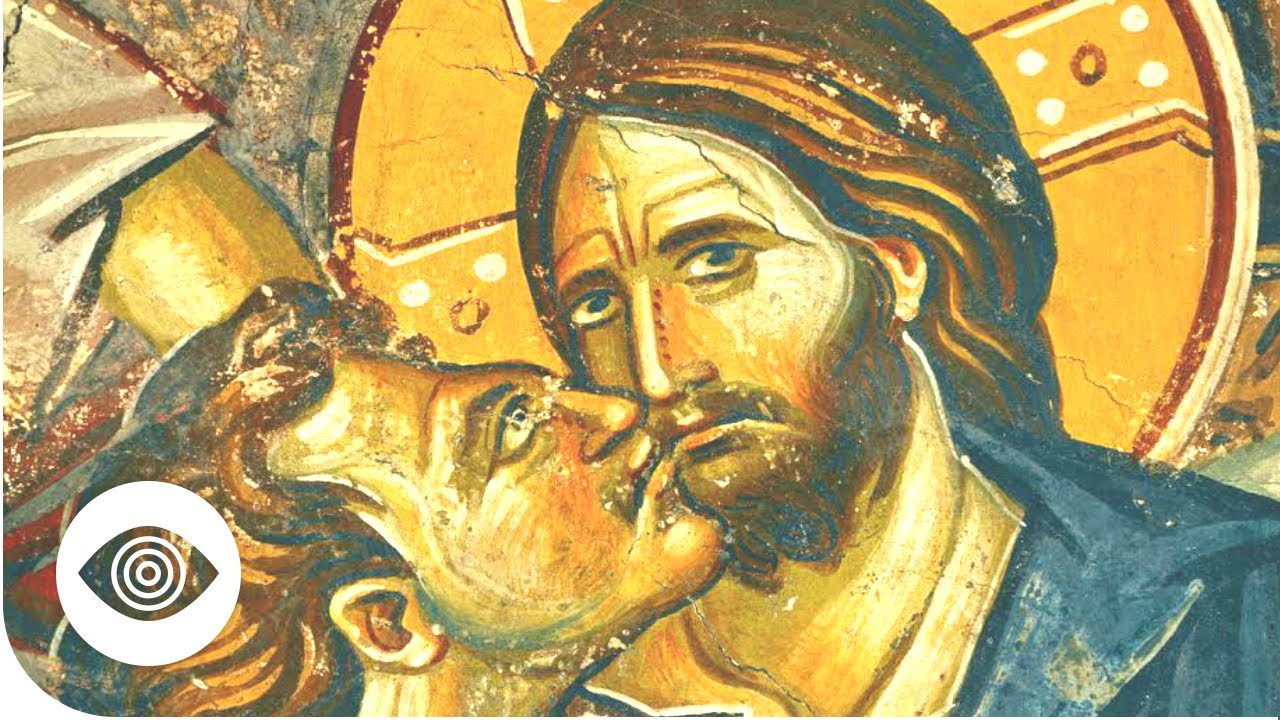
For two thousand years, he’s been the archetype of betrayal, the man who sold his friend, his savior, for a handful of silver coins. His kiss in the Garden of Gethsemane wasn’t an act of affection, but the signal for an arrest that led to the most famous execution in human history. It’s a story we all know. A simple, brutal tale of good versus evil.
But what if it’s a lie?
What if the story we’ve been told is not just wrong, but a deliberate cover-up? A carefully constructed piece of propaganda designed to hide a truth so profound, so earth-shattering, that it could unravel the very foundations of Western religion. A truth contained within a forbidden text, a gospel that was hunted, burned, and buried for nearly 1,700 years.
A gospel written not by Matthew, Mark, Luke, or John. But by Judas.
A Discovery in the Dust
The story doesn’t begin in ancient Jerusalem. It begins in the 1970s. In the shifting sands of the Egyptian desert, near the cliffs of Jebel Qarara. An unnamed villager, perhaps seeking treasure or shelter, stumbles into a dark, forgotten cave. Inside, a limestone box. And within that box, a leather-bound book. A codex. Its papyrus pages are brittle, shattered into a thousand pieces, the ancient Coptic script faded by the relentless march of time.
This wasn’t just any old book. This was the stuff of legends. For years, it languished in obscurity. It passed through the murky, unregulated world of the antiquities black market. It sat in a safe deposit box in Hicksville, New York, for sixteen years, its pages slowly turning to dust. Dealers haggled. Scholars despaired. The world’s most explosive manuscript was literally disintegrating in a bank vault.
Finally, in 2001, after a bizarre and convoluted journey, it was rescued. A team of experts began the painstaking, near-impossible task of putting the puzzle back together. Piece by fragile piece, they translated the lost words. And what they found sent a shockwave through the worlds of theology, history, and conspiracy.
The title was unmistakable. “The Gospel of Judas.”
The Betrayal That Wasn’t a Betrayal
Forget everything you think you know. Throw it out. The Gospel of Judas paints a picture so radically different, so completely alien to the traditional narrative, it feels like it’s from another dimension. In this version of the story, Judas isn’t a villain.
He’s the hero.
Judas, The Chosen One
The text begins with a bang. It describes Jesus laughing at his disciples for praying to a lesser god, the god of the physical world. They don’t get it. They’re blind. They are still trapped in the world of illusion. But one of them understands.
Jesus pulls Judas aside. “Step away from the others and I shall tell you the mysteries of the kingdom,” he says. “It is possible for you to reach it, but you will grieve a great deal.”
Think about that. Out of all the disciples—Peter, the rock; John, the beloved—it is Judas alone who is chosen to receive the deepest secrets of the universe. Jesus trusts him. He confides in him. The other disciples are portrayed as clueless, worshipping the wrong power, completely missing the point of Jesus’s entire message. Judas is the star pupil, the only one capable of grasping the cosmic truth.
A Mission of Liberation
So what was this great truth? It’s pure Gnosticism. The Gnostics were a collection of early Christian groups with a very different view of reality. They believed the material world—our bodies, the planet, the stars—was not a divine creation but a flawed prison, crafted by a lesser, ignorant deity called the Demiurge or Yaldabaoth.
The real God exists in a higher plane of pure spirit. And trapped inside each human is a divine spark, a fragment of that true God, desperate to escape its fleshy cage and return home. Jesus, in this view, wasn’t a savior who died for our sins. He was a spiritual guide, a messenger from the higher realm, who came to show humanity the secret knowledge (or *gnosis*) needed to escape the prison of the flesh.
And how could he complete his own escape? By shedding his physical body.
This is the explosive core of the Gospel of Judas. Jesus doesn’t ask Judas to betray him. He *commands* him to. It’s an assignment. A mission of the highest honor. Jesus tells Judas, “You will exceed all of them. For you will sacrifice the man that clothes me.”
Let that sink in. “The man that clothes me.” The body. Judas isn’t handing over Jesus to be killed. He is liberating his friend’s divine spirit from its mortal prison. The “betrayal” was the ultimate act of loyalty. The kiss wasn’t a mark of treachery; it was the signal that the sacred mission was underway. Judas was the only one brave enough, the only one who loved Jesus enough, to do what had to be done.
The Great Suppression: Why They Buried the Truth
If a text this revolutionary existed, why did it vanish for 1,700 years? Why did we only know the story of Judas the Traitor?
Because it was suppressed. Deliberately. Methodically. And with extreme prejudice.
You see, this isn’t some new-age internet theory. We have the receipts. We have the proof of the cover-up from the people who orchestrated it.
Irenaeus: The Heresy Hunter
Meet our prime suspect: Irenaeus, the Bishop of Lyons, writing around 180 AD. The early Christian church was a chaotic mess of competing ideas. There were dozens of gospels, scores of different interpretations of who Jesus was and what he taught. Gnostic ideas, like those in the Gospel of Judas, were wildly popular.
Irenaeus and other emerging church fathers wanted to crush this diversity. They needed a single, unified, controllable message. An orthodox doctrine. To do that, they had to pick winners and losers. They had to decide which texts were “holy scripture” and which were “heresy.”
In his massive work, “Against Heresies,” Irenaeus specifically names and attacks a group he despises. He writes that they “declare that Judas the traitor was thoroughly acquainted with these things, and that he alone, knowing the truth as no others did, accomplished the mystery of the betrayal.” He even claims they produced “a fictitious history,” which he calls… the Gospel of Judas.
He didn’t just disagree with it. He declared it an abomination. Forbidden knowledge. The work of devils. This was the beginning of a centuries-long campaign to hunt down and destroy every copy of every text that didn’t fit the approved narrative. Burn the scrolls. Silence the believers. Erase them from history.
And for 1,700 years, they thought they had succeeded.
Controlling the Story, Controlling the People
Why such a violent reaction? Why was the idea of Judas the Hero so dangerous? Because it destroys the entire power structure the early church was building.
The orthodox story is simple and powerful: Humanity is sinful. Jesus, the son of God, sacrificed himself on the cross to pay for those sins. The Church holds the keys to this salvation. You need the priests, the bishops, the sacraments. You need them to be saved. This structure gives the institution immense power over the lives of millions.
The Gnostic version in the Gospel of Judas wrecks that. Salvation isn’t about atonement for sin; it’s about attaining secret knowledge to free your own inner spirit. You don’t need a priest or a bishop. You need a spiritual guide, and the keys are already inside you. It’s a message of individual empowerment, not institutional authority.
And the character of Judas? The orthodox story needs a pure villain. A scapegoat. It creates a simple, black-and-white morality that is easy to sell. Good vs. Evil. Us vs. Them. If Judas was actually the most beloved disciple, carrying out a sacred duty, the whole story falls apart. The clean lines get blurry. The moral certainty evaporates. And the Church’s claim as the sole arbiter of truth is shattered.
They couldn’t let that happen. So they created the canon—the official list of approved books—at councils like Nicaea, and declared everything else to be dangerous lies. The Gospel of Judas was cast into the fire, along with the Gospel of Thomas, the Gospel of Mary, and countless other texts that told a different story.
Fact, Fiction, or Something Else?
The discovery is real. The text is real. But is it true? The debate rages on, moving from dusty academic halls to the chaotic forums of the internet.
The Science Speaks
Skeptics can’t simply dismiss this as a modern forgery. The evidence is just too strong. National Geographic, which sponsored the restoration, subjected the codex to every test imaginable. Multiple rounds of carbon-14 dating placed the papyrus somewhere between 220 and 340 AD. Analysis of the ink showed it was a common formula from that exact period. Even the Coptic language used is a specific dialect that perfectly matches other documents from that era in Egypt.
So, we know the physical object is an authentic ancient manuscript. It’s not a hoax. And its existence proves that the story Irenaeus tried to kill was still being told and copied down hundreds of years after Jesus lived.
The Skeptic’s Rebuttal
Of course, authenticity is not the same as accuracy. Mainstream historians and theologians are quick to point out the obvious: this gospel was written late. Probably in the middle of the second century AD, and what we have is a Coptic translation of that original Greek text. That’s a hundred years or more after the events it describes.
They argue it doesn’t represent the historical Jesus. Instead, it reflects the beliefs of a Gnostic sect who were using the characters of Jesus and Judas to explain their own unique cosmology. It’s a theological text, not a historical one. A powerful piece of religious fiction, perhaps, but not a biography.
They say the canonical gospels of Matthew, Mark, Luke, and John, while also written decades after the crucifixion, are far closer to the source and more historically reliable. They see the Gospel of Judas as a fascinating glimpse into the lost world of “heretical” Christianity, but nothing more.
What If…
But let’s step outside the box. Let’s ask the question the gatekeepers of history don’t want us to ask.
What if it’s true?
What if the Gnostics weren’t making things up? What if they were preserving a secret oral tradition, a hidden stream of knowledge passed down from the beginning, one that was too dangerous for public consumption? A tradition that taught that Jesus’s most important lessons were only ever given to his most trusted confidant: Judas.
If that’s the case, then for 2,000 years, the entire world has been worshipping a story built on the character assassination of a hero. The man condemned as the ultimate sinner was, in reality, the ultimate saint. The one who performed the most difficult, most painful, and most necessary act of service.
It changes everything. The meaning of the cross. The nature of God. The purpose of life itself. It suggests that the path to the divine isn’t through faith in an institution, but through a radical, personal quest for enlightenment. It means that the powers that be have built an empire on a carefully edited and brutally enforced lie.
A codex, once buried in an Egyptian cave, now sits in a museum. Its words are out. The whispers suppressed by Irenaeus are now shouts on the internet. The official story is written in stone. The forbidden gospel is open for all to see.
Which one do you believe?