Mountain Mysteries: The Unexplained Secrets Hidden in the World’s Highest Places
Have you ever stood at the base of a mountain and just… looked up? Felt that sense of awe, of scale, of something ancient and powerful staring back at you? Mountains aren’t just giant piles of rock and ice. They are silent keepers of secrets. They are witnesses to history, to tragedy, and to things that defy all explanation. They guard their mysteries with brutal winds, crushing avalanches, and the kind of profound isolation that can drive a person mad.
For centuries, we’ve told stories about these places. Stories of mythical beasts, lost cities, and gateways to other worlds. But some stories are all too real. Some mysteries are written not in folklore, but in blood and ice. From a cursed Canadian valley where men lose their heads, to a holy mountain that might hold a 4,000-year-old secret, to a modern myth of a terrorist fortress that vanished into thin air.
Forget what you think you know. We’re going climbing. And we’re not coming down until we get some answers.
The Valley of Headless Men: Canada’s Cursed Canyon
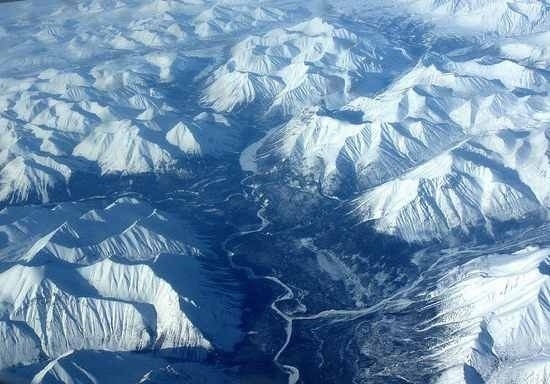
Deep in the remote Northwest Territories of Canada lies a river valley so beautiful it’s breathtaking, and so terrifying it has earned a name whispered in fear for over a century: The Nahanni Valley. But to those who know its history, it has another name.
The Valley of Headless Men.
It sounds like a campfire story, doesn’t it? A tall tale to scare tourists. But the name is horribly, gruesomely literal. This isn’t just folklore. This is history.

A Gold Rush Dream Becomes a Nightmare
Our story begins in the fever dream of the early 20th century. The Klondike Gold Rush was on, and men from all over the world were pouring into the frozen north, chasing rumors of fortunes buried in the frozen ground. Among them were two brothers, Willie and Frank McLeod. In 1906, they decided to ignore the known routes and forge their own path through the Nahanni Valley, convinced a shortcut would lead them to an undiscovered motherlode.
They paddled into the mists of the Nahanni. And then… silence.
For two years, nothing was heard from them. Back in their hometown, rumors swirled. Some said they’d struck it rich and were living like kings. Others feared the worst. The wilderness of the north is unforgiving, after all. But no one was prepared for the truth.
In 1908, a separate prospecting team stumbled upon their final, desperate campsite. They found the brothers’ remains. Both had been decapitated. Their heads were nowhere to be found.
A shocking, macabre end. If it had been the only one, it would be a tragic footnote in the bloody history of the gold rush. But it was just the beginning.
The valley wasn’t done.
- 1917: A Swiss prospector, Martin Jorgenson, built a small cabin in the valley, hoping to find the McLeod’s lost gold mine. He was found dead. His cabin was burned to the ground. His body was decapitated.
- 1945: A miner from Ontario—his name lost to history, another soul swallowed by the valley—was discovered by trappers. He was in his sleeping bag. Lifeless. Headless.
The list goes on. Trapper John O’Brien was found frozen solid beside his campfire, his unlit matches still clutched in his hand, as if something had startled him in the instant before he could save his own life. The state of his head is debated in the lore, but the pattern was set. People who went into the Nahanni Valley sometimes didn’t come out. And those who were found often came out in pieces.
Deep Dive: Monsters, Madmen, or Myth?
So what in the world is going on in the Nahanni Valley? For a hundred years, people have been trying to answer that question, and the theories are as wild as the landscape itself.
The local Dene tribes have legends that go back centuries, long before the gold rush. They speak of the Naha, a fierce tribe of mountain warriors who were said to raid the lowlands, wearing fearsome masks and taking the heads of their enemies as trophies. Could a lost, uncontacted tribe still be living deep in the mountains, protecting their ancestral land from outsiders?
Then there are the other legends. The ones whispered by prospectors after too much whiskey in a lonely cabin. They talk about creatures. The woods are ancient and vast, and full of things we don’t understand. Some blame Sasquatch. But others speak of something far more terrifying: the Waheela. A massive, wolf-like beast, larger than any known canine, with a taste for human flesh and a penchant for… you guessed it… decapitation.
Of course, there are more “rational” explanations. The gold rush was a time of greed, desperation, and violence. “Gold fever” was a real phenomenon, a paranoia that drove men to murder their own partners over a promising glint in a stream. Could the headless victims simply have been the result of brutal, bloody claim jumping? Perhaps. But it doesn’t quite explain the consistency of the mutilations. It feels ritualistic. Personal.
The mystery endures. The Nahanni is a national park now, but its reputation lingers. It’s a place where the world feels thin, where the line between the natural and the supernatural feels blurred. A place that reminds us that some parts of the world are still truly, utterly wild.
The Ararat Anomaly: Did a US Spy Plane Accidentally Find Noah’s Ark?
From the cursed valleys of North America, we travel across the globe to the imposing peak of Mount Ararat in modern-day Turkey. This isn’t just any mountain. For millions of people, it is a sacred place. The final, legendary resting place of Noah’s Ark.
For millennia, the story was one of faith alone. A biblical account of a great flood and a massive vessel that saved humanity. But what if there was proof? What if, in the heat of the Cold War, a US spy plane accidentally captured a photograph of the impossible?
That’s exactly what some people believe happened.

From Spy Photo to Global Sensation
The year is 1949. The Cold War is kicking into high gear. The United States Air Force is flying high-altitude reconnaissance missions along the Turkish-Soviet border, snapping pictures of everything they can. It’s routine intelligence gathering. Tense, but routine.
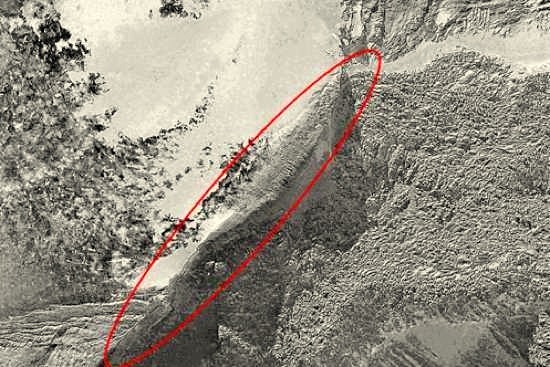
One of those photos, taken of the Ararat massif, was filed away and forgotten for years. When it finally emerged, it set the world of archaeology and theology on fire. The picture is grainy, black and white, shot from miles away. But there, clinging to the edge of a glacier, just 1,300 feet from the summit, is something… odd. Something long, dark, and vaguely boat-shaped. Something that doesn’t look like a rock.
It was dubbed the “Ararat Anomaly.”
The object in the photo seems to be about the right size. The biblical dimensions of the Ark are roughly 515 feet long. The anomaly, accounting for the angle and the ice, appears to fit. It’s in the right location. For ark-hunters, this was the smoking gun they had been waiting for.
Deep Dive: Sifting Through the “Evidence”
The 1949 photo wasn’t the first piece of “evidence.” For centuries, local villagers and explorers had claimed to have seen a massive, man-made structure high on the mountain, emerging from the ice in unusually warm summers. One of the most famous accounts is from George Hagopian, an Armenian man who claimed that as a boy in the early 1900s, his grandfather took him up the mountain to see the holy ship. He described walking on its roof and seeing its massive, petrified wooden beams.
The Anomaly photo gave these stories a new, scientific-seeming credibility. But is it really a 4,000-year-old boat? Or is it just a mountain playing tricks on us?
Geologists are, to put it mildly, skeptical. They point out that the “anomaly” is most likely a natural rock formation. Mountains are full of strange shapes carved by glaciers and erosion. They argue that the object is probably what’s known as a “flow feature”—a mix of rock, ice, and soil that slowly creeps down the mountain, creating an elongated shape. From a great distance, our brains, which are wired to see patterns, fill in the blanks and see a ship.
Subsequent satellite photos taken by the CIA’s KH-9 Hexagon spy satellite in the 1970s and later commercial satellites like IKONOS and DigitalGlobe have provided clearer, but still frustratingly ambiguous, images. Some researchers claim these new photos confirm the ship-like structure. Others say they definitively prove it’s just a strange-looking pile of rocks.
So where does that leave us? The truth remains buried under layers of ice and centuries of hope. Is a piece of sacred history waiting to be uncovered on that frozen peak? Or is the Ararat Anomaly a perfect example of pareidolia—our desperate human need to see a familiar shape in a random pattern? Maybe the answer doesn’t matter as much as the question itself, a question that keeps us looking up at the mountains, wondering.
The Ghost Fortress of Tora Bora: A Modern Mountain Myth
Not all mountain mysteries are ancient. Some are born in the full glare of the 21st-century media spotlight, fueled by war, fear, and propaganda. Let’s fast-forward to the chaotic months after September 11th, 2001. The world was hunting for one man: Osama Bin Laden. And he was hiding, they said, in a fortress.
A fortress straight out of a James Bond movie.
This wasn’t just a cave. This was Tora Bora. A name that became synonymous with an enemy that was not just evil, but diabolically sophisticated. A super-villain in a super-lair.

Building the Bond Villain Lair
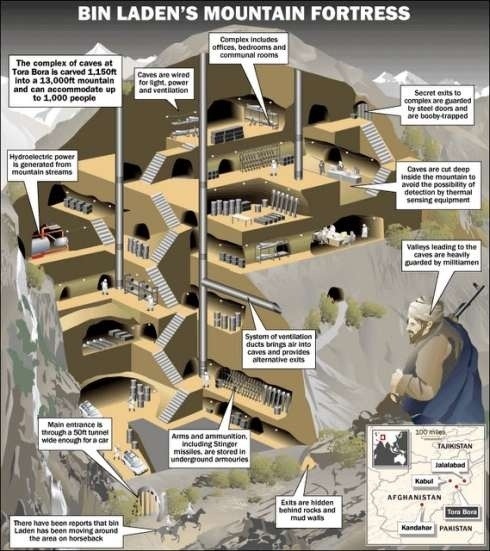
The media reports were sensational. The Times of London published a detailed, almost preposterous cross-section diagram of “Bin Laden’s underground fortress.” It showed a sprawling, multi-level complex burrowed deep inside a mountain in eastern Afghanistan. It had everything:
- Its own hydroelectric power supply, damming underground rivers.
- A state-of-the-art ventilation system.
- Hospitals, offices, and living quarters for thousands of fighters.
- Massive arsenals and ammunition depots.
- Roads wide enough to drive a tank deep into the mountain’s heart.
The US government did little to deny it. When presented with this fantasy blueprint, then-Secretary of Defense Donald Rumsfeld simply said, “there’s not one of those, there are many of those.”
The story had a kernel of truth. Bin Laden, a former civil engineer, had helped expand a network of caves originally built by the Mujahideen in the 1980s—ironically, with CIA money—to fight the Soviets. He likely improved them. But the myth of Tora Bora grew into something else entirely. It became a symbol of an enemy so powerful and entrenched that it required an unprecedented display of military force to destroy.
And so, the bombs fell. The US dropped some of the largest conventional weapons in its arsenal on the Tora Bora mountains, determined to smash this underground fortress to dust and bury Bin Laden inside.
The Fortress That Wasn’t There
So what happened when US and allied forces finally fought their way into the caves of Tora Bora? What did they find inside this mythical mountain fortress?
Nothing.
Well, not nothing. They found a series of small, dusty, natural caves. Some had been slightly enlarged. A few had rudimentary mud-brick walls. There were some small caches of aging ammunition. But there was no hydroelectric plant. No hospital. No ventilation system. No tank-sized roads. The James Bond lair was a ghost. It had never existed.
So what happened? Was it all a lie? A colossal intelligence failure? Or was it something more deliberate?
This is where the conspiracy theories begin. Some argue the myth of the Tora Bora super-fortress was a masterful piece of propaganda. By building up the enemy’s stronghold into an impregnable bastion, it justified the massive bombing campaign in the eyes of the world. It made the enemy seem more powerful, which in turn made the eventual (though delayed) victory seem more impressive.
Others whisper a more chilling possibility. What if the fortress *was* real, and the US military, for all its power, simply couldn’t find it? Or worse, what if Bin Laden and his top lieutenants were allowed to escape from this non-existent fortress as part of some secret deal? The mountains, as always, aren’t talking.
The Tora Bora myth shows us that mountain mysteries don’t need centuries to take root. In the modern age, with a 24-hour news cycle and the machinery of war, you can build a mountain fortress in the public imagination, bomb it into dust, and leave everyone wondering if it was ever there at all.
The Silent Summits
From a Canadian valley that takes men’s heads, to a Turkish peak that might hold humanity’s origin story, to an Afghan mountain range that became the site of a modern myth. Three different places, three different times, but one chilling constant.
Mountains are the perfect place to keep a secret.
Their sheer scale and indifference make our own concerns seem small. They are the ultimate guardians, hiding truth under billions of tons of rock and ice. Whether the secrets are of gold-crazed madmen, ancient artifacts, or the convenient fictions of modern warfare, the mountains hold them close.
The answers we seek may still be out there. Or maybe some questions are never meant to be answered. Maybe the purpose of these mysteries is simply to remind us that no matter how much we explore, map, and conquer, there will always be places on this Earth that remain profoundly, terrifyingly unknown.
Originally posted 2014-02-25 21:43:47. Republished by Blog Post Promoter