The Saucers Arrive
During World War II, Allied flight crews reported mysterious, glowing objects pacing their planes. Assumed at first to be a German secret weapon, they went by the nicknames “foo fighters” and “German fireballs.” Similar objects were reported in the Pacific theater of war as well.
In the summer of 1946, thousands of people in the Scandinavian countries reported seeing rocket-shaped objects silently flying and maneuvering overhead, sometimes seen to explode or crash into lakes. They were also detected on radar. At first, people thought they might be German rockets captured by the Russian. Gen. Jimmy Doolittle was sent over to investigate on behalf of U.S. military intelligence by Gen. Hoyt Vandenberg, then Director of the Central Intelligence Group, but what Doolittle discovered or concluded is still unknown. By chance or design, Doolittle was also in the office of Gen. Vandenberg for a lengthy conference the day after the Roswell case broke in 1947.
Eventually the phenomenon spread into southern Europe. In Greece, a former Manhattan Project physicist and Greece’s leading scientist, Dr. Paul Santorini (key developer of A-bomb proximity fuse, centrimetric radar systems, Nike missile guidance system), was placed in charge of the investigation. In a public talk 20 years later, Santorini stated that they soon established that they were not missiles. Under pressure from the U.S. War Dept., the Greek Army ordered the investigation stopped. Scientists from Washington flew to Greece for secret talks. Later Santorini told researchers that secrecy was invoked because officials were afraid to admit of a superior technology against which we have “no possibility of defense.” Corroborating Santorini’s story was a Top Secret USAF document declassified in 1998. It was stated by Swedish air intelligence that a number of their experts that had studied the ghost rockets and later flying saucers concluded they couldn’t be made by any country on Earth and therefore might have extraterrestrial origins. (Click on thumbnail at right to read document)
A few articles appeared in U.S. newspapers and magazines about the “foo fighters” and “Scandinavian ghost rockets.” But generally speaking, the U.S. public was largely unaware of any strange aerial phenomena. This was soon to change, however.
On June 24, 1947, private pilot Kenneth Arnold saw nine, mirror bright saucer-shaped or disk-shaped objecs flying past the face of Mt. Rainier at speeds Arnold calculated to be in excess of 1200 mph. Arnold’s sighting got picked up by the press and became the first widely reported UFO sighting in the United States. It also soon led to the adoption of the terms “flying saucers” and “flying disks” or “discs” to describe the objects, since Arnold variously referred to them as “disc-shaped” or “saucer-shaped.” However, Arnold noted that they were not completely circular, but were truncated and came to a point in the back, as shown in his drawing to Army Air Force intelligence a few weeks later.
Others then started reporting seeing similar objects. One veteran pilot, Richard Rankin, said he saw a formation of ten saucer-like objects the day before Arnold’s sighting near Bakersfield, CA. However, the dam didn’t burst until July 4. That evening, a United Airlines crew flying over Idaho en route to Seattle reported seeing nine saucer-shaped objects in the distance pacing their plane. According to the originally very skeptical Cpt. E. J. Smith, the objects were in view for 10 minutes and then suddenly disappeared. This story was far more widely reported than the Kenneth Arnold sighting in the nation’s press. The next day, for the first time, most newspapers started carrying front-page stories about the “flying saucers” and “flying disks” or “discs” being sighted all over the country.
On July 7,
William Rhodes took photos of an object with a crescent- shaped trailing edge flying over Phoenix, AZ. Soon afterwards, military intelligence and the FBI confiscated all prints and the negatives. Another strikingly similar object was photographed in 1950 by a photographer for the Louisville Times.
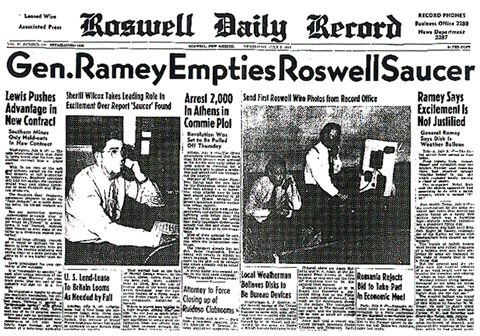
Back in New Mexico and Texas, the so-called “Roswell incident” was beginning to take shape. Roswell Army Air Field. was home of the 509th Bomb Group, the Army Air Force’s one and only atomic bomber base. The 509th was part of the Strategic Air Command (SAC) and was also a subcommand of the Eight AAF headquartered at Fort Worth Army Air Field, Texas. Brigadeer General Roger Ramey was commanding officer of the 8th AAF. His Chief of Staff was Colonel Thomas J. Dubose, who also played a key role in the Roswell case and has been an important witness.
Between June 24 and July 2, there were at least 3 dozen reported UFO incidents in the Arizona/New Mexico/El Paso region, some of the reports coming from military personnel and pilots. An incident involving three Naval missile experts at White Sands Missile Range on June 29 was eventually reported nationally. They watched a bright, silvery disc traveling at speeds estimated to be faster than sound. “It was clearly visible — and then it wasn’t there,” according to team head Dr. C. J. Zohn. The official explanation, however, was that they had seen a balloon.
On July 1, some New Mexico and Texas newspapers (such as the Roswell Morning Dispatch, El Paso Times, and Fort Worth Star-Telegram) carried an AP wire-service interview with Gen. Ramey and his intelligence chief Col. Alfred Kalberer. They expressed great skepticism about the reported saucers flying at supersonic speeds. Kalberer called it “Buck Rogers stuff.” Ramey said people had “been seeing heat waves.” They suggested people were probably also seeing jet aircraft.
The following day, Kalberer continued to scoff at the reports, saying they were “an interesting study in human psychology.” He compared them to people seeing sea serpents or thinking they were being invaded from Mars during the Orson Well’s War of the Worlds radio broadcast a decade earlier. He wished someone “would put salt on the tail of one of these discs and catch it.” (Fort Worth Star-Telegram, El Paso Times, July 2)
A few days later (July 3-5), the AAF Deputy Chief of Staff Gen. Vandenberg was at bases in Dallas and Wichita Falls, Texas. Before returning to Washington on July 5, he was quoted saying that the Army Air Force had receivedthousandsof queries about the flying disks (Austin Statesman and Austin American, July 7). The Houston Chronicle on July 8 quoted Vandenberg saying that the AAF had been intensively studying the situation since July 2.
Vandenberg was to be a major player in the Roswell incident on July 8 when he was the acting Chief of Staff and the story finally broke because of the press release from Roswell base. The newspapers reported him personally taking charge at the Pentagon to get to the bottom of it. More importantly, Gen. Ramey’s teletype message of “THE VICTIMS OF THE WRECK” and shipping something “IN THE DISC” was addressed to him.