The Trillion-Dollar Ghost: How a Master Con Man Hijacked a Football Club and Fooled the World
Some stories sound too wild to be true. They feel like a Hollywood script. A shadowy figure with a silver tongue, an impossible promise of infinite wealth, and a world-famous celebrity caught in the crossfire. This isn’t a movie. This is the story of the biggest con in football history.
It’s a tale that involves a phantom Bahraini royal fortune, the world’s oldest professional football club, and one of the most famous managers on the planet. And at the center of it all? A man the world would come to know as the Trillion-Dollar Con Man.
His name was Russell King.
And he was about to pull off the impossible.
Before the private jets, the five-star hotels, and the whispers of trillion-dollar fortunes, Russell King was just a small-time fraudster from Jersey. A nobody. He’d already been convicted for insurance fraud in the 1990s, a scam involving a supposed theft of classic cars that netted him a cool £600,000. He did two years in prison. But prison didn’t reform Russell King. It just gave him time to think. Time to dream up a bigger con. A much, much bigger con.
His new persona was a masterpiece of deception. He wasn’t just a businessman; he was a gatekeeper. A facilitator for the ultra-rich. He spoke of offshore accounts, of sovereign wealth funds, and of powerful, shadowy backers who moved the world’s markets from behind closed doors. His target? The greedy, the ambitious, and the desperate.
Enter the Mark: Sven-Göran Eriksson
Every great con needs a great mark. A celebrity. A name that brings instant credibility. Russell King found his in Sven-Göran Eriksson.
Sven. The ice-cool Swede. The man who had managed England’s “Golden Generation.” He was a footballing giant, a household name across the globe. But by 2009, his star had faded slightly. After managing England, Manchester City, and Mexico, he was between jobs, a man with a massive reputation and, apparently, a massive appetite for money. He was the perfect target: famous, respected, and looking for one last giant payday.
King approached him not with a simple job offer, but with a vision. A fantasy. He told Eriksson he represented a consortium of investors from the Middle East. Not just any investors. The royal family of Bahrain, he claimed, was ready to pour billions, perhaps even a trillion dollars, into European markets. And they wanted Sven to be the face of their football operations.
Was it just about the money for Sven? Maybe. But King was selling something more potent. He was selling a legacy. A chance to build a dynasty from the ground up, with unlimited funds. A chance to become the most powerful man in football.
Eriksson, the famously unflappable manager, was hooked. Line and sinker.
Deep Dive: Weaving the Web of Lies
A con of this magnitude can’t be built on words alone. King needed to create the illusion of legitimacy. He needed assets. He needed a stage.
His first move was audacious. Using forged documents and the promise of a massive injection of Bahraini cash, King managed to convince the board of a Swiss-based investment bank, First London, to hand over a 49 percent shareholding. Just like that, he had a financial institution. He had letterheads. He had a calling card that screamed “legitimacy.” He was no longer just Russell King; he was a major player in a Swiss bank.
Now he needed his trophy. His stage. And he found it in Nottingham.
Why Notts County?
Why would a supposed trillion-dollar consortium buy a struggling club in the fourth tier of English football? It made no sense. And that was the genius of it.
Notts County wasn’t just any club. It’s the oldest professional football club in the world, founded in 1862. It was a piece of history. A sleeping giant. The narrative was perfect: the world’s oldest club, rescued by the world’s richest investors, to begin an epic journey back to the top.
In the summer of 2009, King, operating through a shell company called Munto Finance, bought Notts County for a nominal fee. The news sent shockwaves through the football world. The club’s long-suffering fans were ecstatic. Their saviors had arrived.
The promises were breathtaking.
- A swift rise through the leagues to the Premier League.
- A brand new, state-of-the-art stadium.
- World-class players flocking to Nottingham.
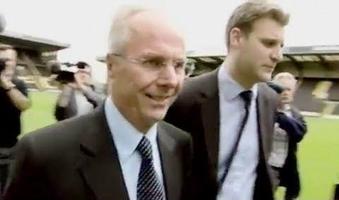
To seal the deal, King unveiled his trump card. Sven-Göran Eriksson was announced as the new Director of Football. The press conference was a global event. Sven, tanned and smiling, sat next to the club’s new owners, talking about the “project.” He was promised a salary in the millions and, more importantly, shares in the club supposedly worth a staggering £10 million. It was the ultimate stamp of approval. If Sven was in, this had to be real. Right?
The House of Cards: A Fantasy Unravels
The dream began to crack almost immediately. The first sign something was deeply wrong was the signing of Sol Campbell.
Campbell was a world-class defender, a former England international who had played for Arsenal and Tottenham. Luring him to the fourth division was a massive statement. He signed a five-year contract worth a reported £40,000 a week—an insane amount for that level of football.
He played one game. One.
He quit soon after, reportedly shocked by the state of the club and the realization that the grand promises were built on sand. The money, it seemed, wasn’t quite there. Cracks were appearing in the facade.
Behind the scenes, things were falling apart. The club’s staff started noticing that bills weren’t being paid. The taxman came knocking. The promised flood of investment from Bahrain was always “just a week away,” delayed by “banking regulations” or “international paperwork.” King was a master of excuses, always calm, always reassuring everyone that the colossal transfer of funds was imminent.
Sven, living in a luxury hotel suite at the club’s expense, started to grow suspicious. He was the public face of this project, but he was being kept in the dark. He later admitted he never once saw any proof of the money. Not a single bank statement. He was running on pure faith.
Journalists began digging into Munto Finance and Russell King. They found a labyrinth of offshore companies, a history of failed businesses, and a trail of angry investors. They discovered his previous conviction for fraud. The story started to leak out. This wasn’t a Bahraini royal consortium. This was a one-man show. A massive, audacious fraud.
What If The Money Was Real? An Alternate History
For a moment, let’s step into the fantasy. What if King wasn’t a con man? What if he really did have access to a trillion-dollar fund? What would football look like today?
Notts County would have rocketed through the leagues. Forget Manchester City or PSG; Notts would have been the original super-club. They would have signed Messi. Ronaldo. They would have built a 100,000-seat stadium made of gold. Okay, maybe not gold. But the Premier League would have been turned upside down. A tiny club from Nottingham would have become the most powerful force in world sports.
Sven-Göran Eriksson would have cemented his legacy, not as the man who got duped, but as the genius architect of the greatest football project in history. It’s a tantalizing thought. A glimpse into a parallel universe where the lie was true. But it was a lie. And the crash back to reality was brutal.
The Escape and the Aftermath
By early 2010, the game was up. The Football League, smelling a rat, was demanding proof of funds that King could never provide. The club was sinking into debt, facing administration, and on the verge of total collapse.
And Russell King? He vanished.
Like a ghost, he simply disappeared. One day he was the charismatic chairman promising the world; the next, he was gone. He fled the UK, leaving a trail of destruction in his wake. He left Notts County with millions in debt, its reputation in tatters. He left Sven-Göran Eriksson feeling like the biggest fool in the world, having worked for months for free and losing over £10 million in promised shares that never existed.
The club was eventually saved by a local businessman, but the scars of the King era remain. It was a bizarre, five-month circus that almost destroyed the world’s oldest club.
The Digital Ghost: Where is Russell King Now?
For years, Russell King was an international fugitive. Warrants were issued for his arrest. British authorities were hunting him for fraud. Stories would occasionally surface on internet forums and in tabloids. He was spotted in Bahrain. He was hiding out in North Korea. He was involved in a gold and diamond deal with the North Korean regime. The stories became more and more bizarre, cementing his mythical status as a master manipulator who could talk his way into—and out of—anything.
In 2019, the ghost was finally captured. Russell King was arrested in Bahrain and extradited back to the UK to finally face justice for his crimes. The man who built an empire on lies was finally brought back to reality.
But the story doesn’t quite end there. The legend of the Trillion-Dollar Con Man is a chilling reminder of how easily people—even rich, powerful, intelligent people—can be seduced by the promise of impossible wealth. He didn’t use a weapon. He didn’t break into a bank. He used a story. A very, very good story.
It’s a warning. A cautionary tale for the ages. In a world obsessed with money and status, a convincing lie can be the most powerful weapon of all. And you have to wonder… who is the next Russell King, and what story are they telling right now?