China’s Ghost Satellite: The Day a Secretive Spacecraft Woke Up and Hunted Its Own
Up there, in the cold, silent blackness, something is moving. It’s not an asteroid. It’s not a natural phenomenon. It’s a machine, built by human hands, performing a secret dance hundreds of miles above our heads. A dance that could be a rehearsal for the next world war.
Most of us look up at the night sky and see stars. But governments and military analysts see something else. They see a chessboard. A high-stakes game where the pieces move at 17,500 miles per hour. And in 2013, China made a move that sent a shockwave through the global intelligence community. A move that remains one of the most chilling and unexplained events in modern space history.
It started with a launch. It ended with a hunt.

A Trojan Horse in Orbit?
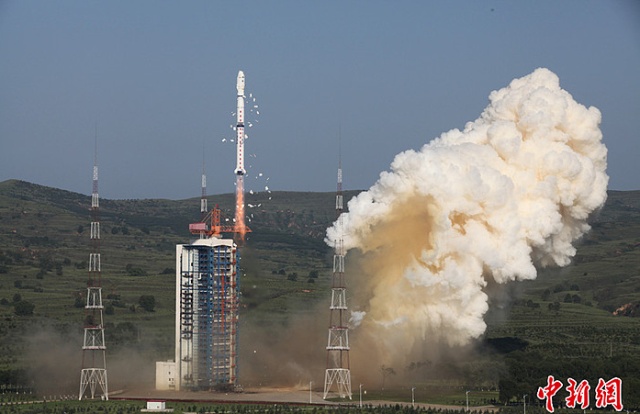
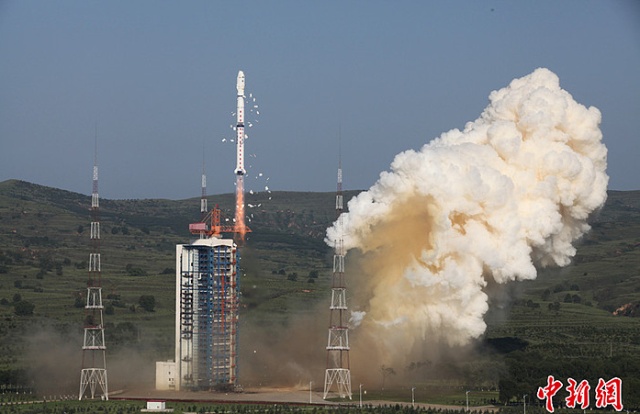
July 20, 2013. A powerful Long March 4C rocket tears through the atmosphere, a pillar of fire against the Asian sky. Onboard, a trio of satellites destined for low-Earth orbit. The official manifest from the China National Space Administration was, to put it mildly, boring. It was routine. It was *science*.
The payloads were listed as Shiyan-7 (SY-7), Chuangxin-3 (CX-3), and Shijian-15 (SJ-15). The names themselves sound innocuous. “Experiment 7,” “Innovation 3,” and “Practice 15.” Beijing told the world they were designed for scientific research. Maintenance tests. Nothing to see here.
And for a while, the world believed them. The satellites settled into their orbits, just another few blips on the screens of NORAD. But then, the blips started to move in ways they shouldn’t.
The Sinister Dance Begins
The focus of the mystery is Shiyan-7. The Experiment. Shortly after reaching orbit, it began a series of strange, deliberate maneuvers. It wasn’t just adjusting its position. It was approaching its launch-mate, Chuangxin-3, with unnerving precision.
They got close. Frighteningly close.
For weeks, the two satellites performed an intricate orbital ballet. A waltz in the void. Analysts watched, puzzled. What was going on? Was this a test of new docking procedures? A practice run for refueling or repairs?
And then it happened. The twist nobody saw coming.
On August 16th, Shiyan-7 abruptly broke off its dance with Chuangxin-3. It fired its thrusters, not for a minor correction, but for a major orbital burn. It began to move with purpose. It had a new target. An old target.
It was hunting Shijian-7.
Deep Dive: A Ghost from the Past
Why was this so strange? Shijian-7 wasn’t part of the 2013 launch. It was a ghost. An old, forgotten satellite launched way back in 2005, drifting in a completely different orbit. For eight years, it had circled the Earth, likely long past its prime operational window. It was, for all intents and purposes, a piece of history.
So why would China’s newest, most sophisticated “experimental” satellite suddenly abandon its modern partners to chase down an eight-year-old relic? The rendezvous was precise. Aggressive. Over the next few days, Shiyan-7 closed the distance, matching speed and trajectory until it was flying in dangerously close formation with the older satellite. It got so close that ground-based telescopes couldn’t resolve them as two separate objects.
Then, another layer of the mystery was peeled back. At the time of the launch, buried in Chinese-language press releases, were mentions of a very specific piece of technology. A “robotic arm manipulator.” One of the three satellites was carrying a claw.
And it was now right next to another satellite.
The Official Story: A Humble Space Janitor?
When confronted with the strange movements, the official and semi-official explanations were simple and peaceful. China was merely testing “space maintenance technologies.” The robotic arm, they suggested, was for “space debris observation.”
To be fair, this is a plausible cover. Space junk is a massive problem. Decades of launches have left a deadly minefield of spent rocket stages, dead satellites, and shrapnel orbiting the planet. A single stray bolt, moving at orbital speeds, can hit with the force of a hand grenade. Developing a robotic arm to grab and de-orbit this dangerous junk would be a noble, peaceful endeavor.
Gregory Kulacki, a senior analyst with the Union of Concerned Scientists, noted that the Chinese press specifically mentioned these benign applications. It fits a narrative of China as a responsible space-faring nation, cleaning up the cosmos for the good of all mankind. A helping hand in the heavens.
But a hand can do more than help. A hand can also crush.
The Forbidden Theory: Orbital Assassins
Here’s the chilling reality of space technology: almost everything is dual-use. A rocket that can launch a satellite for your GPS can also launch a nuclear warhead. A camera that can study weather patterns can also spy on military bases. And a robotic arm designed to gently capture space debris can just as easily grab, crush, or throw a rival nation’s satellite into a death spiral.
Think about it. What did Shiyan-7 really demonstrate?
- Rapid Intercept Capability: It proved it could change its orbit dramatically and quickly to hunt down a specific target.
- Close Proximity Operations: It mastered the art of getting terrifyingly close to another object without crashing. This is a vital skill for both repair and attack.
- Weaponized Technology: It carried a tool—the robotic arm—that could physically interfere with another satellite.
As Dean Cheng, a research fellow at the Heritage Foundation, warned, we should not have “blithe assumptions that this is necessarily for solely peaceful ends.” The Shiyan-7 maneuver wasn’t a test of a garbage truck. It looked a lot more like a test of a cosmic predator.
This wasn’t a rescue mission. It was a simulated takedown.
A Shadow from 2007 Looms Large
Why would analysts immediately jump to this dark conclusion? Because China has a record. A very, very loud one.
On January 11, 2007, the world watched in horror as China launched a ballistic missile not into a test range on Earth, but straight up. Its target was one of its own defunct weather satellites, the Fengyun-1C. The missile, a kinetic-kill vehicle, didn’t carry explosives. It didn’t need to. At orbital velocities, a direct impact is catastrophic.
The kill vehicle slammed into the satellite, obliterating it in a flash of light. The test was a success. China had just proven to the world, and specifically to the United States, that it could shoot down satellites from the ground.
The fallout was immense. The impact created over 3,000 pieces of trackable space debris, instantly making low-Earth orbit a more dangerous place for everyone, including the International Space Station. The international condemnation was swift and severe. But China didn’t care. The message had been sent: Your eyes in the sky are not safe.
That 2007 test is the critical context for the 2013 mystery. The missile was a sledgehammer. Crude, but effective. Shiyan-7, with its robotic arm, represented something far more sophisticated. More sinister. It was the difference between a bomb and an assassin’s blade. It was a tool for a quiet, deniable attack in space.
What If? Imagining a War in the Heavens
Why is this technology so terrifying? Because modern society is built on a fragile network of satellites. Your GPS, your bank transactions, your internet, your TV, and, most importantly, a nation’s military all depend on these vulnerable machines.
A weapon like Shiyan-7 opens up terrifying new possibilities for warfare.
- The Space “Pearl Harbor”: In the opening hours of a conflict, a fleet of these “killer satellites” could silently approach and disable an enemy’s entire network of spy, communication, and navigation satellites. An entire military could be blinded and deafened before the first shot is even fired on Earth.
- Plausible Deniability: A missile launch is obvious. But a “maintenance” satellite that “accidentally” bumps into a rival satellite, causing it to malfunction? That’s much harder to prove was an act of war. It could be spun as a tragic accident.
- Satellite Hostage-Taking: A robotic arm could grab a critical, multi-billion-dollar military satellite and simply hold it, not destroying it but rendering it useless. It could be used as a bargaining chip in a geopolitical crisis.
This is the future of warfare that the Shiyan-7 test hinted at. A quiet, cold war fought in the vacuum of space, with the fate of nations hanging on the movements of robotic arms and silent thruster burns.
The Story Continues: China’s Modern Space Claws
If you think this is old news from 2013, you’re mistaken. The Shiyan-7 incident wasn’t the end of the story. It was the beginning.
Fast forward to 2022. The online community of amateur and professional satellite trackers, the modern-day digital sleuths, noticed something strange again. This time, the satellite was named Shijian-21 (SJ-21).
In January 2022, SJ-21 was spotted performing an incredible maneuver. It approached a dead Chinese satellite, grabbed it, and then executed a massive engine burn, dragging the dead satellite thousands of miles away into a high “graveyard orbit”—a dumping ground for old space junk.
The official line? The same as always. China was just cleaning up debris. But the capability it demonstrated was astounding. This wasn’t a gentle nudge. This was a space tugboat. It proved, beyond any doubt, that China had perfected the technology of grabbing and moving another satellite against its will.
The 2013 Shiyan-7 test was the training mission. Shijian-21 was the final exam. They passed with flying colors.
This is precisely why the United States created the Space Force. The battleground is no longer just land, sea, and air. The high ground of space is now contested territory, and the evidence is clear that China has been developing the tools to dominate it for over a decade.
The Unanswered Questions Haunt Us
Years later, the core mysteries of that 2013 event remain. The silence from Beijing is deafening.
Why did Shiyan-7 specifically hunt down the old Shijian-7? Was there something on that 2005 satellite they needed to retrieve? Or was it simply the perfect practice dummy—an object they knew intimately and could test their new weapon on without suspicion?
What exactly did the robotic arm do when it got close? Did it touch it? Grapple it? Scan it? We may never know for sure.
What we do know is that China played a game in the dark, and the world was barely watching. They tested a weapon system under the perfect disguise of peaceful science. And they’ve only gotten better at it since.
So the next time you look up at the pinpricks of light moving steadily across the night sky, remember the story of Shiyan-7. Remember that some of those “stars” aren’t just observing. They might be hunting. Up there, in the quiet expanse above our world, a silent, undeclared war is already underway. And we on the ground are only just beginning to see the shadows it casts.
Originally posted 2013-09-30 23:46:37. Republished by Blog Post Promoter
![space-mystery-unsolved[1]](https://coolinterestingnews.com/wp-content/uploads/2013/09/space-mystery-unsolved1.webp)