The Unthinkable Truth: Are We All Aliens on Our Own Planet?
You’ve been told a story your whole life. A simple, comfortable story. It goes like this: billions of years ago, a sterile, volcanic rock called Earth cooled down. In a primordial soup of chemicals, a spark ignited. Life began. From that single, miraculous moment, everything you see today—the trees, the animals, you—slowly, painstakingly evolved.
It’s a neat story. It’s the one in all the textbooks.
But what if it’s completely wrong?
What if the story of life on Earth doesn’t start on Earth at all? What if the first spark of life, our ultimate ancestor, wasn’t born in the warm little ponds of our world, but in the cold, dark void of space, on a planet that died billions of years before ours was even born? This isn’t a science fiction movie plot. This is a mind-bending possibility being pieced together by renegade scientists who dared to ask a forbidden question: Is life on Earth an imposter?
A Cosmic Glitch in the Official Timeline
Let’s get our timelines straight. According to mainstream science, the universe is roughly 13.8 billion years old. Our solar system, and our planet Earth, are cosmic toddlers, forming a mere 4.5 billion years ago. The first fossil evidence of life on Earth pops up around 3.8 billion years ago. That leaves a window of about 700 million years for life to go from non-living chemicals to functioning organisms. It seems like a long time, but in the grand scheme of evolution, it’s a cosmic sprint.
But a bombshell study from two researchers throws a wrench in this tidy timeline. They didn’t dig up new fossils or analyze ancient rocks. They used something far more unexpected.
A rule that governs the growth of your smartphone.

Alexei Sharov, a geneticist at the National Institute on Ageing, and Richard Gordon, a theoretical biologist at the Gulf Specimen Marine Laboratory, looked at the crushing complexity of life and made a simple, terrifying calculation. Their results suggest that life didn’t begin 3.8 billion years ago. Not even close.
Their math points to an origin story that began nearly 10 billion years ago.
That’s more than twice the age of Earth. That’s a number so impossibly, ridiculously large that it means one thing and one thing only: whoever we are, whatever life is… it didn’t start here.
Hacking the Code of Life with Moore’s Law
The entire, explosive theory rests on a concept from a completely different field: the world of computer science. It’s a place of silicon and circuits, not carbon and cells. Or so we thought.
So, What is Moore’s Law, Anyway?
You’ve seen Moore’s Law in action, even if you don’t know its name. In 1965, Gordon Moore, the co-founder of Intel, made a simple observation. He noticed that the number of transistors you could cram onto a microchip was doubling roughly every two years. This meant computers were getting exponentially more powerful at a predictable rate.
It’s not a law of physics. It’s just an observation of technological progress. But it’s been uncannily accurate for over 50 years. Think about the phone in your pocket. It has billions of times more processing power than the computers that sent humanity to the moon. That’s Moore’s Law.
If you take this law and run it backward, you can pinpoint the birth of the microchip. The exponential growth curve, when traced to its origin, lands you squarely in the late 1950s and early 1960s. It works. The math checks out.
Applying a Computer Rule to Biology? Seriously?
Here’s the leap of genius. Or madness. Sharov and Gordon looked at life and saw a similar pattern of exploding complexity. Life didn’t just appear. It got more advanced. It started with simple prokaryotic cells—basically tiny bags of chemicals with no nucleus. Then came the much more complex eukaryotic cells (the kind our bodies are made of). Then came multicellular organisms, then worms, then fish, then mammals, and finally, humans with their ridiculously complex brains.
They decided to treat genetic material—our DNA—like a biological hard drive. The complexity of an organism, they argued, can be measured by the size of its functional genome, the number of active base pairs in its DNA. More complexity equals a bigger, more sophisticated genetic “program.”
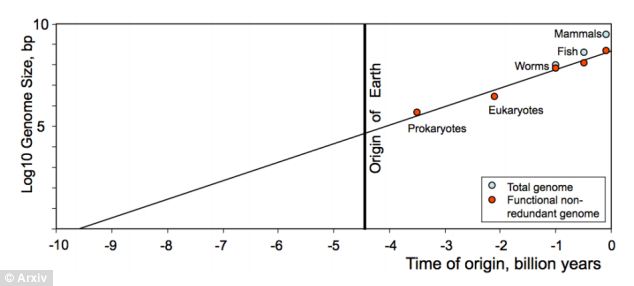
So they plotted it out. They took the known complexity of major life forms throughout Earth’s history and put them on a chart. Just like Moore’s Law, they used a logarithmic scale to turn the exponential curve into a straight line. Then, they did the unthinkable.
They traced the line backward.
The Mind-Blowing Result: A Biological Big Bang
The line didn’t stop at 3.8 billion years ago, the supposed dawn of life on Earth. It didn’t stop at 4.5 billion years ago, the birth of our planet.
It kept going.
The line, representing the steady, exponential growth of life’s complexity, finally hit zero—a single base pair of genetic information, the biological equivalent of the first transistor—at 9.7 billion years ago, give or take 2.5 billion years.

Let that sink in. Our planet did not exist 9.7 billion years ago. Our sun may not have even existed. The Milky Way galaxy itself was much younger, still a chaotic swirl of gas and dust. Yet, according to this biological Moore’s Law, the software for life was already being written.
The conclusion is inescapable. If the math is right, life is an ancient, roaming phenomenon that found a temporary home on Earth. We are the descendants of a biological system that is older than the ground beneath our feet.
Panspermia: Life as a Cosmic Hitchhiker
This idea, as radical as it sounds, isn’t entirely new. It has a name: Panspermia. The theory, which dates back to ancient Greece but was modernized by scientists like Fred Hoyle and Francis Crick (yes, the co-discoverer of DNA’s structure), proposes that life is not an Earthly event but a universal one. It suggests that the “seeds of life” are everywhere, drifting through the cosmos.
The Ancient Theory Gets a Modern, Terrifying Upgrade
For decades, Panspermia was treated as a fringe idea, the stuff of late-night talk shows. The biggest question was always: how? How could life possibly survive the journey? The vacuum of space. The lethal radiation. The freezing temperatures. The violent impacts.
But the more we learn, the less impossible it seems.
Scientists have discovered organisms on Earth called “extremophiles.” These are lifeforms that don’t just survive in hellish conditions; they thrive there. They live in boiling volcanic vents at the bottom of the ocean, in pools of acid, deep within frozen Antarctic ice, and even in the cooling water of nuclear reactors. One of the most famous is the Tardigrade, or “water bear.” This microscopic creature can be boiled, frozen, crushed, dried out, and blasted with levels of radiation that would kill a human a thousand times over. It can survive the vacuum of space. We know this because we’ve tested it.
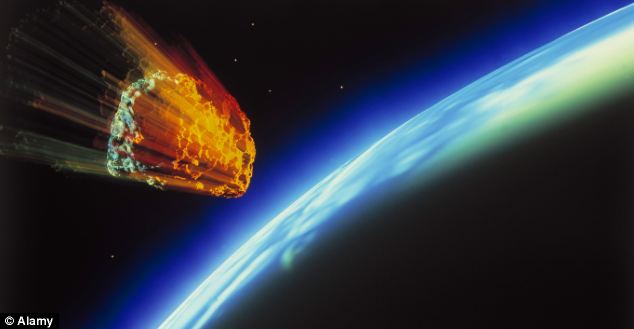
Suddenly, the idea of a microbe surviving a trip through space doesn’t seem so far-fetched. Especially if it’s shielded deep inside a rock—a concept called Lithopanspermia. An asteroid impact on an ancient, life-bearing planet could easily blast tons of rock into space, carrying microscopic passengers safely embedded within.
A Galactic Delivery System
These life-bearing rocks could then drift for millions, even billions, of years. A cosmic message in a bottle. Most would float forever in the void. But some, through sheer chance, would be captured by the gravity of a new, young planet. A planet like Earth.
Imagine a young, sterile Earth, 4 billion years ago, being bombarded by these cosmic seeds. If even one of these microbial arks survived its fiery entry through the atmosphere and landed in a hospitable environment—like a warm ocean—the process would begin. The ancient, pre-programmed genetic code would reactivate. Evolution would pick up where it left off. Life wouldn’t be starting from scratch; it would be rebooting from an ancient backup.
The “What If?” Deep Dive: A Universe Teeming with Ancient Life
If we accept this premise, even for a moment, the implications are staggering. It changes everything we think we know about our place in the cosmos.
If Not Here, Then Where?
So where did this “Genesis Planet” come from? The possibilities are dizzying. Could it have been an early, wetter Mars? We know Mars once had liquid water and a thicker atmosphere. Perhaps life began there and was blasted to Earth when Mars lost its magnetic field and died.
Or maybe it was a hypothetical fifth planet in our solar system that was destroyed in some ancient cataclysm. But Sharov and Gordon’s timeline points to an origin far, far older than our solar system itself. This leads to the most profound possibility of all: interstellar panspermia. Life didn’t come from Mars. It came from a different star system entirely. It came from a planet orbiting a long-dead star, a world that rose and fell billions of years before our sun even ignited.
The “Galactic Genesis” Hypothesis
What if life only has to start *once* per galaxy? Just one time. On one perfect planet, billions and billions of years ago. Once that life becomes robust, it begins to spread. Every asteroid impact becomes a potential seeding event. Over eons, this life spreads from star system to star system like cosmic pollen on the solar winds.
In this model, the galaxy isn’t a collection of sterile planets with a few lucky exceptions. It’s a single, interconnected ecosystem. Life isn’t a rare accident; it’s a galactic infection. We aren’t Earthlings. We are, in the truest sense of the word, the children of the stars. Our DNA carries the genetic memory of a journey that spans light-years and epochs.
The Skeptic’s Corner: Is This Just a Crazy Numbers Game?
Now, let’s pull back from the edge. Before we declare ourselves aliens, we have to acknowledge the serious criticisms of this theory. Is this incredible story built on a solid foundation, or a house of cards?
Is Moore’s Law a Universal Law of Life?
The biggest red flag is the central premise itself. Moore’s Law is an observation about a human-driven industry with a clear economic goal: make things smaller and faster. Biological evolution has no goal. It is a messy, chaotic process driven by random mutation and environmental pressure. There were long periods in Earth’s history where complexity seemed to stall. There were mass extinctions that acted as massive “reset” buttons, wiping out complex life and forcing evolution down new, unpredictable paths.
To assume that genetic complexity increases at a steady, predictable, exponential rate for 10 billion years is a massive, and perhaps completely unfounded, assumption.
The Data Problem
Critics also point out that Sharov and Gordon are drawing a straight line through a very small number of data points. The fossil record of early life is incredibly sparse. We have a few blurry snapshots from billions of years of history. Is it really scientifically rigorous to draw a definitive line backward from such limited data and declare it proof of an alien origin?
Could the rate of complexity have been different in the past? Perhaps it was incredibly slow for the first billion years, and then rapidly accelerated. If that were the case, the entire “10 billion year” timeline collapses.
The Final Question: Earthling or Star-Child?
So where does this leave us? Trapped between a comfortable story and a fantastic one.
On one hand, we have the simple, elegant explanation: life started here. It’s the answer that requires the fewest extraordinary assumptions. It’s the scientific consensus.
On the other hand, we have this haunting mathematical echo. A ghost in the machine of our own DNA that whispers of a past far older and grander than we ever imagined. An equation that suggests our roots stretch back into the deep time before Earth existed, tying us to a lost cosmic ancestry.
The evidence isn’t conclusive. It’s a compelling, deeply unsettling piece of a puzzle we’re only just beginning to comprehend. But it forces us to ask the ultimate question of identity. When you look in the mirror, what are you seeing? A product of Earth’s primordial soup? Or the current, temporary vessel for an ancient, star-hopping intelligence that has been riding the cosmic tides for ten billion years?
The story of who we are may not be written in the rocks of our planet, but in the vast, silent darkness between the stars.