Home Weird World Strange Stories The Mermaid – Real Evidence

The Mermaid – Real Evidence

0
107

Are Mermaids Real? The Shocking Truth Hidden in Plain Sight

Forget the cartoons. Forget the fairy tales. Forget everything you think you know about mermaids.

The story we’ve been sold—the shimmering tails, the seashell bras, the friendly fish sidekicks—is a pale, sanitized version of a legend that is as old as civilization itself. It’s a legend soaked in tragedy, fear, and a question that haunts the edges of our maps: Are we alone on this planet?

The answer might be hiding just beneath the waves.

This isn’t just a story about a mythical creature. This is a story about a global pattern. A biological puzzle. This is about ancient goddesses, terrified sailors, and a controversial theory of human evolution that could change everything.

So take a deep breath. We’re going under.

Mermaid

The First Whisper: An Ancient Goddess’s Shame

Our journey doesn’t start in Denmark or Hollywood. It starts thousands of years ago, in the dust and heat of ancient Assyria, with a goddess named Atargatis.

She was a powerful goddess of fertility and the moon. But she made a mistake. She fell in love with a mortal shepherd, a human man. In a moment of passion and divine power, she accidentally killed him. The grief was immense. The shame, unbearable. She could no longer stand to be in the form that had brought about such sorrow. So she threw herself into a lake, intending to become a fish and vanish forever.

But the waters wouldn’t have it. They refused to fully conceal her divine beauty.

Instead of a complete transformation, only her lower half became a fish. From the waist up, she remained the stunning goddess she had always been. This was the birth of the first mermaid. Not a whimsical creature, but a being born from heartbreak and shame, forever caught between two worlds.

A Global Phenomenon

Think about that. The very first mermaid story isn’t about adventure; it’s about a tragic, world-altering event. And it’s not an isolated incident. The Assyrian tale is just one drop in an ocean of similar stories from cultures that had no contact with one another.

  • In Africa, the Mami Wata spirits are powerful water deities, often depicted as half-human, half-fish, who can bring great fortune or terrible destruction.
  • In Japan, the Ningyo are fish-like creatures whose flesh is said to grant near-immortality to whoever eats it, but catching one brings storms and bad luck.
  • In Scotland, the Selkies are seal-folk who can shed their skin to walk as beautiful humans on land, often falling into tragic love affairs with mortals before being called back to the sea.

Why? Why did so many separate, ancient peoples all dream up the same impossible creature? Was it just a coincidence? A shared fear of the unknown depths? Or were they all describing something they had actually seen?

Columbus’s Logbook: A Case of Mistaken Identity?

Let’s fast-forward a few thousand years. The year is 1493. Christopher Columbus is exploring the Caribbean, charting the “New World.” He’s a seasoned sailor, a man who has spent his life reading the waves, the wind, and the sky. And on January 9th, off the coast of Hispaniola, he writes something stunning in his journal.

He saw three “mermaids.”

But his description is… strange. He notes that they “rose well out of the sea; but they are not so beautiful as they are painted, though to some extent they have the form of a human face.”

The official explanation came centuries later. Debunkers and historians confidently declared that Columbus and his crew, lonely and exhausted after months at sea, simply mistook manatees for mermaids.

Sure. Makes sense. At first.

Manatees, or sea cows, are large, slow-moving aquatic mammals. They have vaguely humanoid faces and front flippers they can use to hold their young. From a distance, in choppy water, maybe you could see the resemblance.

But let’s be real for a second. Columbus was one of the most experienced mariners of his time. He knew what seals looked like. He knew what porpoises looked like. He and his crew had spent their lives identifying animals in the water. Is it really plausible that they would mistake a slow, blubbery, gray sea cow for a creature from legend? He even pointed out they weren’t as beautiful as he’d heard. This suggests he had a clear-enough look to make an aesthetic judgment.

What if he didn’t see a manatee? What if he saw something else, something that didn’t fit any known category, and “mermaid” was the only word he had for it?

The Aquatic Ape Theory: A Radical Rewrite of Human History

This is where things get really weird. And where the possibility of mer-folk shifts from myth into the unsettling world of scientific theory.

It’s called the Aquatic Ape Hypothesis (AAH). And it asks a very simple, but profound, question: what if we evolved from the water?

The standard story of human evolution, the one we all learned in school, is the “Savannah Theory.” Our primate ancestors came down from the trees, stood up on two legs to see over the tall grass, lost their fur to stay cool, and developed big brains to hunt on the African plains.

It’s a neat story. But it has holes. Big ones.

The AAH, first proposed seriously by marine biologist Alister Hardy in 1960, suggests a different path. It proposes that millions of years ago, a group of our ape ancestors were forced by environmental pressures into a coastal, semi-aquatic environment. They spent generations wading, swimming, and diving for food.

And this, the theory argues, explains a ton of bizarre human traits that the Savannah Theory just can’t.

Think About How Weird We Are

  • We’re Naked: Why did we lose our fur? The Savannah Theory says it was to keep cool. But a naked animal under the African sun is a recipe for sunburn and heatstroke. Most savannah mammals, like lions and zebras, kept their fur. But aquatic mammals? Whales, dolphins, manatees… they all lost their fur for a streamlined body in the water.
  • We’re Fat: Humans have a layer of subcutaneous fat bonded to our skin that’s incredibly rare in land primates but universal in marine mammals for insulation in cold water.
  • We Can Hold Our Breath: We have conscious control over our breathing, unlike almost any other land animal. This is a vital adaptation for a diving creature. It’s also why we can speak.
  • We Walk on Two Legs: Bipedalism is an incredibly efficient way to move through chest-deep water, keeping your head above the surface.
  • We Cry Salty Tears: Our bodies excrete excess salt through tears and sweat, a trait more common in marine animals that ingest saltwater.

The list goes on and on. Our streamlined nose, pointing downwards to keep water out. Our natural affinity for swimming. Our craving for seafood rich in omega-3s, which are essential for our oversized brains.

The Aquatic Ape Hypothesis suggests that we are the apes who came back to shore. We are the land-mermaids.

But here’s the terrifying, mind-bending question at the heart of it all.

What if not all of us came back?

What if one branch of these aquatic apes just… kept going? Deeper. Further out. Adapting completely to a life in the sea. Over millions of years, their legs might fuse into a powerful fluke for propulsion. Their hands might remain, perfect for manipulating tools and harvesting food. Their intelligence, fueled by the rich marine diet, might continue to grow.

They wouldn’t be magical. They would be a sister species. Our closest living relative, hidden in the one place we’ve barely explored.

Modern Sightings and Digital Deceptions

The idea of a real, biological mermaid seems insane. Until you start looking at the reports that continue to trickle in, even in our modern, hyper-connected world.

In 2009, reports exploded out of Kiryat Yam, Israel. Dozens of people claimed to have seen a creature—a girl with a fish tail—leaping from the water at sunset and performing aerial tricks before disappearing. The sightings became so frequent and credible that the local town council offered a $1 million reward for proof. The reward remains unclaimed, but the eyewitness accounts persist.

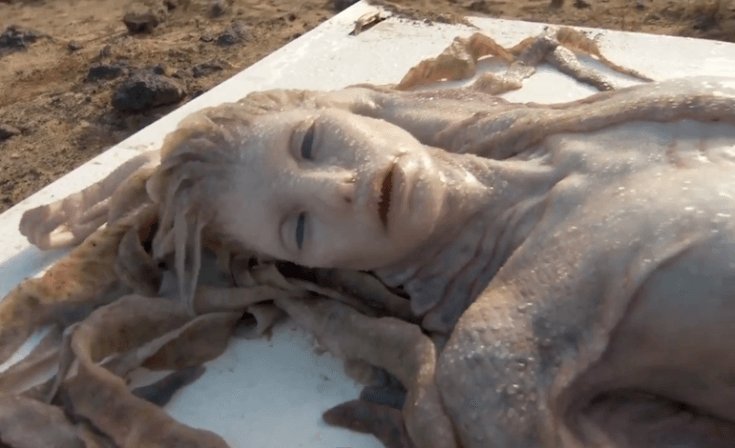
Then there was the infamous Animal Planet mockumentary, “Mermaids: The Body Found.” The film, presented as a serious documentary, used CGI and actors to tell the story of scientists discovering the remains of an unknown aquatic hominid. It was a hoax. A piece of fiction. But it was so convincing that it caused a massive public outcry, with millions believing it was real. The U.S. National Oceanic and Atmospheric Administration (NOAA) had to issue an official statement declaring that “no evidence of aquatic humanoids has ever been found.”

Why did so many people believe it? Because it tapped into that same ancient, global memory. It presented a scientifically plausible creature that aligns with the Aquatic Ape Theory. It felt… right.

The Unseen Kingdom

Skeptics always ask the same question: “If they’re real, why haven’t we found a body?”

It’s a fair question. Until you look at a globe.

Over 70% of our planet is covered by water. The average depth of the ocean is 2.3 miles. We have better maps of the surface of Mars than we do of our own seafloor. The pressures in the deep ocean are so extreme they would crush a human like a soda can. It is a vast, dark, three-dimensional world of canyons, volcanoes, and mountain ranges we have barely begun to probe.

It’s the perfect place to hide.

Anything that dies in the deep ocean is quickly consumed by scavengers or pulverized by the immense pressure. Finding a “mermaid” body would be harder than finding a specific needle in a continent-sized haystack made of needles.

And maybe, just maybe, there’s another reason we haven’t found them. Maybe they are intelligent. If an aquatic humanoid species existed, and they had watched from the depths as we dump our plastic, spill our oil, and drag nets across their homes, would they want to be found? Or would they use their superior knowledge of the ocean’s currents, caves, and abysses to actively avoid the noisy, destructive apes on the surface?

They wouldn’t be mythical creatures. They would be refugees, hiding from the most dangerous predator the planet has ever known. Us.

The Whisper on the Waves

The evidence is circumstantial. A thread of myth here, a biological anomaly there. A strange journal entry, a blurry video.

It’s easy to dismiss. It’s comfortable to dismiss. It’s much simpler to believe that every culture on Earth spontaneously invented the same creature, that seasoned sailors mistook fat sea cows for women, and that all the bizarre quirks of human anatomy are just happy accidents.

That’s the simple answer. But since when is the truth ever simple?

The story of the mermaid is not just one story. It is a thousand stories, from a thousand different shores, all pointing to the same impossible conclusion. It is a question whispered on the tide, a memory that lives in our DNA.

The next time you stand at the edge of the ocean, looking out at the endless, churning blue, listen. Listen past the crash of the surf and the cry of the gulls. You might just hear an echo of that ancient, heartbreaking song. A call from our long-lost cousins, waiting in the deep.

Originally posted 2016-02-17 20:28:03. Republished by Blog Post Promoter