Home Weird World Space NASA’s WISE Telescope Reveals Millions Of Black Holes

NASA’s WISE Telescope Reveals Millions Of Black Holes

0
63

The Cosmic Census That Changed Everything: How NASA Found Millions of Hidden Monsters

Let’s talk about the dark. The real dark. Not the kind you find by flipping a light switch, but the deep, unending blackness between the stars. For centuries, we stared into that void and thought we had a pretty good handle on what was out there. We saw stars. Galaxies. Nebulae. We mapped them. We named them. We felt comfortable.

We were wrong.

So profoundly, terrifyingly wrong.

Because hiding in plain sight, shrouded by cosmic dust and screaming in a language our eyes could never understand, were monsters. Millions of them. Voracious, city-sized objects with the gravity of a billion suns, tearing entire solar systems apart. And we were completely blind to them. Until one mission, one incredible piece of technology, gave us a new set of eyes and revealed a universe far more crowded, chaotic, and violent than we had ever dared to imagine.

This isn’t a sci-fi script. This is the story of NASA’s WISE telescope and the moment it pulled back the curtain on the cosmic horror show we call our universe.

A Telescope That Sees Heat, Not Light

You can’t see a black hole. That’s kind of the point. It’s a region of spacetime so warped that nothing, not even light, can escape. So how do you find one? Let alone millions?

You don’t look for the hole. You look for the mess it’s making.

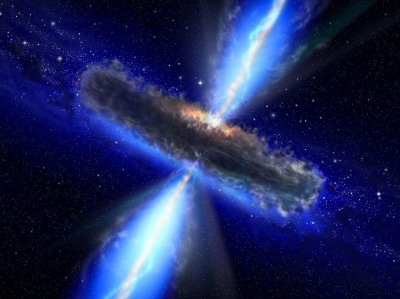
Imagine a tornado tearing through a town at night. You can’t see the vortex itself, but you can see the dust, debris, and sparks being thrown out as it rips buildings apart. Astronomers hunt for black holes the same way. A supermassive black hole at the center of a galaxy isn’t just sitting there quietly. It’s a gravitational tyrant, pulling in colossal clouds of gas, dust, and entire stars. As this material gets sucked into the cosmic drain, it forms a spinning, white-hot disc around the black hole called an accretion disk.

This disk gets so incredibly hot—hotter than the surface of any star—that it blazes with energy. The problem? Much of this energy isn’t visible light. And worse, these galactic centers are often choked with thick, impenetrable clouds of cosmic dust. To a normal telescope like Hubble, it’s like trying to see a bonfire through a mile of thick fog. You see nothing.

But NASA had a trick up its sleeve. The Wide-field Infrared Survey Explorer, or WISE.

Launched in 2009, WISE wasn’t built to see starlight. It was built to see *heat*. It scanned the entire sky in infrared, a wavelength of light that is completely invisible to the human eye. To WISE, the heat signature from a blazing accretion disk could pass straight through those thick dust clouds like they were barely even there. It was the ultimate ghost-hunting machine for the cosmos, designed to see the invisible.

The 2012 Data Dump That Rewrote the Rules

From December 2009 to February 2011, WISE patiently scanned the heavens. It orbited the Earth, its sensitive infrared detectors chilled to fantastically low temperatures by a tank of frozen hydrogen. It took millions of pictures, creating the most comprehensive map of the infrared universe ever assembled. Then, its coolant ran out, its eyes warmed up, and the primary mission was over.

But the real work was just beginning.

In March 2012, NASA did something incredible. They took this monumental trove of data—this treasure map to a hidden universe—and released it to the public. Every astronomer, every researcher, every curious mind on the planet now had access to WISE’s vision.

And what they found was stunning.

A jackpot. That’s what the initial reports called it. They weren’t just finding a few new black holes. They were finding them everywhere. The data pointed to an estimated 2.5 million supermassive black holes actively feeding on gas and dust, objects known as quasars. And that was just in the first pass. Later analysis suggested there could be tens of millions more, lurking like cosmic predators in the dark.

Suddenly, the universe felt a lot more crowded. These weren’t small objects. These were the engines of galaxies, the anchors around which everything else revolved. And our census had been missing millions upon millions of them.

Deep Dive: What Exactly is a Supermassive Black Hole?

Let’s get one thing straight. The black holes WISE was finding are not the kind that form when a single star dies. Those are “stellar-mass” black holes, maybe 10 or 20 times the mass of our sun. They’re dangerous, for sure, but they’re poodles compared to the beasts WISE uncovered.

Supermassive black holes (SMBHs) are a completely different class of monster. They are millions, sometimes even *billions*, of times more massive than our sun. We believe one sits at the heart of nearly every large galaxy, including our own Milky Way. Ours is called Sagittarius A*, a gentle giant (for now) about 4 million times the mass of the sun.

Where do they come from? That is one of the biggest and most unsettling questions in all of astrophysics. The theories are wild.

  • The Primordial Seed Theory: Did they form from the direct collapse of gigantic gas clouds in the very early universe, just moments after the Big Bang?
  • The Runaway Merger Theory: Did they start small and just grow over billions of years, gobbling up stars and merging with other black holes in a relentless cycle of cosmic cannibalism?
  • The Exotic Matter Theory: Could they be something else entirely? Remnants of a type of physics we don’t yet understand?

Scientists just don’t know for sure. It’s a huge, gaping hole in our understanding of the universe. Finding millions more of them with WISE didn’t answer the question. It just made it bigger.

The Cosmic Cover-Up: Why Were They Hidden?

So if there are millions of these things out there, blazing with the energy of a trillion stars, how did we miss them for so long? Was it a cover-up? In a way, yes. A cosmic one.

The universe is a dusty place. The space between stars isn’t empty; it’s filled with vast, swirling clouds of gas and microscopic dust grains. These clouds act like a thick, cosmic fog. When a supermassive black hole is in its most active, violent feeding phase, it often exists in a galaxy that is also bursting with star formation—a place thick with this exact kind of dust.

The dust forms a doughnut-shaped structure, a “torus,” around the black hole’s accretion disk, shrouding it from view. Our powerful visible-light telescopes would peer at these galaxies and see… nothing special. Just a cloudy, fuzzy galaxy.

But WISE’s infrared vision changed the game. The heat from the trapped quasar warms up the surrounding dust, causing the entire shroud to glow in infrared light. WISE could see this glow. It was the ultimate tell. It was like seeing a house at night with all the curtains drawn, but noticing the windows were glowing red-hot. You might not see the fire inside, but you know it’s there.

This discovery was a revelation. The monsters weren’t hiding in some far-off corner of the universe. They were right there, hiding in plain sight, concealed by a veil of dust we simply couldn’t pierce before.

The Shocking Implications: A More Violent Universe

Okay, so we found a bunch of hidden black holes. So what? What does this actually change?

Everything.

This discovery fundamentally altered our models of how galaxies evolve. Before WISE, the number of observed, energetic quasars didn’t quite match what our theories predicted. There was a mismatch. WISE found the missing population, proving that the universe, especially in its youth, was a far more violent and chaotic place than we’d been able to see.

It means galactic collisions were more common. It means these feeding frenzies, where a black hole consumes hundreds of stars’ worth of material every year, were a standard part of galactic life. Our own Milky Way likely went through such a phase, its central black hole lighting up the cosmos as a brilliant quasar before it settled down into its current, quiet state.

It paints a picture of a universe built on destruction. For a galaxy like ours to exist, its central engine had to go on a rampage, clearing out the neighborhood and shaping the very structure of the spiral arms we see today. The universe is not a peaceful, serene expanse. It’s a cosmic demolition derby, and WISE gave us a ringside seat.

Modern Echoes: The Legacy of WISE

The original post you read was from years ago, a snapshot in time from when this discovery was fresh. But the story of WISE didn’t end in 2012. It was just getting started.

The telescope, after its primary mission ended, was reactivated in 2013 with a new name: NEOWISE. Its new job was to use its infrared senses to hunt for near-Earth objects—asteroids and comets that could pose a threat to our planet. It’s been a silent guardian, mapping the space in our own cosmic backyard ever since.

But the original data? The all-sky survey? Astronomers are *still* mining it for secrets.

With the advent of modern AI and machine learning, scientists are now able to sift through the WISE catalog in ways they couldn’t a decade ago. Algorithms can spot patterns human eyes would miss, pulling out faint signals of strange objects from the cosmic noise. They are the new digital archaeologists of the cosmos, and the WISE data is their endless excavation site.

The Successor: James Webb’s Deep Gaze

Today, the spirit of WISE lives on in the James Webb Space Telescope (JWST). Webb is the next generation of infrared astronomy, a hundred times more powerful than its predecessors. It’s taking the map WISE created and zooming in on the most interesting spots. Where WISE saw a glowing smudge, Webb sees the fine details of the accretion disk and the jets of matter being blasted out at near the speed of light.

JWST is already using its incredible power to confirm and expand on WISE’s findings, spotting some of the earliest and most distant supermassive black holes ever. These are black holes that existed when the universe was just a baby, a few hundred million years old. How did they get so big, so fast? It’s a mystery that started with WISE’s census and now continues with Webb’s deep stare into the dawn of time.

The Lingering Questions & The Conspiracy Corner

So, we found the missing monsters. Case closed, right?

Not even close.

The WISE data didn’t just provide answers; it unleashed a flood of new, more unsettling questions. If millions of supermassive black holes could hide so effectively, what *else* is out there that we’re missing? What other classes of objects are lurking behind curtains of dust, operating on principles of physics we can’t yet see?

This is where things get really interesting for those of us who look at the fringes. Some on the internet have taken this discovery to a whole new level. If mainstream science could be blind to millions of galaxy-anchoring behemoths, what else are they not telling us? Or what else do they simply not know?

The search for the hypothetical “Planet 9” in our own solar system heavily relies on sifting through WISE data, looking for the faint thermal signature of a large planet far beyond Neptune. Could this hidden world be related to other unseen phenomena? Probably not, but it shows how much mystery might be hiding in data we already have.

The WISE discovery blew the door wide open. It proved that our perception of the universe is fundamentally incomplete. We are standing in a dark room, and WISE was like a single flash of an infrared camera. It gave us a breathtaking, terrifying snapshot. But it was just one picture.

The darkness is still there. The silence is still vast. And the census of what lies within it has only just begun. The cosmic dark is not empty. It’s just very, very good at keeping its secrets.

Originally posted 2016-03-27 20:27:52. Republished by Blog Post Promoter