The Door to Hell: The Truth Behind a 50-Year-Old Soviet Fire That Won’t Go Out
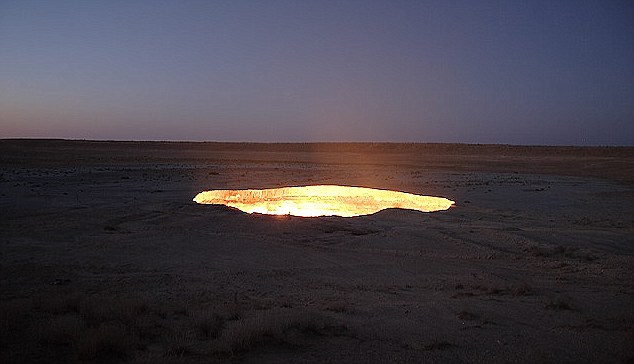
Picture this. You’re in the middle of nowhere. A vast, empty desert stretches in every direction, the silence broken only by the wind. But as night falls, a strange glow appears on the horizon. Not the gentle lights of a distant town. This is a pulsing, angry, orange glare. A fire. A colossal fire.
You get closer. The glow becomes a roar. The ground trembles. And then you see it.
A crater. A gigantic, gaping wound in the Earth, nearly the size of a football field, filled with thousands of writhing, dancing flames. It’s an inferno. A scene ripped straight from a blockbuster disaster movie or a biblical nightmare. But this is real.
For decades, locals in the remote nation of Turkmenistan have called it “The Door to Hell.” And for good reason. It’s been burning for over half a century. Non-stop. A perpetual firestorm in the heart of the Karakum Desert.
The official story is a tidy tale of a scientific blunder. But is it the whole story? Or is this burning abyss a monument to something far stranger? A secret covered up by the Soviets? A mystery that even today, we haven’t fully grasped?
Forget what you think you know. We’re going deep into the fiery heart of the Darvaza Gas Crater.
What Really Happened in 1971? The Official Story
To understand the fire, you have to understand the time. The year was 1971. The Cold War was raging. The Soviet Union, a sprawling empire of secrets and ambition, was locked in a desperate race for resources. Oil and natural gas were the lifeblood of industry and power, and Soviet geologists were sent to every forgotten corner of their vast territory to find them.
One such corner was the Karakum Desert in the Turkmen Soviet Socialist Republic. It’s a harsh, unforgiving place. One of the driest deserts on Earth. But beneath the endless dunes, the Soviets believed, lay a treasure trove of natural gas.
So they set up a rig. A team of engineers and scientists began drilling, punching a hole deep into the desert floor. They hit a pocket of gas, just as they’d hoped. But then, disaster.
The ground beneath the heavy drilling equipment was not solid rock. It was a fragile ceiling of earth above a massive, cavernous pocket of methane. The rig’s weight was too much. The ground groaned, cracked, and then collapsed entirely, swallowing the entire drilling rig and camp in a cataclysmic sinkhole. Miraculously, no one was reported killed in the collapse.
But the team now had a much bigger problem. The crater, about 70 meters (230 feet) wide and 30 meters (100 feet) deep, was now a massive leak. It was spewing colossal amounts of raw, poisonous methane gas into the atmosphere. This was an environmental disaster in the making, and a direct threat to any person or animal for miles around.
The ‘Simple’ Solution That Backfired Spectacularly
The Soviet scientists huddled. They had to stop the gas. But how? Capping a leak this massive and unstable was impossible. So they fell back on a simple, almost primal solution.
Fire.
Their logic seemed sound, at least on paper. Methane is flammable. If they lit the gas leaking from the crater, it would burn off safely. They estimated the entire gas pocket would be incinerated within a few weeks. Maybe a month, tops. Then, the fire would die out, the problem would be solved, and they could all go home. A quick, clean fix.
So, one of them, presumably with a very long match, tossed something into the crater. It ignited with a deafening *WHOOMPH*. A column of fire roared into the sky.
The geologists packed up, satisfied. Job done.
They could not have been more wrong.
The weeks turned into months. The months turned into years. The years bled into decades. The fire never went out. They had massively, catastrophically underestimated the sheer volume of gas lurking beneath the Karakum. They hadn’t just lit a bonfire; they had opened a valve to a seemingly endless reservoir of fuel deep within the planet. They had created a monster.
Inside the Inferno: What Did We Find at the Bottom?
For decades, the crater burned in obscurity, a state secret hidden in a closed-off corner of the Soviet empire. After the USSR collapsed and Turkmenistan gained independence, word of the burning pit began to spread, becoming a piece of modern folklore. But no one had ever dared to venture inside.
Who would? The heat at the rim is unbearable. The air shimmers. The roar of a thousand fires is a constant, deafening assault. It seems like a place hostile to all life.
That was, until 2013.
Enter George Kourounis. A Canadian explorer and storm-chaser, a man who makes a living by going to the most extreme places on Earth. He looked at the Door to Hell and saw not an obstacle, but the ultimate challenge. He would be the first human to ever set foot on the bottom.
A Descent Into Hell
His expedition was a thing of scientific legend. Kourounis, clad in a special heat-reflective suit made of Kevlar and breathing from a self-contained air supply, was lowered by a complex system of ropes and pulleys into the heart of the inferno. Dangling over a sea of flames, he slowly descended into the crater.
He described the experience as being on another planet. The landscape was alien. The sound was overwhelming. The heat was immense. But he wasn’t there just for the thrill. He was on a scientific mission.
His goal? To scoop up soil samples from the crater floor. The big question was: could anything possibly live in a place like this? An environment with scorching temperatures and a toxic, methane-rich atmosphere? Scientists were hunting for “extremophiles”—microscopic organisms that thrive in conditions that would kill any other living thing. Finding them here could have massive implications for our understanding of life, not just on Earth, but potentially on other hostile planets across the universe.
And he found them. The soil samples he brought back to the surface were teeming with bizarre, previously unknown strains of bacteria. Life. Stubborn, resilient life, was flourishing at the literal Door to Hell. The crater wasn’t just a symbol of destruction; it was a bizarre, self-contained ecosystem.
The Conspiracy Corner: Was It *Really* an Accident?
The official story is neat. It’s tidy. A classic tale of human hubris and unintended consequences. But for a mystery this spectacular, a simple explanation just doesn’t sit right with many people. The internet is buzzing with alternative theories. The lack of detailed Soviet records from the time only adds fuel to the fire. Literally.
So, let’s put on our tinfoil hats and ask the question: What if 1971 wasn’t a simple drilling accident?
Theory 1: A Secret Soviet Weapons Test?
Think about the secrecy of the Soviet military-industrial complex. They conducted countless secret tests in the most remote parts of their territory. Could the Darvaza site have been something more than a simple gas field? Some theorists suggest it was an attempt to test a new kind of subterranean weapon, or perhaps an experiment in creating a massive fuel-air bomb that went horribly wrong. A catastrophic collapse and a perpetual fire would be an excellent reason to classify the project, bury the records, and cook up a simple cover story about clumsy geologists.
Theory 2: Hiding Something Bigger?
This theory flips the official story on its head. What if the crater wasn’t created by the drilling, but the drilling *discovered* the crater? What if the Soviets punched their drill into a massive, pre-existing underground cavern system? The collapse could have been much more significant than reported. Maybe they weren’t just drilling for gas. Some online forums whisper about searches for exotic minerals or even an underground base. Setting the gas leak on fire becomes less about a cleanup operation and more about a “scorched earth” policy—a desperate attempt to make the site inaccessible and hide whatever they uncovered.
Theory 3: The Ancient Legends
This one goes deeper into the strange. Local folklore in the region has long spoken of spirits and strange phenomena in the desert. Is it possible this place has always been considered… special? Some have suggested the crater is a natural phenomenon, a “burning mountain” or eternal flame that has existed for centuries. In this version of the story, the Soviets simply stumbled upon it. Not wanting to look scientifically backwards or admit to a natural wonder they couldn’t explain, they fabricated the 1971 accident story to claim it as their own creation, a controllable industrial event rather than a powerful and mysterious force of nature.
From Soviet Secret to Bizarre Tourist Trap
Whatever its true origin, after the fall of the Soviet Union, the Door to Hell’s reputation began to grow. What was once a symbol of industrial failure and a closely guarded secret became Turkmenistan’s most famous, albeit bizarre, tourist attraction. In a country that is notoriously difficult for outsiders to visit, the burning crater became a must-see for adventurous travelers.
The journey itself is part of the allure. A grueling off-road trek through the bleak, featureless Karakum Desert. There are no signs. No gift shops. No guard rails. Just you, the vast emptiness, and a growing orange stain in the night sky. Campers set up their tents a safe distance away, watching the hellish spectacle unfold under a canopy of brilliant desert stars. It’s a primal, unforgettable experience.
The President’s Command: Extinguish the Flames?
For decades, the crater burned. A weird, fiery constant in a changing world. But its future is now uncertain.
In early 2022, Turkmenistan’s president, Gurbanguly Berdymukhamedov, appeared on state television and officially ordered his government to find a way to extinguish the fire. The Door to Hell, he declared, must be closed.
His reasons were starkly practical:
- Environmental Damage: The crater is a climate catastrophe in a single location. It burns an unimaginable amount of methane, a potent greenhouse gas, every single day.
- Wasted Resources: Turkmenistan sits on one of the world’s largest reserves of natural gas. The crater is essentially a massive, open pipe, wasting billions of dollars’ worth of a valuable resource that could be captured and sold.
- Public Health: While the area is sparsely populated, the constant emission of gas and other byproducts is a health concern for those living in the region.
But how do you kill a fire that has raged for half a century? How do you put out hell itself? The challenge is monumental. Experts have proposed various high-risk solutions, from drilling a relief well to divert the gas flow to trying to snuff the fire out with a massive explosion, a technique used on oil well fires. So far, no plan has been put into action. The fiery pit defies a simple solution, just as it did in 1971.
A Burning Question: What is the Crater’s True Legacy?
The Door to Hell is so much more than a hole in the ground. It is a monument to a collision of worlds. A story of Soviet ambition crashing into the raw, unpredictable power of nature. It’s a scientific laboratory hiding clues to life on other planets. It’s a modern-day campfire for conspiracy theorists, its flames fanned by a lack of facts and a hunger for a story bigger than the one we’ve been told.
Today, it stands as a terrifying symbol of an environmental disaster and, simultaneously, a breathtaking spectacle of terrible beauty. A warning. A wonder.
The question now is whether its time is running out. Will humanity finally succeed in closing the door it so carelessly opened all those years ago? Or will the crater resist, continuing to burn through this century as it did the last? A fiery, defiant scar on the face of the planet, forever guarding the secrets blazing in its depths.