The Curse of Dudleytown: Inside Connecticut’s Village of the Damned
They say some places are born bad. A wound on the landscape that never heals. Deep in the forested hills of Connecticut, there’s a place like that. An empty space where a town used to be.
They call it Dudleytown.
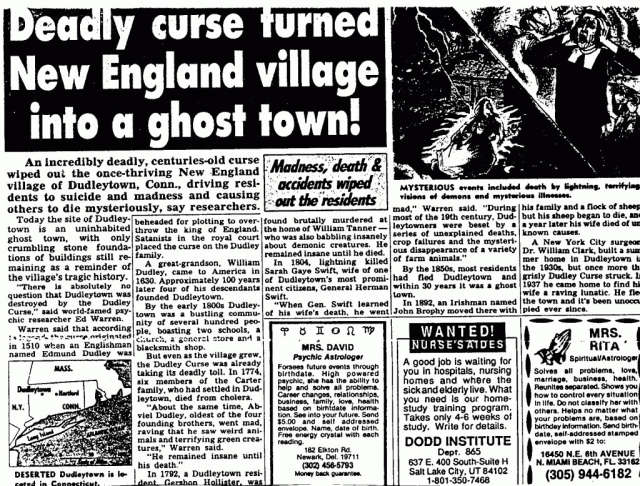
It’s not on any modern map. You can’t drive there. The roads that once led to it have been swallowed by the forest, and the people who own the land now guard it with an almost desperate ferocity. State Police issue hefty fines to anyone caught trespassing. Why? What are they so afraid of people finding in those silent, brooding woods?
The stories say the ground itself is sour. Cursed. They whisper of a royal execution, a blood curse that crossed an ocean, and a history of madness, suicide, and inexplicable vanishings that stained this small patch of New England soil. It’s a ghost town, yes. But some tales claim the residents never truly left. They’re just… waiting.

A Grudge Forged in Royal Blood
To understand the shadow that hangs over Dudleytown, you have to travel back in time. Back across the Atlantic. Back to the treacherous, back-stabbing world of 15th-century England and the court of King Henry VII.
This is where our story begins. With a man named Edmund Dudley.
Edmund was no peasant. He was a nobleman, a brilliant lawyer, and a key advisor to the king. He was powerful. He was feared. Along with his partner, Richard Empson, he was one of the king’s chief tax collectors, and they were notoriously ruthless. They squeezed every last penny from the English aristocracy, filling the king’s coffers and making a legion of powerful enemies in the process.
Deep Dive: The Fall of a King’s Man
When King Henry VII died in 1509, his young, ambitious son took the throne as Henry VIII. The new king needed to win over the nobles his father had alienated. What better way than to offer them a sacrifice? Edmund Dudley and Richard Empson were the perfect targets. They were arrested on trumped-up charges of “constructive treason”—a vague accusation that basically meant they had plotted against the king. It was a political hit job, plain and simple. Despite a weak case, they were convicted.
On August 17, 1510, Edmund Dudley was led to a scaffold on Tower Hill. The axe fell. His head was separated from his body. And it’s here, in this moment of bloody political theater, that the legend says a curse was born. A curse on the Dudley name. A curse that would ripple through generations, waiting for a place to fester.
Did the curse continue in England? You could make a case. Edmund’s own son, John Dudley, rose to become the Duke of Northumberland and the most powerful man in England under the young King Edward VI. But his ambition was his undoing. He tried to place his daughter-in-law, Lady Jane Grey, on the throne instead of Mary Tudor. The plan failed spectacularly. Lady Jane, the “Nine Days’ Queen,” was executed. And soon after, John Dudley followed his father to the executioner’s block. Two generations. Two beheadings. Coincidence? Or the first bitter fruits of a family curse?
The Curse Finds a New Home
Centuries passed. The Dudley family spread, and like so many others, some sought a new life in the American colonies. In the 1740s, several Dudley brothers—Abiel, Barzillai, and Gideon among them—found their way to a remote, hilly plateau in northwestern Connecticut. Along with a few other families, they began to carve a settlement out of the unforgiving wilderness. They called it Dudleytown.
It was a brutal existence. The land was not kind. The soil was thin and rocky, terrible for farming. The hills made travel and trade a nightmare. The water source was reportedly poor. From a purely logical standpoint, the town was doomed from the start. It was built in the wrong place.
But the legend offers a more sinister explanation. Maybe the land wasn’t just difficult. Maybe it was *wrong*. Some modern paranormal theories suggest the curse on the Dudley bloodline didn’t just follow them; it was *attracted* to this specific location, a place that already held its own dark energy. A place where the veil between worlds was thin. A perfect breeding ground for misery.
A Timeline of Unraveling Horror
The town never thrived. But its failure was more than just economic. It was a slow, agonizing decay punctuated by moments of shocking violence, madness, and death. The curse, it seemed, had taken root.
The First Cracks Appear
The trouble started early. One of the founding brothers, Abiel Dudley, is said to have lost his mind. He squandered his family’s entire fortune on bizarre, fruitless schemes, eventually descending into complete dementia. In the 18th century, “madness” was a terrifying and mysterious affliction. Was it just illness? Or was something in the woods whispering in his ear?
Then came the strange, violent deaths. At a barn raising—a communal, celebratory event—a man named Gershon Hollister simply fell from a beam and was killed. A tragic accident, surely. But in a town growing ever more superstitious, it felt like an omen. Another man, a military officer named General Herman Swift, was married to a Dudley woman. His wife was struck and killed by lightning on their porch during a freak storm in 1804. An act of God? Or a targeted strike from a malevolent force?

Visions of Demons and the Noose
As the 19th century wore on, the town’s population dwindled. The families that remained seemed to suffer the most. The story of Mary Cheney, wife of Horace Greeley, is often tied to the town. Plagued by depression, she took her own life in 1872. While her connection to actually living in Dudleytown is heavily disputed, her tragedy became woven into the town’s dark fabric.
A more chilling and direct account is that of Harriet Clarke. After moving to Dudleytown with her husband, she fell into a deep, terrifying madness. She told her horrified family that she was seeing things. Visions. Demons and dark creatures that came out of the surrounding woods at night. Her sanity shredded, she hanged herself. What did she see? Was it merely the tragic hallucination of a troubled mind, or did she catch a glimpse of what truly lived in the dark entry forest?
The Final Family: A Cascade of Calamity
By the end of the Civil War, Dudleytown was all but empty. The rocky farms were abandoned. The houses were falling into ruin. Everyone with any sense had left for greener pastures and easier lives in the valleys below.
Everyone except John Brophy.
For some reason, he and his family stayed. It was a decision that would obliterate them. In a terrifyingly short span of time, Brophy’s life disintegrated. First, his wife died of consumption. A common enough tragedy for the time. But what happened next was not. Shortly after the funeral, his two young children walked into the woods. And never came back. A frantic search found nothing. They had simply vanished from the face of the earth.
Grief-stricken and alone, John Brophy’s nightmare wasn’t over. One night, his farmhouse mysteriously caught fire and burned to the ground. After that, John Brophy himself disappeared. Some say he went looking for his children. Others say he simply walked into the woods and let the darkness take him. No one ever saw him again.
The Modern Haunting of Dudleytown
The town was dead. But the story was not.
In the early 20th century, a New York physician named Dr. William Clarke—no relation to the tragic Harriet—began buying up the abandoned land. He and his wife fell in love with the secluded, rustic beauty of the area. They built a summer home there. According to the legend, the curse was waiting for them. The story goes that Dr. Clarke returned from a trip to New York to find his wife completely insane, ranting about inhuman things in the forest, whispering voices, and shadowy figures among the trees. She soon took her own life.
Dr. Clarke, however, was not deterred. He later remarried and, along with several friends, formed the “Dark Entry Forest Association” in 1924. Their stated mission was conservation—to buy up the land and preserve it as a pristine nature sanctuary. A noble goal. But the name itself, “Dark Entry,” only fueled the sinister reputation of the place.
The Warrens Weigh In
The legend of Dudleytown might have remained a local ghost story if not for two people: Ed and Lorraine Warren. The famous (or infamous, depending on your view) paranormal investigators visited the site in the 1970s. Their verdict was chilling. They declared the area a case of “demonic possession.” Not a haunting of human spirits, but something older, darker, and profoundly malevolent. They claimed the entity or entities there fed on the negative energy of the tragedies, growing stronger with each death and each moment of despair.
The Warrens’ investigation, complete with alleged audio recordings of inhuman growls and photos of strange light “orbs,” launched Dudleytown into the national consciousness. It was no longer just a ghost town. It was a certified paranormal hotspot.
The Skeptic’s Corner: Unraveling the Legend
So, is Dudleytown truly a portal to hell located in the Litchfield Hills? Or is there a more rational explanation?
Plenty of researchers say yes. The most prominent debunker is Rev. Gary P. Dudley, a genealogist who literally wrote the book on the town’s history. He argues that the entire “curse” is a modern invention, a campfire story that got out of control.
Here’s the breakdown:
- The “Curse”: Rev. Dudley found no direct genealogical link between the Connecticut Dudleys and the beheaded Edmund Dudley. They were likely from a completely different branch of the family. The entire foundation of the curse is, he claims, historically baseless.
- The Deaths and Madness: Life in the 18th and 19th centuries was brutal. Diphtheria, cholera, and consumption swept through communities. Suicides were tragic but not unheard of. “Insanity” could have been anything from clinical depression to late-stage syphilis, or even lead poisoning from pewter plates and contaminated well water.
- The Abandonment: Dudleytown didn’t die because of demons. It died because of economics. The soil was terrible. The industrial revolution was booming in the valleys below, offering jobs and easier lives. The town failed because it was a poor location for a settlement, simple as that.
- The Warrens’ Evidence: Critics point out that “orbs” in photos are often easily explained as dust particles, moisture, or lens flare. Audio recordings can be interpreted in countless ways. The Warrens were, at the end of the day, showmen who profited from these stories.
An Unsettling Silence
The skeptics make a compelling case. A very logical one. But it doesn’t quite explain everything. It doesn’t explain the sheer volume of stories. It doesn’t explain the intense, oppressive feeling that so many modern-day trespassers report—a sense of being watched, of profound dread, of equipment batteries draining in an instant.
And most of all, it doesn’t explain the secrecy.
Today, the Dark Entry Forest Association still owns the land. They aggressively prosecute trespassers. Signs are posted everywhere. The police patrol the perimeter. Why go to such extreme lengths to protect a few stone foundations and an old cellar hole? Are they simply protecting their private property and a fragile ecosystem from ghost hunters and vandals?
Or are they hiding something? Are they caretakers, not of a forest, but of a prison? Maybe the reason they don’t want anyone going into Dudleytown isn’t to protect the forest from us. Maybe it’s to protect us from the forest.
The debate rages on in internet forums and late-night paranormal shows. Is it a cursed patch of land, saturated with centuries of pain? Or is it just a failed colonial town whose story has been twisted into America’s most terrifying ghost story? The truth remains buried, deep in the silent, forbidden woods of Dudleytown.
Originally posted 2016-07-06 22:01:47. Republished by Blog Post Promoter