
Wednesday, May 6, 2026
HomeWeird WorldThe FutureThe City Under the Sea?

The City Under the Sea?

The City Under the Sea?When Will We Finally Live in the Underwater City?

Look at the ocean. Really look at it. It is a massive, shifting blue blanket that covers seventy percent of our planet, yet we treat it like a stranger. We have mapped the surface of Mars with better precision than our own ocean floors. Why? The sea presented early humans with a vast, terrifying black box. What worlds and fabulous creatures exist in the deep? Giants? Gods? Monsters?

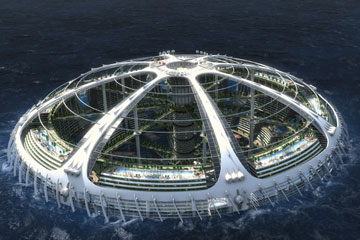
Today, the textbooks tell us our understanding has expanded. They show us diagrams of currents and lists of fish species. But don’t be fooled. The world’s waters still offer us an abundance of mystery and awe that science hasn’t even begun to scratch. We dream less about mermaid city and sunken Atlantis now. We’ve traded magic for mechanics. Instead, we imagine underwater metropolises and seafloor colonies. Glass domes. Neon lights cutting through the murky depths. A life where your morning commute involves a submarine.

But where is it?

We were promised this future. It’s been decades. Where are the bubble cities? Where are the aquatic highways? To understand why we are still stuck on dry land, we have to go back. We have to look at the moment humanity almost took the plunge, and then… stopped.

The Golden Age of the Aquanaut

The zeal was especially strong in the late 1950s and early 1960s. It was a different time. A time of cowboys and astronauts. But while the eyes of the world were turning toward the stars, a small, brave group of pioneers looked down. This was the era of Jacques Cousteau’s Conshelf project and the United States Navy’s Sealab. These weren’t just experiments. They were the first steps in a colonization effort. They saw the dream of undersea living realized.

Imagine the guts it took. Through three stages of field tests on the ocean floor, both programs proved that humans can live and work for extended periods of time underwater. It wasn’t sci-fi. It was happening. Real people. Real danger.

The test subjects weren’t just sitting around. They tended underwater gardens. They tackled underwater construction projects. They lived the life of an aquanaut. They proved that the human body could withstand the crushing pressure if you just gave it the right mixture of gases. They became something else. Something new.

Conshelf: The Village on the Ocean Floor

Cousteau, the man in the red beanie, was obsessed. In 1962, he launched Conshelf I. Two men lived in a steel cylinder 33 feet down for a week. They played chess. They listened to the radio. It sounds boring, right? It was revolutionary. Then came Conshelf II in the Red Sea. This wasn’t a tube. It was a village. A garage for a diving saucer. A main house. Even an underwater shed for tools. Five men lived there for a month without surfacing. It was a triumph.

They showed us that we didn’t have to be visitors. We could be residents.

Sealab: The Navy Gets Involved

Then the US Navy stepped in. The Cold War was freezing over, and the military wanted the high ground—or in this case, the low ground. Sealab I dropped off the coast of Bermuda in 1964. Four divers stayed down for 11 days at 192 feet. The water was warm. The vibe was good.

But Sealab II? That was a beast. They dropped it off the coast of La Jolla, California. The water was freezing. It was pitch black. It was miserable. Yet, they stayed. Astronaut Scott Carpenter spent 30 days down there. He even spoke to President Lyndon B. Johnson from the bottom of the sea. But there was a catch. The helium in the air mixture made everyone sound like Donald Duck. The President could barely understand a word Carpenter said. It was funny, but it highlighted a dark truth: the environment was changing them.

The Great Abandonment: Why Did We Stop?

Half a century later, the under cities under the sea still aren’t here. We have iPhones. We have self-driving cars. We have rovers on Mars. But the ocean floor? Empty. A graveyard of abandoned dreams.

Sure, we have unrealized designs such as Giancarlo Zema’s semisubmerged Trilobis 65 dwelling. We have the glossy renderings of the proposed underwater Dubai skyscraper, Hydropolis. It looks amazing on a brochure. But let’s be real. There are very few underwater habitats actually functioning today. The bottom line is that while humans can live underwater, it’s not an easy or cheap life. It’s also not necessary. Or so they tell us.

Here is the official narrative: Money. It costs a fortune to keep people alive under 20 atmospheres of pressure. You have to scrub the CO2. You have to heat the habitat. You have to supply food. And the physiological toll is nasty. “Bone rot” (dysbaric osteonecrosis) is a real risk for saturation divers. Your bones literally start to die from the inside out.

But is that the whole story?

The Space Distraction

Think about the timing. Sealab III ended in disaster and death in 1969. Do you know what else happened in 1969? We walked on the moon. NASA sucked all the air out of the room. The funding shifted overnight. Why look at the mud at the bottom of the ocean when you can look at the stars? Space was sexy. The ocean was dark, wet, and scary.

But conspiracy theorists have been buzzing about this for years. Did we find something down there? Did the navies of the world realize that the ocean floor wasn’t as empty as they thought? Some speculate that the rush to space was a distraction. A way to keep the public’s eyes looking up, while the real action—military bases, secret testing, maybe even recovery of ancient tech—was happening deep below the waves.

The Modern Reality: Robots Over People

Circumstances haven’t forced humans to consider underwater living seriously. We aren’t out of land yet. And when it comes to oceanic exploration, the human element has been removed. Unmanned submersibles and automated seafloor stations offer a better value proposition. They don’t need to breathe. They don’t get cold. They don’t go crazy from isolation.

The National Science Foundation’s Ocean Observatories Initiative, for example, calls for a worldwide network of automated observation stations and autonomous underwater vehicles. A web of sensors. Watching. Listening. Recording.

It makes sense on a spreadsheet. But it lacks soul. A robot cannot feel the awe of a bioluminescent jelly drifting past the viewport. A robot cannot feel the terrifying squeeze of the deep.

The Darker Theories: What Are They Hiding?

Let’s take off the “logical” hat for a second and look at the weird stuff. The internet is on fire with theories about why we aren’t colonizing the ocean. Have you heard of the Baltic Sea Anomaly? A massive, disc-shaped object found on the sea floor that looks suspiciously like the Millennium Falcon. Electronic equipment fails when divers get close to it. The official explanation? Glacial deposit. The alternative? Crashed craft.

And then there are the USOs. Unidentified Submersible Objects. The US Navy recently released videos of “UAPs” (UFOs) that don’t just fly; they dive. They hit the water at hundreds of miles per hour and don’t break up. They travel underwater at speeds that should be physically impossible due to drag. If there is something down there—something faster and more advanced than us—maybe that’s why we aren’t building condos in the Mariana Trench. Maybe the neighborhood is already taken.

The Billionaire Bunkers

While the public is told that underwater living is “too hard,” the ultra-elite are quietly testing the waters. There are whispers of luxury survival bunkers being designed not for underground, but for underwater. If the surface becomes uninhabitable due to war or climate collapse, the bottom of the ocean is the safest place to be. Radiation can’t get you there. Pandemics can’t reach you.

There are hotels in the Maldives and Key West where you can sleep underwater—for a price that would bankrupt a normal family. These aren’t colonies; they are novelties. But they prove the tech exists. The acrylic is strong enough. The life support works. The only thing missing is the will to scale it up.

Will We Ever Go Back?

So, is the dream dead? Not entirely. The surface world is getting crowded. The weather is getting wilder. The seas are rising. It is a cruel irony that the very water threatening to swallow our coastal cities might eventually be our only refuge.

Japan is already thinking about it. The “Ocean Spiral” concept by Shimizu Corporation envisions a floating city that spirals down to the ocean floor, using the temperature difference in the water to generate energy. It’s a beautiful idea. Sustainable. Independent.

But until the pressure—literally and figuratively—forces us off the land, the underwater city remains a ghost story. A retro-future fantasy that we abandoned in favor of rockets and satellites. We stand on the beach and stare at the horizon, ignoring the massive, dark universe right beneath our toes. We are looking for life on Europa and Enceladus, searching for oceans on other moons, while we ignore the alien world in our own backyard.

Maybe one day, we will return. We will fix the rusting shells of Sealab. We will build the domes. And maybe, just maybe, we will finally meet whatever has been waiting for us down there in the dark.

Amit Ghosh
Amit Ghoshhttps://coolinterestingnews.com
Aloha, I'm Amit Ghosh, a web entrepreneur and avid blogger. Bitten by entrepreneurial bug, I got kicked out from college and ended up being millionaire and running a digital media company named Aeron7 headquartered at Lithuania.
RELATED ARTICLES
- Advertisment -

Most Popular

Recent Comments

Warren Pan Abbott on The legend of the Devil Monkey !
chris davies on The McPherson Tape Mystery
Reed Reedly on ET has Internet!
Bea Houseoffashion on Proof Of Time Travellers – Gallery
Marcus2012 on ET has Internet!
Reed Reedly on ET has Internet!
LaughsAtConspiracyNuts on The 9/11 Conspiracy – Myths and Facts
Alex Sliverman on Did the ancients fly?
Doctor Wholigan on Time Traveler in 1938 film
chris davies on The McPherson Tape Mystery
Archie1954 on 10 secret UFO hideouts
chris davies on Ghosts of flight 401
Marcus2012 on ET has Internet!
jason Macdonald on Proof of Time Travel? – China
chris davies on Long-Lost Pyramids Found?
Reed Reedly on ET has Internet!
Milkman on Connected Universe
Tenmiles on Baigong Pipes Mystery
Simon Foster on Sirius – The Documentary
From the 1st April on 2013 – Alien Contact date ?
SkyWatcher on Is ET ignoring us?
I Come From The Future on Obama to make UFO Alien disclouser soon ?
ÛñK?øWn on 2013 – Alien Contact date ?
Just another person on 2013 – Alien Contact date ?
Malcolm Windowcleaner on The strange case of Rudolph Fentz
Mason Servio on Strange Things on Mars
Marke Wisdom Seeker on What will we find as arctic melts?
Andrea A Elisabeth Levyne on Aliens Captured in Varginha, Brazil
Mitch Grouyeki on Amazing Space Shuttle pictures









