They tell you to keep your head down. Focus on your phone. Grind through the workday. But have you looked up lately? I mean, really looked up?
Something is happening in our skies. And the official story? It’s starting to crack.
If you check the textbooks, or listen to the drone of the evening news weather report, they have a name for it. They call it a halo. Sounds angelic, doesn’t it? Safe. Pretty. A “nimbus,” an “icebow,” or a “gloriole.” Science tells us it is nothing more than basic atmospheric optics. A trick of the light.
But ask yourself this: why are we seeing so many of them now? Why are they becoming so complex, so vivid, and frankly, so terrifyingly geometric? We aren’t just talking about a fuzzy ring around the moon anymore. We are talking about eyes in the sky. Massive, shifting crosses. Pillars of fire that look less like weather and more like an orbital laser weapon powering up.
Let’s rip the cover off this phenomenon. We are going to look at the physics, the history they don’t teach you in school, and the dark theories bubbling up from the corners of the internet that suggest these “ice crystals” might be evidence of something much bigger. Maybe it’s a simulation glitch. Maybe it’s geoengineering. Or maybe, just maybe, the sky has finally broken.
The “Official” Narrative: Just Ice and Geometry?
Before we go down the rabbit hole, we have to understand the mask they put on it. The standard definition goes like this: A halo is an optical phenomenon produced by light interacting with ice crystals suspended in the atmosphere. That’s the script.
According to mainstream meteorology, the upper atmosphere—specifically the troposphere, about 3 to 6 miles up—is a graveyard of frozen water. Cirrus or cirrostratus clouds drift there, carrying billions of tiny, hexagonal ice crystals. Not round droplets. Hexagons. Nature loves a hexagon, right? Or is that just the most efficient shape for a grid?
When sunlight or moonlight hits these floating prisms, it doesn’t just pass through. It bends. It refracts. It reflects. It bounces off the internal faces of the crystal like a laser in a hall of mirrors. Depending on how these crystals are tilted—randomly jumbled or perfectly aligned like soldiers—you get different shapes in the sky.
The 22° Halo: The Ring
This is the one you’ve probably seen. A perfect circle of light around the sun or moon. The science says this happens when light enters one side of a column-shaped crystal and exits another side, bending by exactly 22 degrees. It’s consistent. It’s mathematical. almost too mathematical.
Sun Dogs: The Mock Suns
Then you have the “parhelia,” or Sun Dogs. These are those bright spots of light that flank the sun on the left and right. Sometimes they are so bright they look like three suns rising at once. The explanation? Plate-shaped crystals, flat hexagons falling through the air like dinner plates, acting as side-mirrors for the sun.
But here is where it gets weird. For these to appear, the atmosphere has to be calm. Dead calm. The crystals have to align horizontally with near-perfect precision. If there is turbulence, the image breaks. Yet, we see these vivid, perfect alignments over chaotic, windy cities. How?
Diamond Dust: When the Sky Falls to Earth
Usually, this action happens miles above our heads. But in extreme cold, the show comes down to ground level. They call it diamond dust. It’s not snow. It’s a fog made of ice. Tiny, floating jewels right in front of your face.
When this happens, the light doesn’t just create rings. It creates pillars. Light Pillars. These are vertical columns of light that appear to shoot up from the ground into the heavens (or beam down from above). If you are driving at night and see these, your brain screams “Alien Abduction.” It looks like the transporter beam from Star Trek. It looks like the rapture.
Science says: “It’s just streetlights reflecting off flat ice crystals floating near the ground.”
Maybe. Or maybe it’s a convenient explanation for why the sky looks like a barcode scanner.
The Moscow Incident: A Glitch in the Matrix?
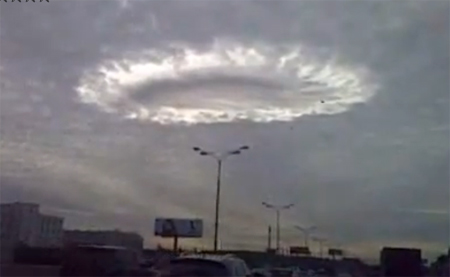
Take a look at that image above. That was snapped in Moscow. Does that look like “ice crystals” to you? Look at the structure. The density. The way it punches a hole through the cloud layer. It looks solid. It looks like a craft cloaked in vapor, or a portal ripping open.
When this footage first surfaced, people panicked. Obviously. It looks like Independence Day is starting. The local authorities scrambled to control the narrative. The meteorologist—the designated “expert” sent to calm the herd—dismissed any supernatural theory immediately. They labeled it “spectral effects.”
A spokesman for the city’s weather program gave a statement that felt rushed, almost clumsy. He said: “This is just an optical effect, although it looks very impressive. If you get closer you can see the rays of the sun wearing sun projection halo clouds. When observing clouds often, you’ll see several other strange phenomena clouds in the same floor but if seen in different areas will be completely different.”
Read that again. “Wearing sun projection halo clouds”? “In the same floor”? It’s word salad. It’s technobabble meant to bore you into submission. They want you to shrug and say, “Oh, just weather,” and go back to watching reality TV. But the visual evidence tells a different story. That isn’t a passive reflection. That is a luminous anomaly.
Ancient Omens: We Have Seen This Before
We are not the first people to look up and freak out. Our ancestors saw these things, but they didn’t have a “spokesman” to tell them it was just ice. They saw them for what they felt like: Messages.
History is littered with battles, religions, and empires that shifted because of a halo.
The Battle of Mortimer’s Cross (1461)
Picture the scene. The Wars of the Roses. A brutal civil war in England. The Yorkist army is terrified. Then, the sun rises. But it’s not one sun. It’s three. A massive Sun Dog display. The soldiers want to run. They think the world is ending.
But the future King Edward IV? He’s smart. He spins it. He tells his men the three suns represent the Holy Trinity—Father, Son, and Holy Ghost—and that God is on their side. They rally. They win. The course of English history changed because of some ice crystals.
Constantine’s Vision
Go back further. Rome. Emperor Constantine is marching to battle. He looks up and sees a “Cross of Light” in the sky above the sun. Most modern historians agree this was likely a rare halo display—probably intersecting arcs creating a cross shape. Constantine takes it as a sign from the Christian God. He paints the Chi-Rho symbol on his shields. He wins. The Roman Empire converts to Christianity. The entire Western world is reshaped. All because of atmospheric optics.
So, were they just superstitious primitives? or were they interpreting a technology we have forgotten how to read?
The Modern Conspiracy: Project Blue Beam and Geoengineering
Fast forward to today. The cameras are better. The internet connects us. And the theories are getting darker. Why? Because the phenomena are getting weirdly frequent.
Search “chemtrails” and “sun dogs” together. You will find thousands of observers documenting a pattern. First come the planes, leaving trails that do not dissipate. They spread out, turning the blue sky into a milky white haze. This artificial cloud layer—cirrus aviaticus, if you want the polite term—is chemically distinct from natural clouds.
Theories suggest this haze is full of heavy metals. Aluminum. Barium. Strontium. These aren’t just for blocking the sun (solar radiation management); they are conductive particulates.
Here is the kicker: Artificial clouds create brighter, more frequent halos.
If the sky is being seeded with reflective metals, the atmosphere becomes a giant projection screen. This leads us to the “Project Blue Beam” theory. The idea? That the global elite plan to stage a fake alien invasion or a “Second Coming” using massive holographic technology projected onto the atmosphere. Those light pillars? Those strange glowing rings? Are they test runs? Are they calibrating the projector?
HAARP and the Sky Heater
You can’t talk about sky anomalies without talking about HAARP (High-frequency Active Auroral Research Program). Officially, it’s for studying the ionosphere to help with radio communication. Unofficially? It’s a massive heater that blasts the upper atmosphere with energy.
Conspiracy theorists argue that HAARP can manipulate the shape of the ionosphere, effectively bending the “lens” of our sky. If you heat up a section of the sky, you change how light passes through it. Could these “rare” halos actually be side effects of atmospheric heating experiments?
The Simulation Theory: Rendering Errors
Let’s get even stranger. Forget governments. Forget aliens. What if the problem is reality itself?
Simulation Theory suggests we are living in a digital construct. Like a video game, the world is rendered for the observer. In video games, when the graphics engine gets overloaded or encounters a bug, what happens? You get lighting glitches. Lens flares that don’t make sense. Textures that stretch into infinity.
Look at a complex halo display again. The Tangent Arcs. The Parry Arcs. The Supralateral Arcs. It looks like a wireframe model. It looks like the geometry underneath the texture is showing through. When people see the “Eye of God” halo, are they staring into the code?
Weather Lore: The Old Code
Before we had satellites, we had grandmothers. We had farmers. They knew how to read the sky code.
- “Ring around the moon, rain comes soon.”
- “Sun dogs in the morning, sailors take warning.”
This wasn’t magic; it was empirical data. Halos typically appear in the leading edge of a warm front. The high cirrostratus clouds arrive first, bringing the crystals. Behind them comes the thick blanket of nimbostratus, and then the rain. A halo is a 24-hour warning siren that a low-pressure system is knocking on the door.
But today? The lore is broken. We see halos on days that stay sunny. We see them during droughts. The old rules of the weather simulation don’t seem to apply as strictly as they used to. Has the weather been weaponized, or is the climate just that broken?
The Rare Ones: What to Look For
If you want to be a sky-watcher, you need to look beyond the simple ring. Keep your eyes peeled for the “Impossible” ones.
- The Circumzenithal Arc: It looks like an upside-down rainbow. It’s smiling at you from the very top of the sky. The colors are purer and brighter than any rainbow because the light doesn’t bounce inside a water drop; it refracts through ice with laser precision. They call it a “smile in the sky.” Or is it a crack?
- The 120° Parhelia: These are white spots that appear on the halo ring, but way behind you. If you see these, the sky is filled with crystals across the entire dome.
- The Moondog: Just like a sun dog, but at night. Rare. Ghostly. If you see this, the veil is thin.
Conclusion: Keep Watch
So, what are we looking at? Is it just frozen water vapor dancing in the wind? A harmless display of Newtonian physics?
Maybe. That’s the comfortable answer. That’s the answer that lets you sleep at night.
But when you see a pillar of light standing over your city like a judgement, or a ring around the sun that looks synthetic, remember the Moscow photo. Remember the “weather spokesman” stumbling over his words. Remember that history is written by the people who interpret the signs, not the ones who ignore them.
The atmosphere is changing. The chemistry is changing. The sky is becoming a canvas, and we are just now realizing that someone—or something—might be holding the brush.
Don’t stop looking up.