
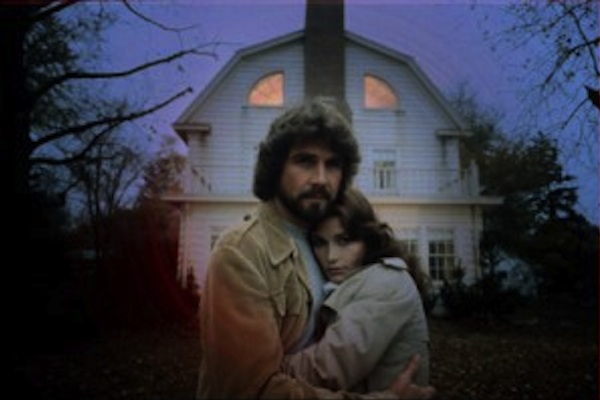
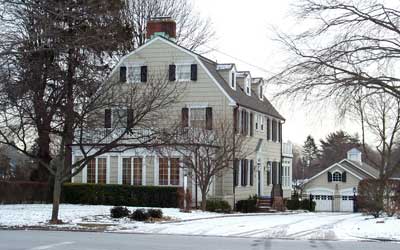
There won’t be many people reading this list who have not heard of the Amityville horror movie – and the majority will no doubt have watched it. What you may not know is that it is based on true events. The authors of the original book (George and Kathy Lutz) were convinced right up to their deaths that the story was true. In 1975, the couple moved in to a home in Amityville, New York. Unbeknownst to them, 13 months earlier, the son of the previous owners shot and killed all six members of his family – claiming to have been directed by voices in his head. The killer (Ronald DeFeo) is still in prison in New York and will remain there until his death. Most strangely, all six of the victims were found lying face down in their beds with no signs of a struggle or sedatives having been administered.
Within 28 days of moving in to the house, George and Kathy Lutz fled – claiming a series of horrific experiences forced them to leave. The family experienced foul smells, loud voices, physical attacks, and unexplained noises. All members of the family, at one time or another, witnessed glowing red eyes in the house. Kathy discovered a small hidden room that was painted red and the family dog refused to go near it. A priest was called in to bless the house and he also witnessed some of the phenomena which he later testified to on camera. The current owners, and those after the Lutzes claim to have had no unusual experiences in the house. The distinctive Dutch style windows have been remodeled to keep curiosity seekers away.
FACT or Fiction ?
“George and Kathy Lutz moved into 112 Ocean Avenue on December 18. Twenty-eight days later, they fled in terror.” So begins Chapter One of Jay Anson’s novel, The Amityville Horror. Written as a work of nonfiction, the book purports to relate the day-to-day events that drove the new residents of High Hopes from their home in terror. The book became a runaway bestseller, and was made into a popular movie starring Rod Steiger, Margot Kidder and James Brolin. “Their fantastic story, never before disclosed in full detail, makes for an unforgettable book with all the shocks and gripping suspense of The Exorcist, The Omen or Rosemary’s Baby, but with one vital difference…the story is true,” reads the trailer on the book’s back cover.
The one vital difference between truth and fiction is what paranormal investigator Dr. Stephen Kaplan spent many years trying to expose in regard to the Amityville “Horror.” Now deceased, Dr. Kaplan was a well-respected Long Island parapsychologist. The founder of the Parapsychology Institute of America, he was a frequent guest on the WBAB radio program, “Spectrum with Joel Martin.” On February 16, 1976, shortly after the Lutz family “fled” from the house on Ocean Avenue, Dr. Kaplan received a phone call from George Lutz, requesting that Dr. Kaplan and his associates investigate the house. As Dr. Kaplan recalled in his account of the incident, “The Amityville Horror Conspiracy”, this initial conversation immediately began to arouse his suspicions as to the validity of George’s claim that the house was haunted by demons and all variety of evil spirits.
“I began to ask questions. What actually happened to him and his family? George…says that he simply can’t describe the psychic phenomena. But there are demons there. He even knows their names!
” ‘What are their names?’ I ask. [George] won’t tell me. He claims they’ll appear if he as much as mentions their names out loud.
” ‘Who told you that?’ I ask.
” ‘I read it in a book.’ I ask him for the title, but he can’t remember — he’s read so many books since they bought the house. Books on demonology, witchcraft, Satanism, ghosts, psychic phenomena — the list went on and on. And all in just a few short weeks, or so George claims.
“I press him about the demons and he answers by reciting ‘facts’ he has learned about demons and Satan worship. In a discussion about witchcraft, [George] mentions Ray Buckland, a prominent witch in the area who ran the Witchcraft Museum in Bayshore before moving to New England.
I am getting more suspicious by the minute. Didn’t George just tell me that he knew nothing of the occult up until the past two months? Ray Buckland had been gone from New York for a year or two now. That would mean George had discussed ‘the craft,’ as it is called, with one of the most knowledgeable witches in the country long before he bought the house.”
Dr. Kaplan’s doubts about the veracity of the Lutz haunting were confirmed a year-and-a-half later, when he received a copy of The Amityville Horror. Reading it from cover to cover, he swiftly came to the conclusion that George had indeed done his witchcraft and demonology homework — the account was packed with every sort of ghost, ghoul, poltergeist, and demon, all of which employed every trick in the book to terrorize the Lutz family, but could not scare them into leaving for an entire month. The inconsistencies and fabrications Dr. Kaplan found include:
- The complete exaggeration of the role a priest friend played in the whole drama. In the book, a priest character named Fr. Mancuso is terrorized by a demon while trying to bless the new home. He is then stalked by the specter back to the rectory, where he is afflicted with boils, bleeding palms (a la stigmata), a fever, and the pervasive scent of excrement. In real life, a priest did bless the house, and did have some concern about the possibility of a haunting. Both the real priest and rectory were unharmed by any such demon.
- Henry’s Bar, the scene of Butch’s shocking revelation, is referred to as the “Witches Brew.” An imaginary police sergeant named “Gionfriddo” mentions that the police discovered the murders because Butch told the bartender, a depiction of events that doesn’t even come close to how they really occurred.
- The supernatural phenomena that the Lutz’s describe witnessing is too wide-ranging, which is to say that no one home could possibly hold enough demons, spooks, etc. to cause everything they say happened to them. For instance, George claims that a porcelain lion leapt from a corner of the living room and “bit” him on the ankle; George saw a ghostly vision of Ronnie DeFeo, Jr.’s head floating in the cellar; George and his wife Kathy believe they saw the burned impression of a demonic, hooded figure on their fireplace; Kathy levitated above their bed; Kathy looked in the mirror and saw a decrepit elderly woman looking back; the toilets backed up with black smelly ooze, and the walls of the house were covered with slime; George and Kathy looked out the living room window and saw a floating pig with glowing red eyes.
In the end, this tale of horror and demonic possession was debunked by the Catholic Diocese of Rockville Center, the Amityville Police Department, William Weber (Butch DeFeo’s defense attorney), U.S. District Court Judge Jack Weinstein, and even George and Kathy Lutz, who ended up recanting certain parts of the tale. The new owners of 112 Ocean Avenue in Amityville were disturbed by no other visitors than the hordes of curious onlookers, and those convinced that theirs was a haunted house. This entire fabrication detracted from what was in fact the true horror of Amityville, the cold-blooded murder of six innocent people by one of their own family members












