Imagine a place where time didn’t just stop. It drowned.
We are talking about a ghost town on a scale that is almost impossible to wrap your head around. No broken windows. No looting. Just a massive, imperial metropolis frozen in the amber of a man-made catastrophe. It is the closest thing to Atlantis we have on Earth, and it is hiding in plain sight.
But this isn’t myth. This isn’t Plato telling stories. This is Shicheng.
Deep beneath the dark, swirling waters of Qiandao Lake in China’s Zhejiang province, a sleeping giant lies waiting. They call it the “Lion City.” And for over half a century, the world forgot it existed. Until now.

The Day the Water Won
Let’s rewind. The year is 1959. The world is changing fast. In China, the push for modernization is hitting like a sledgehammer. The government needs power. Massive amounts of it. The solution? Hydroelectric energy.
They looked at the valley at the foot of Wu Shi Mountain (Five Lion Mountain) and saw a battery waiting to be charged. They decided to build the Xin’an River Hydropower Station.
There was just one problem. A big one.
People lived there. History lived there.
Shicheng wasn’t some backwater village. It was a cultural powerhouse. Established around 208 AD—back when the Roman Empire was still kicking—this city had been the center of politics and economics in the county of Sui’an for over a millennium. We are talking about 1,300 years of continuous human life. Streets worn smooth by generations of sandals. Temples filled with incense. Walls that had withheld armies.
In a matter of months, it was over. The order came down. The dam was built.
The floodgates opened.
Water rushed into the valley, rising higher and higher, swallowing the Lion Mountain, swallowing the trees, and eventually, swallowing the city whole. It wasn’t a slow decline. It was an execution.

The Great Exodus
The numbers are staggering. To create this lake, 290,000 people were forced to pack up their lives. Think about that. That is the population of a mid-sized American city, evicted. Ancestral homes, family shrines, the bones of their grandfathers—all left behind to the rising tide.
They say some of the elders refused to leave until the water was lapping at their ankles. They couldn’t understand it. How do you drown a mountain?
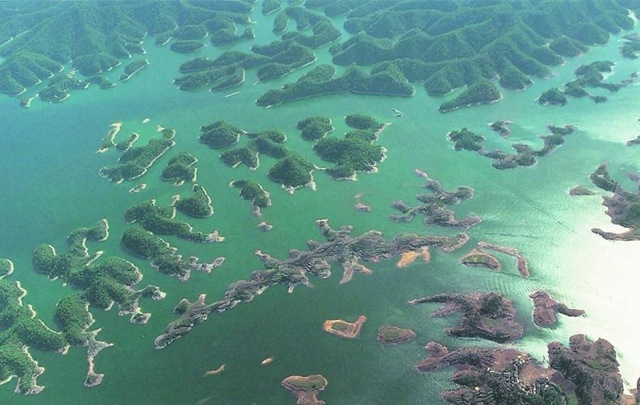
When the water finally settled, Shicheng sat between 85 and 131 feet (26-40 meters) below the surface. The valley became Qiandao Lake—the “Lake of a Thousand Islands.” It’s beautiful on the surface. But the real story is what lies beneath.
The Time Capsule Effect
Fast forward to 2001. The city had been underwater for over 40 years. Most people assumed it was destroyed. Crushed by the pressure, eroded by the currents, or buried under tons of silt.
Enter Qiu Feng. He was a local tourism official with a wild idea. He knew the legends of the old city. He wondered: Is anything left down there?
He organized a dive. What they found shocked the scientific world.

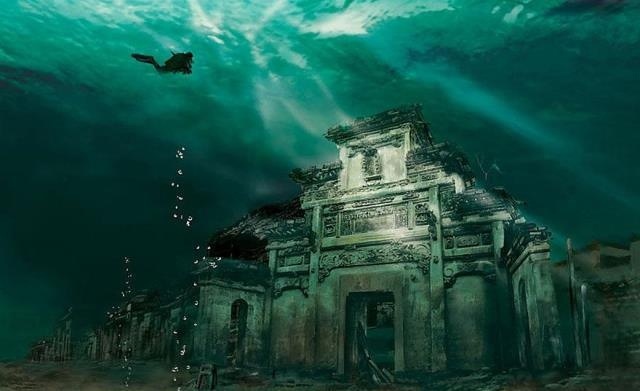
It wasn’t a pile of rubble. It was pristine.
Shicheng hadn’t decayed. It had been pickled. The water at that depth is cold. Freezing. It doesn’t get much sunlight, and it doesn’t have the same oxygen levels as the surface. The destructive bacteria that usually eat wood and erode stone? They can’t survive down there.
The result is a time capsule that puts Pompeii to shame. Pompeii was burned and crushed by ash. Shicheng was gently held in suspension.
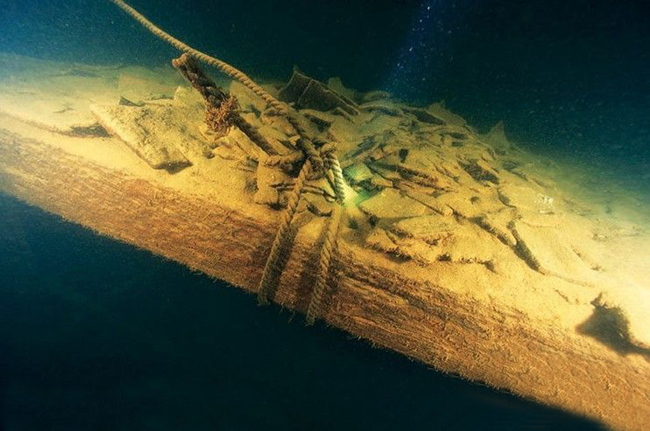
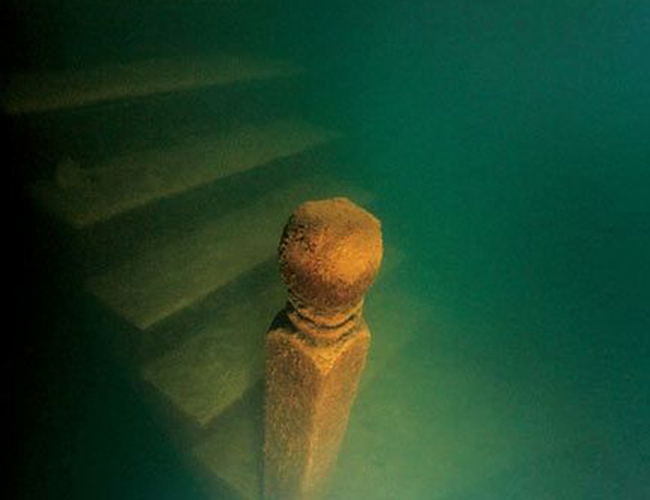
Divers found wooden staircases that were still intact. They found heavy wooden beams that hadn’t rotted a day. But the stone? The stone is where things get truly spooky.
Stone Dragons and Forbidden Gates
The architecture of Shicheng is bizarre. It breaks the rules.
Traditionally, Chinese cities from this era had four gates. North, South, East, West. It’s about balance. Feng Shui. Order.
Shicheng has five gates. Five towers.
Why? Nobody is quite sure. Some theories suggest it was to honor the “Five Lion” mountain looming above (and now below) it. Others think it points to a specific, unique cultural significance that we barely understand today.

Against the city walls, you don’t just see bricks. You see art.
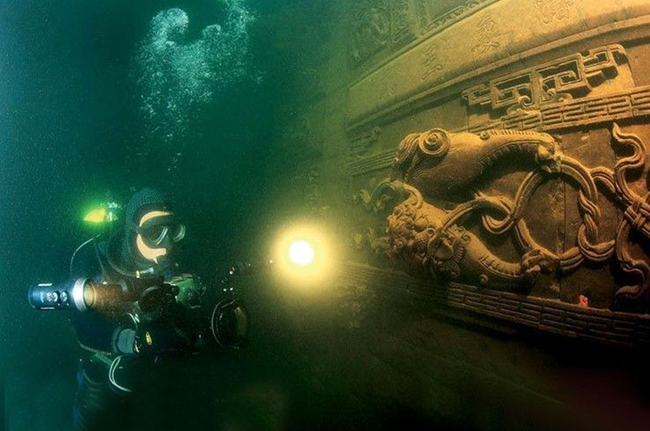
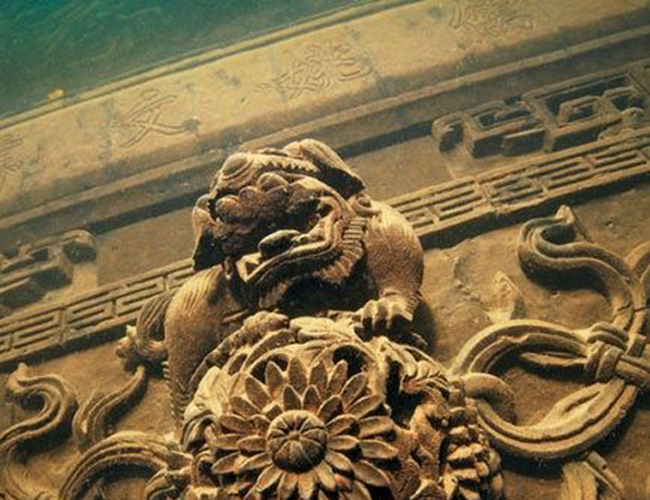
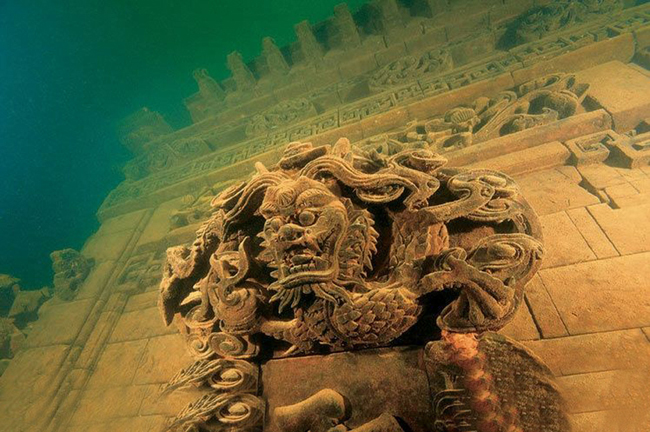
The stonework reveals incredible carvings of lions, dragons, phoenixes, and historical inscriptions dating back to 1777 and beyond. The “Garment of the City”—the outer wall—is still standing. The archways are grand, looming out of the murky green darkness like portals to another dimension.
When divers shine their lights on these carvings, the shadows play tricks. The dragons seem to writhe. The lions seem to watch. It’s an eerie sensation, floating weightless through a street where merchants used to shout and children used to play tag.
The Silence is Deafening
Explorers from “Big Blue,” a dive operator based in Shanghai, describe the experience as spiritual. You aren’t just looking at ruins. You are trespassing in a tomb.
There are no fish inside the houses. Just stillness.
Furniture is still inside some of the structures. There are rumors of tables still set for meals that were never finished, though the currents have likely shifted the smaller objects over the decades. But the shell? The skeleton of the empire? It is rock solid.

The Dark Side: The Qiandao Lake Incident
It wouldn’t be a true mystery without a body count. And sadly, Qiandao Lake has a darkness that has nothing to do with architecture.
While the city below is peaceful, the surface has seen horror.
In 1994, an event occurred that chilled the world. It’s known as the Qiandao Lake Incident. A ferry boat, the Hai Rui, was carrying 24 tourists from Taiwan and 8 crew members and guides. They were out to see the “Thousand Islands,” blissfully unaware of the ancient city beneath them.
They never came back.
Three hijackers boarded the boat. This wasn’t a simple robbery. It was a massacre. They forced all 32 people into the lower cabin of the boat. They locked the doors. And then, they set the ship on fire.
Every single person on board perished. 32 lives snuffed out.
The aftermath was a diplomatic nightmare between China and Taiwan, full of cover-ups, conflicting police reports, and anger. But for the locals? For the people who remember the old legends? It was something else.
Whispers started.
They say the lake is haunted. They say the 290,000 people who were displaced left a heavy energy behind. They say that disturbing the resting place of the Lion City demanded a price. 32 ghosts now patrol the waters, joining the silent stone lions in the deep.
Is it superstition? Probably. But try telling that to a diver when their flashlight flickers out at 100 feet down, surrounded by the ruins of a dead civilization.
The “Atlantis of the East” Today
So, can you go there? Can you see it yourself?
Technically, yes. But it isn’t for the faint of heart.
This isn’t snorkeling in the Caribbean. This is advanced, technical diving. The water is pitch black at the bottom. You need powerful lights. The temperature drops drastically as you descend. The silt on the bottom is like fine dust—one wrong kick with a flipper and visibility drops to zero instantly. You could get lost in a 1,300-year-old maze and run out of air before you find your way out.

Yet, the allure is too strong to resist.
Plans have been floated (pun intended) to build an “Archimedes Bridge”—a floating tunnel submerged in the water that would allow tourists to walk through the lake and see the city through glass windows. But the engineering is risky. Constructing it might damage the ruins. The silt would cloud the view.
For now, Shicheng remains the exclusive playground of the brave few.
What Else Is Hiding Down There?
Here is the craziest part: Shicheng isn’t alone.
Another ancient city, He Cheng, lies nearby, also drowned in 1959. It’s even older, dating back to the Han Dong dynasty. And beneath the silt? Who knows. China’s history is layers upon layers. We might be looking at the top floor of a skyscraper of history, with even older secrets buried in the mud below.
We are obsessed with looking at the stars for alien life. We spend billions sending rovers to Mars. But right here, on our own planet, entire civilizations are sitting in the dark, waiting for someone to knock on the door.
Shicheng is a reminder. We build our cities. We think we are permanent. We think our concrete and steel will last forever. But nature—and water—always wins in the end.
The Lion City is still down there. The lions are still watching. And they have 1,341 years of secrets they aren’t telling anyone.
Originally posted 2014-03-09 20:16:31. Republished by Blog Post Promoter