Thursday, May 14, 2026
HomeWeird WorldPhoto GalleriesThe abandoned Spanish town of Belchite

The abandoned Spanish town of Belchite

Belchite: The Spanish Ghost Town Where The Screams Never Ended

There are places on this Earth where the past refuses to die. Where history isn’t just something you read in a book; it’s a cold spot on the back of your neck. A whisper on the wind. It’s a feeling. A heavy, oppressive weight that tells you something terrible happened here. And that it never truly left.

Welcome to Belchite, Spain.

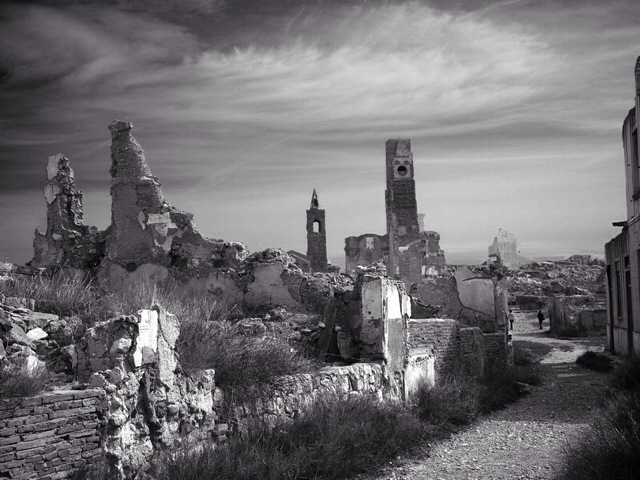
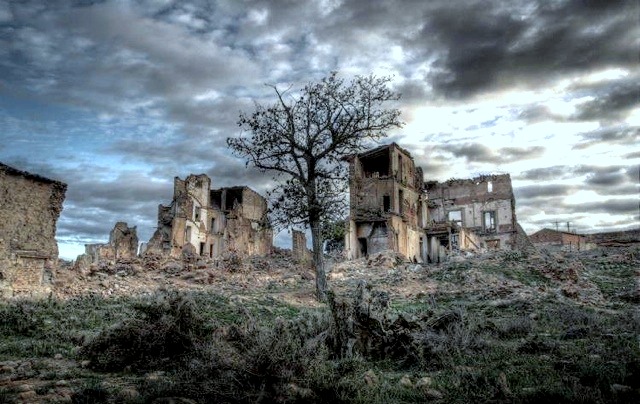
From a distance, it looks like a scar on the arid plains of Zaragoza. A skeleton of a town, its hollowed-out churches and bombed-out homes clawing at the sky like skeletal fingers. This isn’t just an abandoned village. It’s a tomb. A permanent, open-air monument to one of the most brutal battles of the Spanish Civil War. And for decades, visitors, investigators, and terrified locals have sworn that the final, agonizing moments of Belchite are playing out on a loop, trapped in the very stones of its ruins.

But are these just stories? The sad ramblings of a traumatized nation? Or is Belchite a genuine gateway, a place where the veil between our world and the next was torn apart by the sheer violence of humanity?

Before the Fire: The Town That Was

It’s easy to see only the rubble. To think of Belchite only as a place of death. But before the war, it was the opposite. Before 1937, Belchite was alive. It was a thriving community, a small but proud town with a history stretching back centuries. Imagine bustling streets, not silent, debris-choked lanes. Picture the two grand churches, San Martín de Tours and San Agustín, filled with the faithful, their bells ringing out over the olive groves that surrounded the town.

This was a place of farmers, merchants, and families. Children played in the squares. Neighbors chatted over stone walls. Life followed the simple, ancient rhythms of the Spanish countryside. They had everything they needed. Shops. Cafes. A future. They had no idea they were living on borrowed time, sitting directly in the path of a storm that would tear their country, and their world, to pieces.

20140219-012311.webp

A Nation at War: The Spanish Civil War Deep Dive

To understand what happened to Belchite, you have to understand the fire it was thrown into. The Spanish Civil War (1936-1939) wasn’t just a war; it was a schism. It was a violent, ideological earthquake that pitted neighbor against neighbor, brother against brother.

On one side, you had the Republicans. A messy coalition of socialists, communists, anarchists, and liberals who supported the democratically elected government. They were backed by the Soviet Union and international volunteers.

On the other, the Nationalists. Led by General Francisco Franco, this was a faction of monarchists, conservatives, and fascists. They wanted to overthrow the republic and restore a traditional, authoritarian Spain. They had the powerful support of Nazi Germany and Fascist Italy, who saw Spain as a testing ground for their new weapons and tactics. Blitzkrieg? The infamous Condor Legion practiced their dive-bombing runs on Spanish towns long before they hit Poland.

This was a war of ideologies, a dress rehearsal for World War II. And it was fought with a savagery that shocked the world. Belchite was about to become its most infamous stage.

The Battle That Erased a Town

By the summer of 1937, the war was in full swing. The Republicans, desperate for a major victory to boost morale and reclaim territory, launched the Zaragoza Offensive. Their goal was to capture the regional capital of Zaragoza, a major Nationalist stronghold. And standing right in their way was the fortified town of Belchite.

What followed was two weeks of pure, unadulterated hell.

From August 24th to September 7th, 1937, thousands of Republican soldiers threw themselves against the town’s defenses. The Nationalists inside, though outnumbered, were dug in deep. They were determined to fight to the last man. The battle quickly devolved from an open assault into a gruesome, house-by-house, room-by-room meat grinder.

Think about it. No clear front lines. An enemy behind every broken wall, in every cellar, on every rooftop. Artillery shells rained down, turning buildings into dust. The air was thick with the smell of cordite and death. Water ran out. Food became scarce. Civilians were trapped in the middle, cowering in basements as the world above them was systematically demolished. Snipers picked off anything that moved. Hand-to-hand combat erupted in the narrow medieval streets. It was brutal. It was personal.

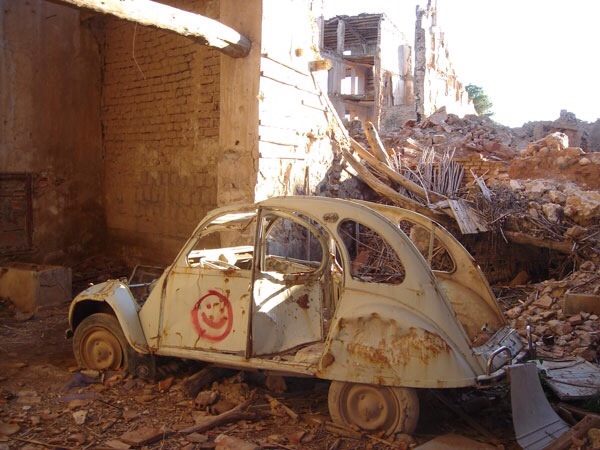
When the dust finally settled, the Republicans had “won.” They had taken Belchite. But what was left to take? The town was gone. Over 5,000 people were dead—soldiers and civilians alike. The once-proud community was nothing more than a smoking, corpse-strewn ruin.

20140219-012422.webp

Franco’s Cruelest Monument

After the war ended and Franco seized power, a decision was made about Belchite. Any normal leader would have cleared the rubble and rebuilt. But Franco was not a normal leader. He saw a different kind of opportunity in the wreckage.

He decreed that the ruins of Old Belchite would be left exactly as they were. Untouched. A permanent, rotting memorial. But a memorial to what? To the victims? No.

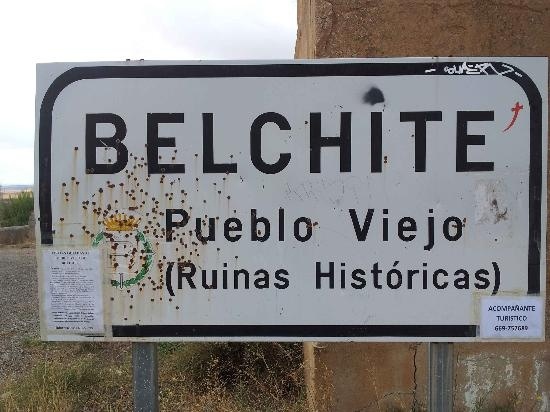
It was a calculated act of political propaganda. He built a new town, Belchite Nuevo, right next door, using Republican prisoners of war as slave labor. The old town was to serve as a constant, looming reminder of the “Red barbarism.” A sign was erected at the entrance: “Pueblo Viejo de Belchite, ejemplo de heroĂ­smo y sacrificio por Dios y por España.” (Old Town of Belchite, example of heroism and sacrifice for God and for Spain.) It was a victory monument for the fascists, built from the bones of a town they helped destroy.

The survivors were moved to the new, sterile town, forced to live their lives in the shadow of their own gravestone. Imagine waking up every morning and seeing the skeletal remains of your childhood home, the church where you were baptized, the streets where your friends died. It was a psychological masterstroke of the cruelest kind.

Do the Dead Still Cry in Belchite?

As the living moved out, something else seemed to move in. Or perhaps, it had never left. For decades, the stories have trickled out of the ruins. First as local folklore, then as whispers among tourists, and now as a full-blown phenomenon investigated by paranormal experts from around the globe.

People who venture into the ruins, especially after dark, report a staggering consistency of strange experiences. The silence of the abandoned town is shattered by impossible sounds. The sudden, chilling cry of a baby. The desperate wail of a woman. The guttural shouts of men in the throes of combat. The terrifying drone of airplanes flying overhead, followed by the whistle of bombs that never land.

Are these just the winds of Aragon playing tricks on the mind? Or is the air itself still vibrating with the trauma of 1937?

20140219-012428.webp

Deep Dive: The Psychophonies of Belchite

The paranormal claims surrounding Belchite exploded in 1986. A Spanish paranormal radio show, “Medianoche” (Midnight), led by the famous investigator Dr. GermĂ¡n de Argumosa, conducted an investigation in the ruins. What they captured on their audio equipment that night has become the stuff of legend in the world of Electronic Voice Phenomena (EVP).

They recorded what they called the “SinfonĂ­a del Infierno” — the Symphony from Hell. When played back, their tapes, which had been recording in the supposed silence of the church of San Juan, were filled with a cacophony of battle sounds: bombs, machine gun fire, and the screams of dying men. It was a perfect audio snapshot of the battle, recorded nearly 50 years after the last shot was fired.

But that wasn’t the most disturbing recording. From the chaos, one clear, terrifying voice emerged. It was the unmistakable sound of a young boy, crying out in pure terror.

“MamĂ¡… mamĂ¡… tengo miedo.”

“Mom… mom… I’m scared.”

This single piece of audio has chilled investigators for decades. It’s not a vague whisper; it’s a clear, emotional plea from a child seemingly trapped in a moment of ultimate fear. Skeptics have tried to debunk it as stray radio signals or fraud, but no one has ever been able to definitively explain it away. Many believe it is the genuine voice of a spirit, one of the many children who perished in the crossfire, his final moments imprinted on the environment itself.

Shadows in the Rubble

It’s not just sounds. Visitors report seeing things that defy explanation.

  • Shadow Figures: Dark, human-shaped forms seen darting between buildings, disappearing the moment you turn to get a better look.
  • Soldiers in the Mist: Full-bodied apparitions of soldiers in the tattered uniforms of both sides, seen patrolling the ruined streets as if the battle never ended for them.
  • The Monk of Belchite: A recurring legend speaks of a hooded, monk-like figure seen walking solemnly through the nave of the ruined San AgustĂ­n monastery, a silent guardian of a desecrated place.

These aren’t isolated incidents. The sheer volume of similar reports from unrelated witnesses over many years is what makes Belchite so compelling. It’s a place where reality feels thin, where the past is not just a memory but an active, and sometimes interactive, presence.

20140219-012436.webp

Theories: A Scar on Time Itself?

So what is going on in Belchite? The internet is ablaze with theories, each more mind-bending than the last.

The Stone Tape Theory: This is the classic explanation. The idea is that intense, traumatic events can be “recorded” onto the physical environment, particularly stone and water. The buildings of Belchite, made of stone and soaked in blood and fear, might be acting like a psychic video tape, replaying the most intense moments of the battle under certain atmospheric conditions. The sounds and sights aren’t conscious spirits, but residual echoes of the past.

Trapped Spirits: The more unsettling theory is that these are not mere echoes. They are the actual, conscious souls of those who died so violently and suddenly. Unaware that they are dead, or so traumatized by their final moments, they are forced to relive their deaths for eternity, trapped in a loop within the ruins of their homes. The child’s cry for his mother isn’t an echo; it’s a real little boy, lost and scared in the darkness.

A Dimensional Bleed-Through: Some modern theorists propose something even stranger. Could a place of such immense energy and suffering punch a hole through the fabric of reality? Are we not hearing ghosts, but momentarily hearing and seeing the actual events of 1937, bleeding through time into our present? A glitch in the matrix caused by the profound trauma of the battle.

Of course, there are the skeptics. They’ll tell you the sounds are just the wind whistling through hundreds of holes in the ruins. They’ll say the sightings are tricks of the light, the power of suggestion in a creepy place. And maybe they’re right. Maybe it’s all in our heads.

But can the wind sound like a child crying for its mother? Can shadows and suggestion make hundreds of different people report seeing the same spectral soldier in the same ruined street? Something more is happening in Belchite. You can feel it.

The Ruins Are Waiting

Today, the ruins of Belchite are fenced off, accessible only through official guided tours. It’s a measure to protect both the fragile structures and the tourists who flock here by the thousands every year. It has become a mecca for dark tourism, for ghost hunters, for historians, and for the morbidly curious. It’s even been used as a filming location for movies like Terry Gilliam’s “The Adventures of Baron Munchausen” and Guillermo del Toro’s “Pan’s Labyrinth,” its authentic devastation providing a backdrop no movie set could ever replicate.

To walk through Belchite is to walk through a wound. You can stand in the collapsed nave of the Church of San MartĂ­n, look up through its blasted dome to the sky, and feel the weight of history press down on you. You can see the pockmarks from machine gun bullets peppering every remaining wall. Every step is a reminder of the fragility of life and the horrifying cost of hatred.

Whether you believe in ghosts or not is almost beside the point. Belchite is haunted. It is haunted by the memory of what happened there. It is haunted by the political cynicism that left it to rot as a propaganda piece. And maybe, just maybe, it is haunted by the thousands of souls who drew their last breath in its streets, their final screams and whispers forever absorbed by the stones, waiting for the right moment, and the right person, to listen.

Amit Ghosh
Amit Ghoshhttps://coolinterestingnews.com
Aloha, I'm Amit Ghosh, a web entrepreneur and avid blogger. Bitten by entrepreneurial bug, I got kicked out from college and ended up being millionaire and running a digital media company named Aeron7 headquartered at Lithuania.
RELATED ARTICLES
- Advertisment -

Most Popular

Recent Comments

Warren Pan Abbott on The legend of the Devil Monkey !
chris davies on The McPherson Tape Mystery
Reed Reedly on ET has Internet!
Bea Houseoffashion on Proof Of Time Travellers – Gallery
Marcus2012 on ET has Internet!
Reed Reedly on ET has Internet!
LaughsAtConspiracyNuts on The 9/11 Conspiracy – Myths and Facts
Alex Sliverman on Did the ancients fly?
Doctor Wholigan on Time Traveler in 1938 film
chris davies on The McPherson Tape Mystery
Archie1954 on 10 secret UFO hideouts
chris davies on Ghosts of flight 401
Marcus2012 on ET has Internet!
jason Macdonald on Proof of Time Travel? – China
chris davies on Long-Lost Pyramids Found?
Reed Reedly on ET has Internet!
Milkman on Connected Universe
Tenmiles on Baigong Pipes Mystery
Simon Foster on Sirius – The Documentary
From the 1st April on 2013 – Alien Contact date ?
SkyWatcher on Is ET ignoring us?
I Come From The Future on Obama to make UFO Alien disclouser soon ?
ÛñK?øWn on 2013 – Alien Contact date ?
Just another person on 2013 – Alien Contact date ?
Malcolm Windowcleaner on The strange case of Rudolph Fentz
Mason Servio on Strange Things on Mars
Marke Wisdom Seeker on What will we find as arctic melts?
Andrea A Elisabeth Levyne on Aliens Captured in Varginha, Brazil
Mitch Grouyeki on Amazing Space Shuttle pictures