The Ghost Ship Pamir: What if the Sea Never Took Her?
Some stories die. They sink beneath the waves, lost to pressure and time, their final moments a footnote in a dusty ledger. Other stories… don’t. They linger. They cling to the fog and the salt spray, whispered by sailors on lonely night watches. They become something more than history. They become a haunting.
This is one of those stories.
It’s the story of a magnificent ship, a titan of the seas from a forgotten age. A vessel that officially met its end in the screaming winds of a killer hurricane more than 60 years ago. But the official story, as it so often does, feels thin. Brittle. Because what if the *Pamir* never truly sank? What if, instead, it was condemned to sail the world’s oceans forever, a ghost ship crewed by the dead, forever searching for a port it can never reach?
Forget what you’ve been told. The truth is far, far stranger.
A Cathedral of the Sea: The Last Windjammer
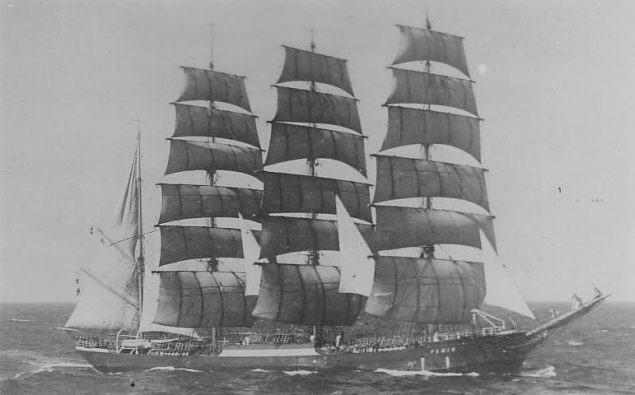
To understand the ghost, you must first understand the machine. The *Pamir* wasn’t just any ship. She was a four-masted barque, a work of art and engineering forged in the Blohm & Voss shipyards of Hamburg, Germany, in 1905. She was one of the legendary Flying P-Liners, a fleet of the fastest, grandest merchant sailing ships the world had ever seen. In an age when steam was choking the horizons with smoke, the P-Liners were the last defiant roar of the age of sail.
Imagine it. Over 375 feet of steel, four colossal masts clawing at the sky, acres of canvas snapping in the wind. She wasn’t built for comfort; she was built for power and speed, a cargo-hauling beast designed to wrestle with the most violent oceans on Earth. And she did. For decades, the *Pamir* was a workhorse, rounding the treacherous Cape Horn a staggering 17 times on her nitrate runs from Chile to Europe. She carried grain from Australia, guano from Peru. She saw two World Wars, changing hands from German to Italian to Finnish to British control, a silent witness to a world tearing itself apart.
By 1957, she was an antique, a living dinosaur. Modern diesel-powered bulk carriers were faster, more reliable, and didn’t depend on the whims of the wind. The *Pamir* was operating at a loss, a relic kept alive by a consortium that saw her as a training vessel for a new generation of merchant mariners. Her crew on that final voyage was a mix of seasoned officers and 52 young cadets, some as young as 16, learning the ancient art of seafaring on its last great cathedral.
They were sailing a legend. They just didn’t know they were sailing it straight into hell.
The Final Voyage and the Fury of Carrie
The end began in Buenos Aires, Argentina, in August of 1957. The *Pamir*’s holds were filled with 3,790 tons of barley, destined for Hamburg. The mood was likely one of adventure. For the cadets, this was the trip of a lifetime. But a shadow was already gathering over the Atlantic. A storm system was churning, growing, feeding on the warm ocean waters. It had a name. Hurricane Carrie.
Modern meteorology was in its infancy. The ship received some warnings, but they were patchy, imprecise. Captain Johannes Diebitsch, a competent but perhaps overly confident sailor, believed he could outrun the storm, plotting a course to pass ahead of its predicted track. It was a fatal miscalculation.
Deep Dive: The Treachery of Grain
Why was the cargo so important? Transporting grain in a sailing ship is a uniquely dangerous business. If not properly secured, a mountain of loose barley can act like a liquid. As the ship rolls in heavy seas, the entire cargo can shift violently to one side. This is called “cargo liquefaction,” and it’s a death sentence. A sudden, massive shift in weight can throw a ship onto its side in seconds, a point of no return from which recovery is impossible. The investigation after the sinking would suggest the barley wasn’t properly stowed. The crew may not have even had the materials to do it correctly. They were sailing on a time bomb.
On September 21st, 500 miles southwest of the Azores, Carrie found them. And she was a monster. Winds screamed at over 100 miles per hour. Waves, the size of office buildings, rose up from the black water, crashing over the decks. The ship, designed to dance with the wind, was now being brutalized by it.
The radio began to crackle with panicked transmissions. Sails, the ship’s mighty engines, were shredded by the hurricane-force winds, leaving the *Pamir* powerless, a toy at the mercy of the storm. Then the cargo shifted. The ship lurched violently, settling into a terrifying 45-degree list. Water poured over the rails, flooding the decks, a prelude to the inevitable.
At 8:00 PM local time, the last message, a desperate cry for help, pierced the static:
‘Heavy hurricane – all sails lost – 45 degree list – danger of sinking – need help…’
Then, silence. The Atlantic had swallowed a legend whole.
A Frantic Search, A Tragic End
The silence sparked one of the largest search-and-rescue operations in maritime history. Ships and planes from a dozen nations converged on the *Pamir*’s last known position, scouring a churning, hostile sea. For days, they found nothing. No wreckage. No lifeboats. No bodies. Just the angry gray ocean.
It was the American freighter, the *USNS Saxon*, that finally found the first sign of life. A single, battered lifeboat, impossibly still afloat, containing five exhausted, traumatized survivors. Five young men out of a crew of 86. The next day, another lone survivor was pulled from the water, clinging to debris. His name was Günther Haselbach.
Six. Only six survived.
Their stories were horrific. They spoke of the ship being knocked on its side, of the chaos as lifeboats were smashed or washed away before they could be launched. Of men being swept into the sea, their cries swallowed by the wind. Of floating for days in the storm-tossed water, watching their friends and shipmates disappear one by one.
The world mourned. The official investigation concluded. The *Pamir* was gone, lost to a confluence of a monster storm and improperly stowed cargo. The book was closed. Eighty souls were gone, their bodies given to the deep.
But the sea doesn’t always keep what it takes.
The Whispers Begin: An Impossible Sighting
Four years passed. The tragedy faded into maritime history. The world moved on.
Then, in 1961, things got strange.
The *Esmeralda*, a Chilean sail-training ship, was navigating a gale in the English Channel. It was a modern vessel, but its crew knew the old ways. They knew the silhouettes of the great sailing ships. Through the rain and the spray, the lookout called down, his voice a mixture of confusion and disbelief. Another sailing vessel was out there with them, running through the storm. A huge one. A four-masted barque.
As it drew nearer, its form became unmistakable. The rake of its masts, the cut of its jib. The crew of the *Esmeralda* stared in stunned silence. It was the *Pamir*. Not a ship *like* the Pamir. It *was* the Pamir, under full sail, slicing through the waves as if the gale was a summer breeze. She was magnificent. And she was impossible.
The *Esmeralda*’s captain logged the encounter. The report was met, predictably, with ridicule. A mistake. A trick of the light and the storm. A mass hallucination brought on by stress. The ship was at the bottom of the Atlantic, thousands of miles away. End of story.
But it wasn’t the end. It was the beginning.
A Cascade of Phantom Encounters
The *Esmeralda* sighting opened a floodgate. The dam of rational explanation broke, and a river of impossible stories began to flow. If it had been a single incident, it could be dismissed. But it wasn’t.
The Lone Yachtsman
Months after the *Esmeralda* incident, an American yachtsman named Reed Byers was sailing solo off the Virgin Islands. One calm, moonless night, he was startled by the sight of a massive shape gliding silently past his small boat. It was a four-masted sailing ship, all sails set, but making no sound. Not a creak of rigging, not a cry from a lookout. It was utterly silent. Byers, an experienced sailor, identified the ship’s unmistakable profile. It was the *Pamir*. He reported it, his voice shaking, over his radio. Again, he was dismissed. A dream. Too much sun.
The Sailors Who Knew
Then came the reports that were harder to ignore. They came from the crews of the German sail-training ship *Gorch Fock* and the Norwegian *Christian Radich*. These weren’t just any sailors; these were men training on the last great windjammers in the world. They knew the *Pamir* intimately. They had studied her lines, her history. They knew her like a brother. And they both reported seeing her, on separate occasions, sailing on horizons where she could not possibly be. They saw her clear as day. A ghost etched in sea spray.
The Official Confirmation?
The most chilling report came from the United States Coast Guard Cutter *Eagle*. The *Eagle* is itself a historic four-masted barque, a sister ship to the *Pamir* (originally the German *Horst Wessel*). The crew of the *Eagle* are among the most professional sailors on the planet. During a patrol, they logged a visual contact with a vessel matching the *Pamir*’s description, crossing their path before vanishing into a fog bank that wasn’t there. An official USCG vessel had sighted a ghost. The report was filed. And then it was buried.
Deep Dive: The Crew That Never Left
This is where the story turns from a maritime mystery into a full-blown horror tale. The sightings were strange enough, but the details that trickled out of these encounters were even more disturbing. The crews who saw the phantom ship didn’t just see an empty vessel. They saw her crew.
In the first sightings, like the one from the *Esmeralda*, the reports claimed the *Pamir*’s decks were lined with figures. A full crew, standing watch, their ghostly forms visible against the rigging. They were silent, motionless, staring straight ahead as their ship sailed on its impossible course.
But then, a terrifying pattern emerged.
With each subsequent sighting, the reported number of crewmen on deck decreased. It was as if, with every appearance, some of the souls were finding their final rest, leaving the ship behind. The crew of the *Gorch Fock* reported seeing maybe forty or fifty men. Years later, the *Eagle* saw fewer still. The last credible sighting, from a fishing trawler in the late 1970s, reported seeing the majestic ship glide past in an eerie twilight. On her deck stood only twenty men. Twenty silent, lonely figures.
Where are they going? Are the 80 souls lost in 1957 being released from their watery prison one by one? Is the ship doomed to sail until the last of its young cadets finally finds his way home?
What REALLY Happened to the Pamir? Tearing Down the Veil
The official story is tidy. The unofficial story is a chaotic, terrifying masterpiece. So what is the truth? The internet is alive with theories, each more mind-bending than the last.
- Theory 1: A Maritime Time Slip. Is the *Pamir* a wound in time? Perhaps the sheer traumatic energy of her sinking ripped a hole in the fabric of reality. The ship isn’t a ghost in the traditional sense; it’s a recording, an echo of 1957 endlessly replaying, occasionally bleeding through into our present. The sightings aren’t hauntings; they are glimpses into the past.
- Theory 2: The Flying Dutchman of the Modern Age. Maritime lore is filled with tales of phantom ships, from the legendary *Flying Dutchman* to the *Mary Celeste*. These stories speak to a fundamental fear of the sea – its power to claim lives and hold them captive. Is the *Pamir* simply the 20th-century incarnation of this ancient archetype, a modern myth born from a very real tragedy? A story sailors tell to remind themselves of the ocean’s power.
- Theory 3: The Cursed Object Theory. Some online forums have speculated wildly. Was there something else in the cargo, hidden amongst the barley? Something ancient or powerful that tethered the ship and its crew to this world? It’s a fantastic notion, but in a story this strange, can any possibility truly be dismissed?
- Theory 4: A Vast Cover-Up. This is the darkest theory. What if the *Pamir* didn’t sink in Hurricane Carrie? What if the sinking was a cover for something else? A Cold War intelligence operation gone wrong? Was the ship captured, its crew silenced, and the storm used as a convenient explanation? Could the sightings be of the *real* ship, repurposed for some clandestine mission, its appearance altered just enough to create confusion? It sounds like a spy thriller, but the world of the 1950s was a strange and paranoid place.
The book on the *Pamir* may have been officially closed in 1957, but the story is still being written. It’s written in the logs of ships that report impossible sightings, in the hushed conversations of sailors in waterfront bars, and in the chill that runs down your spine when you stare out at a dark, empty ocean.
The sea keeps its secrets. It holds its dead close. But every now and then, it shows us what it has taken. The *Pamir* is still out there. Her young crew is still on deck. Their voyage isn’t over. And as their numbers dwindle, one terrifying question remains: what happens when the last ghost is gone?