Tuesday, August 4, 2026

Strange facts about Puma Punku

Puma Punku: The Impossible Ancient Puzzle That Defies All Explanation

High in the barren, wind-swept plains of the Bolivian Andes, nearly 13,000 feet above the sea, lies a scar on the landscape. A collection of shattered, impossibly complex stones that whisper a story our history books refuse to hear. This is not just another ancient ruin. This is Puma Punku.

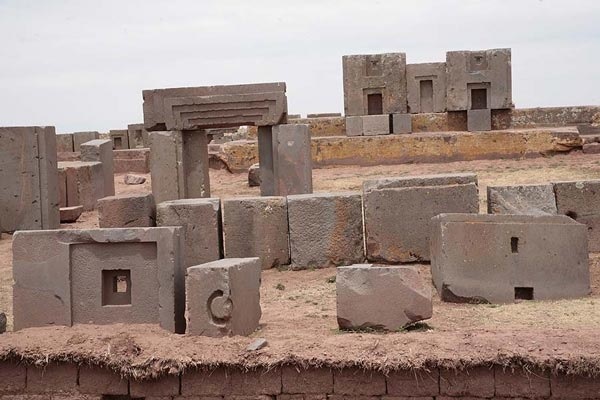
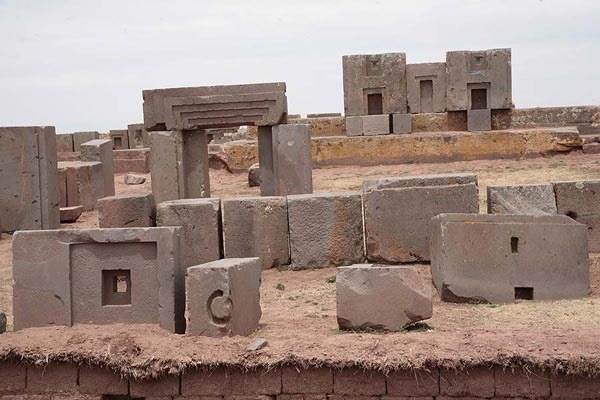
Forget everything you think you know about the ancient world. Forget the neat timelines and the simple stories of men with bronze chisels and brute force. Puma Punku laughs at those explanations. It stands in defiant silence, a collection of massive, intricately carved blocks scattered across the altiplano like a cosmic giant’s discarded Lego set.

The official story is simple. Tidy. It tells us Puma Punku was a ceremonial complex built by the Tiwanaku culture around 500 AD. But look closer. Stare into the perfect angles and the impossibly smooth surfaces. A terrifying question starts to form in your mind. A question that challenges the very foundation of human history.

How?

A Landscape of Shattered Giants

To visit Puma Punku is to walk through the aftermath of an unknown cataclysm. It’s not a pristine temple. It’s a field of beautiful destruction. Massive red sandstone slabs, some weighing over 130 tons, form what was once a sprawling plaza. But it’s the other stones—the grey andesite blocks—that truly boggle the mind.

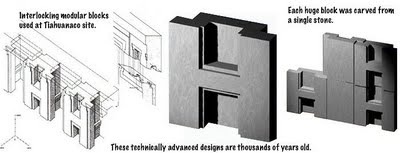
Andesite is a volcanic rock of incredible hardness. It’s right up there with granite. On the Mohs scale of hardness, it scores a 7 out of 10. For context, the bronze tools the Tiwanaku people supposedly used barely scratch a 3. Yet here, scattered across the ground, are H-shaped blocks carved from solid andesite with a precision that modern engineers would find difficult to replicate. These aren’t rough-hewn blocks. They are masterpieces of stonework.

We see drill holes. We see interior corners cut to near-perfect 90-degree angles. We see surfaces polished to a mirror-like sheen. This isn’t craftsmanship. It’s something else entirely. It feels like manufacturing.

The Impossible Engineering of Puma Punku

Let’s get down to the brass tacks. The evidence that makes this place so unnerving isn’t just a feeling. It’s measurable. It’s tangible. And it makes absolutely no sense.

The “Laser-Cut” Stones

Look at the famous H-blocks. They are all of a uniform size and design, as if they came off an assembly line. They are interlocking pieces, designed to fit together in a complex, three-dimensional puzzle. Many of them feature deep, narrow grooves with perfectly straight edges and consistent depth. How do you carve a 1mm-wide groove into one of the hardest stones on Earth with a bronze chisel?

You don’t. It’s not possible.

Ancient astronaut theorists and alternative historians point to these features as undeniable proof of advanced technology. They ask, were these blocks cut with diamond-tipped power tools? High-pressure water jets? Or, as some daringly suggest, were they shaped with sound waves or even laser technology? When you run your hand over the impossibly smooth surfaces and trace the lines of the perfect grooves, the official explanation of patient craftsmen with stone hammers feels less like history and more like a fairy tale.

How Did They Move 130-Ton Blocks Above the Clouds?

The engineering mystery deepens when you consider the logistics. The massive red sandstone slabs were quarried from a site nearly 10 miles away. That’s a challenge, but perhaps doable with enough manpower. The real problem is the andesite. The quarry for this super-hard stone is located near the shores of Lake Titicaca, a staggering 60 miles away.

Let that sink in. They moved multi-ton blocks of incredibly hard stone, uphill, for 60 miles, at an altitude of 12,800 feet where the air is thin and oxygen is scarce.

But the real kicker? This high-altitude desert is located far above the natural tree line. There were no large trees to fell for logs to use as wooden rollers. The mainstream theory of rolling these stones on logs is, quite simply, a non-starter. So how did they do it? Did thousands of people drag these blocks with llama-hide ropes over uneven, mountainous terrain? The sheer physics of the problem seems to scream “impossible.”

What if the answer is something we’ve been told is pure science fiction? Legends in the Andes speak of ancient priests who could make stones move through the air with the power of sound. Is it possible they had mastered some form of acoustic levitation? A lost technology that allowed them to negate gravity and float these monoliths into place? It sounds crazy. Until you stand there, staring at a 100-ton block, and realize the “sane” explanations are even crazier.

The Tiwanaku Enigma: A Global Crossroads?

Puma Punku does not exist in a vacuum. It is part of the larger Tiwanaku archaeological site, once the capital of a vast and powerful pre-Incan empire. Scientists believe Tiwanaku was a bustling metropolis, home to more than 40,000 people. It was a civilization that dominated the southern Andes for centuries before mysteriously vanishing around 1000 AD.

But Tiwanaku holds its own deep mysteries that connect directly to the strangeness of Puma Punku. The statues found at Tiwanaku are… odd. They don’t just depict the local Aymara people. Carved in stone are figures that seem to represent all the races of mankind. There are statues of people with broad noses and thick lips, suggesting African features. Others have thin noses and flowing beards, resembling Semitic or European men. Some wear turbans. And most chillingly, some depict beings with elongated skulls, a phenomenon found in ancient cultures across the globe.

What was going on here? Was Tiwanaku, sitting in its isolated mountain perch, somehow a global meeting point in the ancient past? A place where travelers from every corner of the world convened? The stone faces stare back, offering no answers, only more profound questions that hint at a forgotten chapter of human migration and interaction.

The Smoking Gun in a Ceramic Bowl

If the stones of Puma Punku are the physical anomaly, then the Fuente Magna Bowl is the cultural bombshell. Discovered by a local farmer near Lake Titicaca, this large ceramic bowl is one of the most controversial artifacts in South American history.

Why? Because its interior is covered in writing. And that writing appears to be a mix of local Quechuan ideograms and, astoundingly, Proto-Sumerian cuneiform.

Sumeria. The cradle of civilization in Mesopotamia, modern-day Iraq. Half a world away. According to our history books, there was zero contact between the ancient Andes and the ancient Middle East. Their worlds were separated by thousands of miles of ocean and thousands of years of separate development.

Yet here is a bowl that suggests otherwise. Mainstream academia has largely dismissed the bowl as a hoax, a modern forgery designed to stir up controversy. But other researchers have studied the inscriptions and swear they are authentic. They claim to have translated the Sumerian script, which tells a story of a ritual quest for purification and bounty.

If the Fuente Magna Bowl is real, it doesn’t just rewrite a chapter of history. It burns the whole book. It would mean that Sumerian sailors navigated the globe thousands of years before Columbus, reaching the highlands of South America. It would mean our understanding of the ancient world is fundamentally, catastrophically wrong. It would mean the strange, “multi-racial” statues at Tiwanaku might not be so strange after all.

Exploring the “What If?” Zone

When the official explanations fail, when the evidence on the ground screams that something is wrong with the story we’ve been told, we have to look elsewhere. We have to dare to ask the big “What if?” questions.

Theory 1: A Lost Human Super-Civilization

What if the builders of Puma Punku were not the simple, bronze-age Tiwanaku people? What if they were the inheritors of a much older, much more advanced global civilization? A culture that mapped the world, understood advanced mathematics and engineering, and had a technology we are only just beginning to rediscover. A civilization that was wiped from the face of the Earth by a great cataclysm—a flood, a pole shift, a comet impact—leaving behind only a few enigmatic ruins like Puma Punku and the Giza pyramids as their haunting legacy. Perhaps Puma Punku is not 1,500 years old. Perhaps it is 15,000 years old, a relic from before the last Ice Age, its true origins lost to a forgotten time.

20140113-223110.webp

Theory 2: The Ancient Astronaut Intervention

This is the theory that sends shivers down the spine of the establishment. But for many, it’s the only one that fits all the pieces of the Puma Punku puzzle. The precision engineering far beyond the known capability of any ancient culture. The logistical nightmare of transporting 100-ton blocks. The strange, otherworldly knowledge of global geography and different human races. Could it be that Puma Punku was not built *by* humans, but *for* them? Or with their assistance?

Was this a base? A temple built to honor sky-gods who were not gods at all, but flesh-and-blood visitors from another world? Did they bring their technology—their power tools, their anti-gravity devices—and teach a select group of humans how to build in their image? In this scenario, the H-blocks are not just building materials; they are components. The complex was not just a temple; it was a machine. A machine whose purpose we can no longer even guess at, now shattered and silent.

The Stones Remain Silent

In the end, we are left standing in the thin, cold air of the Andes, surrounded by a puzzle that may never be solved. Archaeologists can give us their dates and their theories, but they fall short. They don’t explain the feel of the place. The energy. The cold, hard, mathematical impossibility of it all.

Puma Punku is a gaping hole in the official story of our past. It is proof that we do not know the full story of our origins. The stones don’t offer up their secrets easily. They sit in quiet judgment of our arrogance, challenging us to look deeper, to question everything, and to admit that our ancestors may have been far more capable, and far less alone, than we ever dared to imagine.

Amit Ghosh
Amit Ghoshhttps://coolinterestingnews.com
Aloha, I'm Amit Ghosh, a web entrepreneur and avid blogger. Bitten by entrepreneurial bug, I got kicked out from college and ended up being millionaire and running a digital media company named Aeron7 headquartered at Lithuania.
RELATED ARTICLES
- Advertisment -

Most Popular

Recent Comments

Warren Pan Abbott on The legend of the Devil Monkey !
chris davies on The McPherson Tape Mystery
Reed Reedly on ET has Internet!
Bea Houseoffashion on Proof Of Time Travellers – Gallery
Marcus2012 on ET has Internet!
Reed Reedly on ET has Internet!
LaughsAtConspiracyNuts on The 9/11 Conspiracy – Myths and Facts
Alex Sliverman on Did the ancients fly?
Doctor Wholigan on Time Traveler in 1938 film
chris davies on The McPherson Tape Mystery
Archie1954 on 10 secret UFO hideouts
chris davies on Ghosts of flight 401
Marcus2012 on ET has Internet!
jason Macdonald on Proof of Time Travel? – China
chris davies on Long-Lost Pyramids Found?
Reed Reedly on ET has Internet!
Milkman on Connected Universe
Tenmiles on Baigong Pipes Mystery
Simon Foster on Sirius – The Documentary
From the 1st April on 2013 – Alien Contact date ?
SkyWatcher on Is ET ignoring us?
I Come From The Future on Obama to make UFO Alien disclouser soon ?
ÛñK?øWn on 2013 – Alien Contact date ?
Just another person on 2013 – Alien Contact date ?
Malcolm Windowcleaner on The strange case of Rudolph Fentz
Mason Servio on Strange Things on Mars
Marke Wisdom Seeker on What will we find as arctic melts?
Andrea A Elisabeth Levyne on Aliens Captured in Varginha, Brazil
Mitch Grouyeki on Amazing Space Shuttle pictures