Earth’s Alien Scars: Satellite Images The Mainstream Gets Dead Wrong
The universe is watching. Our planet is hiding secrets in plain sight. From the cold, silent perch of orbit, our satellites stare down and see a world we barely recognize. They send back whispers of forgotten civilizations, hints of alien geometry, and monuments to human ambition that border on madness.
They show you a picture. They give you a label. Simple. Tidy. But what if the label is wrong? What if the official story is a chaotic mess of misidentified locations and half-truths? What if the confusion isn’t an accident?
Forget what you’ve been told. We’re going on a deep dive. We’re looking at a handful of satellite photos that have been floating around the internet for years, tangled in a web of mistaken identity. We’re going to peel back the layers of bad information to uncover the mind-bending reality hiding underneath. Prepare yourself. The truth is often stranger than any fiction they could ever cook up.
The Eye of Atlantis? Decoding the Sahara’s Unblinking Stare
It’s one of the most haunting images ever captured from space. A giant, unblinking eye staring out from the desolate sands of Mauritania. A perfect bullseye, 40 kilometers wide, etched into the planet. Some sources, in their haste, might mislabel this as something mundane. They get it wrong.
This is the Richat Structure. Or, as it’s known in the hushed corners of the internet… The Eye of the Sahara.

Geologists will give you the textbook answer. It’s a “deeply eroded geologic dome,” they’ll say. A freak of nature. Millions of years of uplift and erosion just happened to sculpt these perfect, concentric rings. Nothing to see here.
But can you accept that?
Look at it. Really look. Does that look like an accident to you? The precision is breathtaking. The symmetry is unnatural. For decades, researchers thought it was an impact crater, but there’s no melted rock, no shocked quartz. No signs of a violent impact. So if something didn’t smash into it, and it didn’t erupt… what is it?
Deep Dive: The Atlantis Connection
This is where the story takes a wild turn. In the 4th century BC, the Greek philosopher Plato wrote about a legendary island nation called Atlantis. He described it as a marvel of engineering, a concentric city built of alternating rings of land and water. A central island, surrounded by a ring of water, then a ring of land, then another ring of water, and so on.
Sound familiar?
Proponents of the Atlantis theory are screaming right now. They point out that Plato’s descriptions match the Richat Structure with chilling accuracy. The dimensions are nearly a perfect fit. And while it’s in the middle of a desert now, we know the Sahara was once a green, lush region with rivers and access to the ocean. Could the “eye” be the flattened remains of the Atlantean capital, buried by the sands of time after a cataclysmic event?
The theory gained massive traction online, with countless videos and forums dissecting every detail. They point to evidence of ancient waterways flowing from the structure. They analyze the mineral composition. For them, this isn’t pareidolia—seeing a face in the clouds. This is an archaeological blueprint, visible only from the heavens.
So, what are we looking at? Is it the greatest coincidence in geological history? A stunning work of natural art that just happens to mirror our most persistent myth? Or is it a ghost? The faded footprint of a lost, hyper-advanced civilization, waiting for us to finally see what’s been right in front of us all along. Geology… or the geography of the gods?
The Green Hexagons: An Alien Grid or a Modern Miracle?
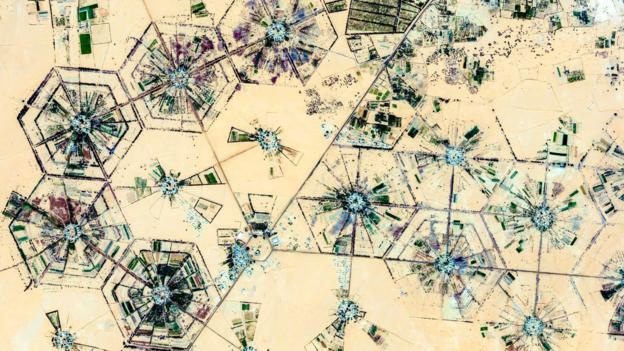
Next, we journey east, across the vast emptiness of the Sahara to Libya. Here, our satellites spot another anomaly. This one isn’t a single eye, but a sprawling, repeating pattern. A honeycomb of perfect circles glowing with an eerie green light against the tan wasteland. The original source for this article? They thought this was a mine. A scar. They couldn’t have been more wrong.
This is not a scar. It is life. It is a design.

From orbit, it looks like a circuit board laid over the desert. A landing field for visitors from another world. The sheer scale and perfection are hard to process. Each circle is up to a kilometer in diameter. Why would anyone build such a thing in one of the most inhospitable places on Earth?
Ancient astronaut theorists would have a field day. Is this evidence of extraterrestrial terraforming? A message carved into the landscape, meant to be seen only from above? The precision seems beyond simple human effort. It feels… calculated. Alien. A signal to the stars.
Deep Dive: The Great Man-Made River
The truth is, in a way, just as science-fictional. This isn’t an alien project. It’s a human one. And it’s one of the most ambitious engineering projects in the history of our species.
These are farms. The circles are created by center-pivot irrigation systems. A long, wheeled pipe, anchored in the center, rotates like the hand of a clock, spraying water over the crops below. The water itself is the real mystery. It’s not coming from rain—there is none. It’s being pumped from deep, deep underground.
Beneath the Sahara lies the Nubian Sandstone Aquifer System. It is the largest known fossil water aquifer in the world. This is ancient water, trapped in the rock tens of thousands of years ago, when the Sahara was a vibrant savanna. It is a finite resource. An underground ocean that is not being refilled.
In the 1980s, Libya began the “Great Man-Made River” project, a network of massive underground pipes, some four meters in diameter, to pump this ancient water to the surface and turn the desert green. It’s a staggering achievement. A testament to humanity’s refusal to bow to nature. They are literally mining for water to create these oases.
But there’s a dark shadow hanging over this miracle. The clock is ticking. Every drop of water pumped to the surface is a drop that will never return. Experts estimate the aquifer could be depleted in less than a century. These glowing green circles are a temporary marvel. A beautiful, defiant, and ultimately doomed spectacle. We are watching a modern miracle built on borrowed time. How long until the green turns back to brown forever?
The Blue Bleed: A Toxic Wound or a Buried Treasure?
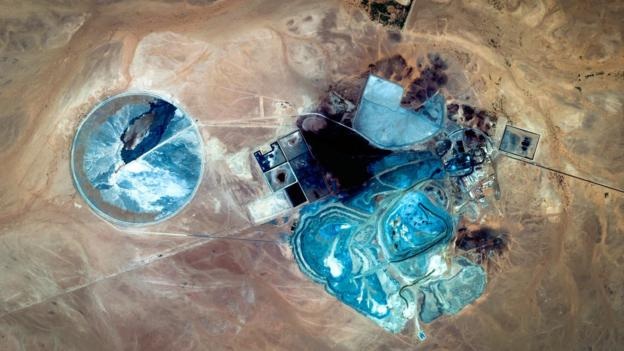
Our journey returns to Mauritania, not far from the Eye of the Sahara. But here, the satellite sees something else entirely. Not a perfect circle, but a brilliant, ugly, unnatural smear of turquoise and blue, bleeding into the golden sand. It looks like an industrial accident. A toxic spill from some secret facility. A chemical wound on the face of the planet.
The confusion surrounding this image is almost comical. In an astonishing mix-up, the source material for this post identified this location as “The Pearl-Qatar,” a luxury artificial island resort. How could anyone, anywhere, mistake this raw, bleeding gash in the desert for a playground of the super-rich?
The disconnect is staggering. It makes you wonder what else they’re getting wrong.

Let your mind wander. What could create such a color? Could it be the crash site of an otherworldly craft, its exotic metals and power sources leaking into the environment? Perhaps a failed terraforming experiment, where alien microbes reacted unexpectedly with the desert minerals? The color is so vibrant, so out of place, it screams “not from here.”
The Real Story: Riches and Scars
The reality is more grounded, but no less dramatic. This is the Guelb Moghrein copper and gold mine near the town of Akjoujt. That brilliant blue-green color? It’s the result of copper oxidation. When copper ore is dug up and exposed to air and water, it essentially “rusts,” creating colorful copper carbonate deposits. It’s the same chemical reaction that turns the Statue of Liberty green.
This is a treasure map, written in chemistry. The blue stain is a giant signpost pointing to immense wealth buried beneath the sand. This single mine is a cornerstone of Mauritania’s economy. In the mid-2000s, it was projected to produce over 3,000 kilograms of pure gold per year. That’s a staggering fortune being pulled from this one spot.
But that fortune comes at a price. Open-pit mining is an inherently destructive process. You are literally moving mountains and digging colossal pits to get at the valuable ore. The blue “bleed” is a visual reminder of that process—both the wealth it creates and the permanent scar it leaves on the landscape. The very thing that makes the country rich is also a wound upon its surface. Today, satellites are used by environmental groups to monitor sites just like this, turning our eyes in the sky from simple cameras into powerful watchdogs for the planet’s health.
The Man-Made Mirage: Islands Built on Hubris
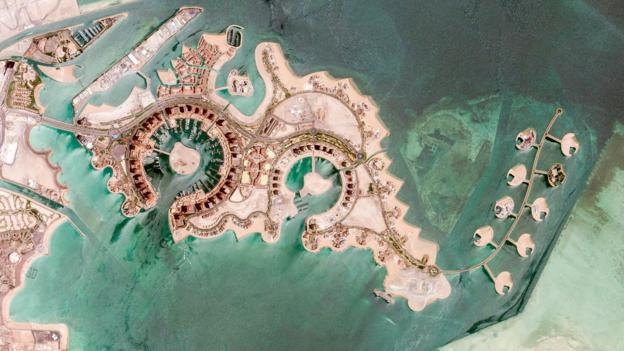
From extracting treasures buried in the earth, we now turn to a place where humanity decided to build treasure on top of the water. This brings us, finally, to the place the last image was mistaken for: The Pearl-Qatar.
Imagine it. You have so much money from oil and gas that you run out of things to buy. So you decide to buy the one thing no one can own: the sea itself. You decide to build your own land.
The Pearl-Qatar is an enormous artificial island in the Persian Gulf, a sprawling complex of luxury villas, five-star hotels, and designer boutiques. It’s an act of pure, unadulterated will. Engineers dredged millions of tons of sand from the seabed and piled it up until a new coastline was born. It’s humanity playing God, shaping the world to fit its desires.
But this paradise is built on a frighteningly unstable foundation. These man-made islands are in a constant war with nature. The sea wants its territory back. Without continuous maintenance, dredging, and reinforcement, the waves and currents will simply wash the islands away. Erosion is a relentless enemy.
We’ve already seen the cautionary tale. Not far away, in Dubai, the “The World” islands project—an artificial archipelago shaped like a map of the globe—stalled after the 2008 financial crisis. Reports for years have claimed the islands are slowly, steadily sinking back into the sea. It’s a ghost world, a monument to ambition that overreached.
Is The Pearl-Qatar destined for the same fate? Are these glittering towers just the world’s most luxurious and slowest-sinking ships? It is a modern Tower of Babel, a testament to wealth so vast it believes it can conquer the planet itself. But the planet always gets the last word.
From the ancient, mysterious eye of the Sahara to the sinking islands of tomorrow, our planet is a canvas of wonders. The view from space doesn’t give us all the answers. Sometimes, it just gives us better, more profound questions. The truth isn’t just out there… it’s down here. You just have to know how to look. And never, ever trust the first label they give you.
Originally posted 2015-11-26 10:40:18. Republished by Blog Post Promoter