Friday, July 10, 2026
HomeUnexplained MysteriesCrime MysteriesThe unexplained disappearance of Ludwig Leichhardt

The unexplained disappearance of Ludwig Leichhardt

Imagine a modern jumbo jet disappearing from the radar. No debris. No black box. No distress signal. Just gone. Now, take that image and transport it back to 1848. Replace the jet with a massive, noisy expedition party. Seven men. Fifty giant bulls. Twenty mules. Seven horses. A literal moving zoo.

They walked into the Australian bush and vanished off the face of the Earth.

This isn’t just a cold case; it is the “Mary Celeste” of the desert. It is the Titanic of Australian exploration. How do you hide a herd of cattle in a flat, red wasteland? How does an entire caravan evaporate without leaving a single buckle, rifle, or bone for over a century? The story of Ludwig Leichhardt is a maddening puzzle of incompetence, brilliance, madness, and a silence so loud it still deafens historians today.

The unexplained disappearance of Ludwig Leichhardt

The Prussian Prince of Bad Ideas

To understand the disappearance, you have to understand the man. And Ludwig Leichhardt was, to put it mildly, a weird guy. He wasn’t your typical rugged outdoorsman. He was the opposite. When he hit the Australian shores in 1842, the continent was a terrifying blank slate. The map edges were filled in, but the center? That was a white void labeled “Terra Incognita.”

Most explorers were military men. Hardened. Disciplined. Leichhardt was a Prussian draft dodger. He fled the army in October 1840 and ran all the way to Sydney. He claimed to be a doctor, having studied at the prestigious universities of Gottingen and Berlin. But did he have a degree? No record of it exists. He was a “fake it ’til you make it” kind of guy in a land where faking it usually meant dying of thirst.

His eccentricities were legendary. Picture this: A tall, gangly man wandering the bush wearing a Chinese coolie hat to block the sun, carrying a sword because he was terrified of guns. He had terrible eyesight. His sense of direction was famously awful. This is the man who decided he would be the one to conquer the Australian interior. It sounds like the setup for a dark comedy, but it was deadly serious.

The Myth of the Inland Sea

Why go there? What was the point? In the 1840s, a fever gripped explorers. They believed that the center of Australia wasn’t a desert, but a paradise. They thought a massive “Inland Sea” lay in the middle, waiting to be discovered. Leichhardt wanted to be the Christopher Columbus of this imaginary ocean. He yearned to chart the land route from the south all the way to the northern tip, conquering the Great Dividing Range.

The Miracle Run: Why He Thought He Was Invincible

Here is where the story gets tricky. If Leichhardt had failed immediately, he would be a footnote. But he didn’t. He succeeded. Against all odds, logic, and safety regulations.

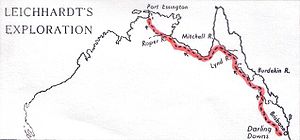
In September 1844, he scraped together a “rag-tag crew.” They had no government funding. Just private backers who bought into Leichhardt’s charisma. They left the Darling Downs with terrible equipment. They didn’t even bring enough water canteens. Their strategy? “Don’t walk more than ten miles from a creek.”

It was a disaster on paper. But they kept moving. For months, they slashed through scrub. In June 1845, tragedy struck. At the edge of the Gulf of Carpentaria, an Aboriginal group attacked the camp. John Gilbert, a brilliant naturalist and the most competent man on the team, was killed instantly. Two others were speared. It should have ended there.

But Leichhardt, the man afraid of guns, pushed them forward. Six months later, ragged, starving, and looking like walking skeletons, they stumbled into Port Essington. They had done the impossible. They crossed the continent.

When they took a ship back to Sydney, the city went wild. They had been given up for dead. Now, they were ghosts returned to life. Leichhardt was a superstar. The King of Prussia pardoned his desertion. Geographical societies threw medals at him. He was the most famous man in Australia. And that fame went straight to his head.

image-10

The descent into Madness

Success is a dangerous drug. Leichhardt believed he could do no wrong. He planned something bigger. A trans-continental sprint. East to West. From the Darling Downs, up to the Gulf, and then straight across the burning heart of the deserts to the Swan River settlement (modern-day Perth).

This is where the cracks started to show. He launched the second expedition in December 1846. If you know anything about Australia, you know December is hell on earth. It is the peak of summer. The heat can melt boots. He dragged a massive herd of sheep, goats, and cattle with him.

It was a fiasco. They were hit by torrential rains and then blistering heat. The group got sick. Why? Because Leichhardt started giving bizarre orders. He insisted they cook the game meat with the entrails still inside. He believed it was nutritious. His men believed it was poison. They spent weeks violently ill.

The “Doctor” had lost his touch. When supplies ran low, he allegedly stole food from his own men’s rations. The team mutinied in spirit, if not in action. After eight months of wandering aimlessly and losing their livestock, they turned back. They returned in failure.

Leichhardt was humiliated. But he was also obsessive. He blamed the weather. He blamed his men. He blamed the goats. He didn’t blame himself. He immediately started planning the third trip.

1848: The Great Vanishing

April 1848. This is the date that haunts historians. Leichhardt found new backers—people who still believed in the miracle of the first trip. He assembled a fresh team. Six mates. But look at the logistics of this train:

  • 50 head of bullock cattle.
  • 20 mules.
  • 7 horses.
  • Tons of equipment.

This wasn’t a stealth mission. This was a parade. It would have been loud, smelly, and slow. They left the Darling Downs, wrote a final letter from a station on the Cogoon River, and walked into the bush.

And that was it.

Silence. Absolute, crushing silence. No one ever saw Ludwig Leichhardt or his men again. No one saw the 50 cows. No one saw the mules. It is as if the ground opened up and swallowed them whole.

The Deep Dive: What Actually Happened?

For 170 years, people have been trying to solve this. It is the holy grail of Outback mysteries. How does a convoy that size disappear? Let’s break down the wildest, scariest, and most plausible theories.

Theory 1: The Great Flood

The Australian interior is a land of extremes. It can be bone dry for five years, and then, in a single afternoon, drown you. Some modern researchers believe the party camped in a dry riverbed. A flash flood, triggered by storms hundreds of miles away, could have roared down the channel at night. A wall of water and mud would have smashed the camp, drowning the men and the animals instantly, and burying the wreckage under ten feet of silt. This explains the lack of artifacts. They are simply buried too deep.

Theory 2: The Mutiny

Remember the entrails? Remember the stolen food? Leichhardt was not a good leader. He was arrogant and erratic. Did the men finally snap? There is a dark theory that out in the middle of nowhere, the men killed Leichhardt. But what then? They would have to disappear too, or risk hanging for murder. Did they kill him and then die of thirst trying to get back? Or did they melt into the population, living a lie for the rest of their lives?

Theory 3: The Aboriginal Wars

Leichhardt was walking through sovereign nations. The interior was not empty; it was populated by Aboriginal tribes who defended their land. The expedition was heavily armed (despite Leichhardt’s sword) and encroaching on sacred waterholes. A coordinated attack could have wiped them out. However, usually, in these cases, trade items (buckles, guns, pots) would circulate through tribes and eventually be found. In this case? Nothing.

Theory 4: The “Wild White Man”

This is the creepiest one. For decades after 1848, rumors floated out of the bush. Stockmen and settlers whispered stories of a “wild white man” living with a tribe deep in the interior. Was it a survivor? Was it Leichhardt himself, his mind broken, living out his days away from the civilization he failed? There were reports of red-haired children in tribes where no white men had officially been.

The Clues That Don’t Add Up

It’s not true that we found nothing. We just found things that don’t make sense.

Over the years, “L” marked trees were found. Leichhardt marked his camps with a large “L” cut into the bark. These trees were found hundreds of miles apart, suggesting the party made it much further than anyone thought. But trees die, and bark grows back. The evidence is organic and rotting.

Then came the bombshell.

The 1938 Discovery

This is the smoking gun that leads nowhere. In 1938, nearly a century after the disappearance, an expedition led by the president of the Royal Geographic Society of South Australia went to the edge of the Simpson Desert. This is brutal country. Red sand dunes that go on forever.

They were chasing rumors of skeletons. What they found was chilling. Lying in the sand were unidentifiable bone fragments and teeth. Human? Maybe. But right next to them lay the real treasure: Two coins.

  • A gold half-sovereign.
  • A Maundy three-pence.

Both were minted before 1848. These were coins that Leichhardt’s men would have had in their pockets. Why were they there, deep in the Simpson Desert, hundreds of miles off Leichhardt’s intended course? Had they gotten hopelessly lost? Had they gone mad and walked into the killing sands of the Simpson?

The “Franklin of Australian Exploration,” as the Sydney Bulletin called him, remains a ghost. We have mapped the surface of Mars better than we have mapped the final resting place of Ludwig Leichhardt.

Did the heat take them? Did the spears take them? or did the sheer vastness of the continent just absorb them? Until someone finds a brass buckle, a rusted gun barrel, or a skull in the red dust, Leichhardt waits. Watching. The man with the coolie hat and the sword, standing forever on the horizon.


Originally posted 2016-09-07 02:01:39. Republished by Blog Post Promoter

Arindam Mukherjee
Arindam Mukherjee
Arindam loves aliens, mysteries and pursing his interest in the area of hacking as a technical writer at 'Planet wank'. You can catch him at his social profiles anytime.
RELATED ARTICLES
- Advertisment -

Most Popular

Recent Comments

Warren Pan Abbott on The legend of the Devil Monkey !
chris davies on The McPherson Tape Mystery
Reed Reedly on ET has Internet!
Bea Houseoffashion on Proof Of Time Travellers – Gallery
Marcus2012 on ET has Internet!
Reed Reedly on ET has Internet!
LaughsAtConspiracyNuts on The 9/11 Conspiracy – Myths and Facts
Alex Sliverman on Did the ancients fly?
Doctor Wholigan on Time Traveler in 1938 film
chris davies on The McPherson Tape Mystery
Archie1954 on 10 secret UFO hideouts
chris davies on Ghosts of flight 401
Marcus2012 on ET has Internet!
jason Macdonald on Proof of Time Travel? – China
chris davies on Long-Lost Pyramids Found?
Reed Reedly on ET has Internet!
Milkman on Connected Universe
Tenmiles on Baigong Pipes Mystery
Simon Foster on Sirius – The Documentary
From the 1st April on 2013 – Alien Contact date ?
SkyWatcher on Is ET ignoring us?
I Come From The Future on Obama to make UFO Alien disclouser soon ?
ÛñK?øWn on 2013 – Alien Contact date ?
Just another person on 2013 – Alien Contact date ?
Malcolm Windowcleaner on The strange case of Rudolph Fentz
Mason Servio on Strange Things on Mars
Marke Wisdom Seeker on What will we find as arctic melts?
Andrea A Elisabeth Levyne on Aliens Captured in Varginha, Brazil
Mitch Grouyeki on Amazing Space Shuttle pictures