The Ghost of Babylon: Have We Been Looking for History’s Greatest Wonder in the Wrong Place?
Of the Seven Wonders of the Ancient World, six are ghosts. The Lighthouse of Alexandria, crumbled. The Colossus of Rhodes, toppled. The Temple of Artemis, torched. We have their ruins, their foundations, their stories etched in stone and scroll. We know where they stood. We know who built them.
But one of them is different.
One is a true phantom. An enigma wrapped in a historical riddle.
The Hanging Gardens of Babylon.
It’s the only one of the Seven Wonders whose location has never been found. Not a single brick. Not a stone foundation. Not one definitive archaeological trace. For centuries, we’ve been told a beautiful story: a lovelorn king, a homesick queen, and a mountain of green built in the middle of a dusty Mesopotamian plain. It’s a fantastic tale. But what if it’s just that? A tale. What if the reason we can’t find the Hanging Gardens of Babylon… is because they were never in Babylon at all?
The Legend We All Learned in School
You know the story. It’s been passed down for over two millennia. Around 600 BC, the mighty King Nebuchadnezzar II, ruler of the Neo-Babylonian Empire, looked upon his new bride, Amytis of Media. She was miserable. Used to the green mountains and lush valleys of her homeland, she found the flat, sun-baked landscape of Babylon to be a desolate prison.
So, in a romantic gesture of epic proportions, the king ordered the impossible. He would build her a mountain.
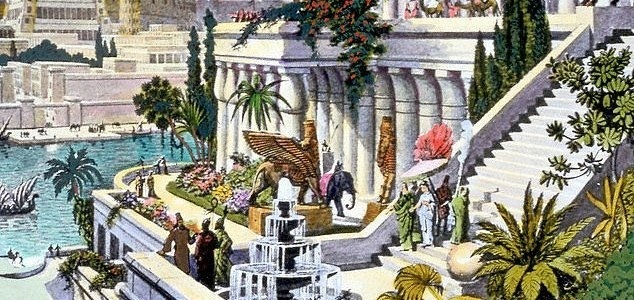
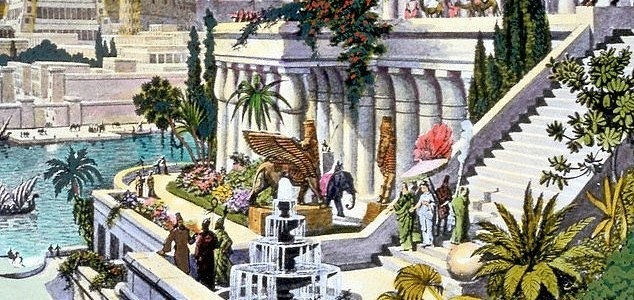
He commanded the construction of a series of terraced gardens, rising hundreds of feet into the sky. An artificial ziggurat of vibrant life. Exotic trees, fragrant flowers, and cascading vines were imported from across the known world. It was a botanical masterpiece, a self-contained ecosystem engineered with breathtaking genius.
Ancient writers who never saw it, but heard the legends, tried to describe the marvel. They spoke of hollow, baked-brick terraces filled with soil deep enough for large trees to take root. They whispered of a complex and hidden irrigation system, perhaps using an early form of the Archimedes’ screw, that endlessly lifted water from the nearby Euphrates River to the very top, creating artificial streams and waterfalls that cooled the air. It was a green paradise suspended in the sky. A wonder for all peoples.
A Major Problem: The Silence of the Scribes
It’s a perfect story. There’s just one colossal problem. It’s almost certainly not true.
The biggest red flag? Complete and utter silence from the people who should have been shouting about it from the rooftops: the Babylonians themselves.
King Nebuchadnezzar II was no humble ruler. He was a prolific builder and an obsessive record-keeper. We have countless cuneiform tablets from his reign. He brags about everything. He details the construction of the massive city walls of Babylon, the majestic Ishtar Gate, the temples, the palaces, his military victories. He lists materials, labor, and dedications to the gods. He wrote about everything.
Everything, except a gigantic, world-famous, mountain-sized garden.
Think about that. The king who documented the specifications of his temple doors makes no mention of the single greatest engineering feat of his reign? It doesn’t add up. It’s like reading a biography of Gustave Eiffel that forgets to mention the tower.
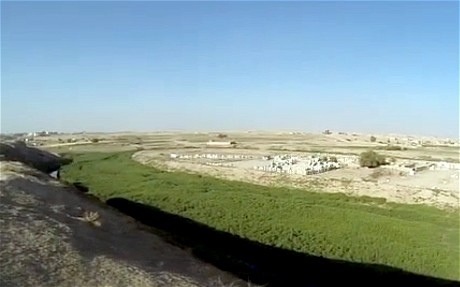
The silence extends to archaeology. For over a century, teams have scoured the ruins of ancient Babylon (near modern-day Hillah, Iraq). They’ve unearthed Nebuchadnezzar’s palace. They’ve found the foundations of the legendary Tower of Babel. They have mapped the city. But the gardens? Nothing. Zero. Zilch. A historical dead end.
A New Suspect, A New City
For decades, this baffling mystery was a historical cold case. An unsolvable puzzle. That is, until a brilliant historical detective decided to look at the evidence from a completely different angle. Dr. Stephanie Dalley, an Assyriologist from Oxford University, spent over twenty years piecing together ancient texts, re-examining evidence, and came to a stunning conclusion.
Everyone has been looking in the wrong place.
She argues that the Hanging Gardens did exist. They were real. But they weren’t in Babylon, and they weren’t built by Nebuchadnezzar.

According to her exhaustive research, the true location was some 300 miles north of Babylon, in the capital city of the Babylonian’s most bitter enemies: the Assyrian empire. The city was Nineveh. And the master builder wasn’t Nebuchadnezzar, but the ruthless and brilliant Assyrian king, Sennacherib, who reigned about a century earlier.
Deep Dive: The Case for King Sennacherib of Assyria
This isn’t just a wild guess. This is a theory built on a mountain of converging evidence that untangles a 2,000-year-old historical mix-up.
Exhibit A: The King’s Own Confession
Unlike Nebuchadnezzar, King Sennacherib couldn’t stop talking about his garden. His own cuneiform records, which Dr. Dalley meticulously translated, are filled with boasts about his magnificent palace at Nineveh, which he called a “Palace Without a Rival.” And right next to it? You guessed it.
He describes, in his own words, creating a massive, man-made, terraced landscape. A “wonder for all peoples.” He talks about planting a vast array of trees and exotic plants, creating a replica of the high mountain country of Amanus. He even details the incredible technology he used to water his creation.
Sennacherib wrote about constructing an enormous, 18-meter-wide canal and a sophisticated aqueduct system that stretched over 50 miles from the mountains to bring fresh water to Nineveh. He proudly describes inventing a new method for casting bronze and using it to create huge “water-raising screws” or cylinders to lift the water up to the highest terraces. This perfectly matches the descriptions of the garden’s irrigation from later Greek writers, a technology they mistakenly attributed to Archimedes, who lived 400 years later!
The evidence is right there, in the king’s own words. A terraced wonder. Exotic plants. A complex, high-tech irrigation system. It’s all there.
Exhibit B: The “Babylon” Blunder
“But wait,” you say, “why was it called the Hanging Gardens of *Babylon*?”
This is the linchpin of the whole mix-up. After the Assyrians, led by Sennacherib, conquered and sacked Babylon in 689 BC, their capital city of Nineveh became the undisputed center of the Mesopotamian world. Assyrian kings began to give their own cities ceremonial names. Gates in Nineveh were named after the gates of Babylon. It became a kind of symbolic conquest. Dr. Dalley argues that Nineveh itself came to be known in some contexts as “New Babylon.”
Centuries later, when Greek historians like Herodotus and later writers heard tales of this magnificent garden in “Babylon,” they naturally assumed it meant the famous city of Babylon itself. The name of the famous city stuck, but the real location—the rival capital of Nineveh—was forgotten. It was a simple, but profound, geographical error that echoed through history, sending generations of archaeologists on a wild goose chase.
Exhibit C: The Smoking Gun on the Wall
Perhaps the most compelling piece of evidence is visual. In the ruins of Sennacherib’s “Palace Without a Rival” at Nineveh, archaeologists unearthed a series of extraordinary bas-reliefs—carved stone panels depicting the king’s life and achievements.
And what do they show?
One distinct set of reliefs portrays the palace situated next to a stunning garden. It’s not just a flat park. It’s a lush, terraced structure, thick with trees, with an aqueduct clearly shown feeding water into it. Arched colonnades support the terraces, and water can be seen flowing down the structure. It’s a picture of the Hanging Gardens. It’s an exact visual match for the descriptions in Sennacherib’s own texts.
It’s the blueprint. The visual confirmation. We have the king’s words describing his garden and a picture carved by his own artists showing that very garden. In the world of ancient history, it doesn’t get much clearer than that.
The Modern-Day Twist: A Treasure in a War Zone
So, the mystery is solved, right? We just need to go to Nineveh, near the modern city of Mosul in northern Iraq, and start digging for the foundations.
If only it were that simple.
This is where the story takes a tragic, modern turn. The proposed site for Sennacherib’s gardens has, for recent decades, been one of the most dangerous and unstable places on the planet. The region has been ravaged by war and conflict. Archaeological sites, including parts of ancient Nineveh, were catastrophically damaged or destroyed by ISIS during their occupation of Mosul. Priceless history was turned to dust.
The very ground that may hold the final, definitive proof of history’s most elusive wonder is a minefield, both literally and figuratively. The quest to unearth this truth is fraught with peril. It’s a heartbreaking irony: just as we’ve finally figured out where to look, the location has become almost inaccessible. The final secrets of the gardens are held hostage by the conflicts of the modern world.
So, What Do We Believe?
The romantic story of Nebuchadnezzar’s gift to his queen is beautiful. It’s a story of love and grand gestures that has captured our imaginations for centuries. But it is a story with no evidence. No texts, no ruins, nothing.
The theory of Sennacherib’s garden at Nineveh is a story of a proud, ingenious, and brutal king. It’s less romantic, perhaps, but it is backed by an avalanche of evidence:
- Sennacherib’s own detailed written accounts.
- Visual proof in the form of palace bas-reliefs.
- The archaeological discovery of his massive aqueduct system.
- A logical explanation for the long-standing “Babylon” confusion.
Was history’s most phantom wonder simply mislabeled? A clerical error that lasted 2,700 years? The evidence is overwhelming. The ghost of Babylon may well be the treasure of Nineveh.
The case seems closed, yet the final, physical proof—the foundations of those terraces, the remnants of those water screws—remains buried. It lies waiting beneath the troubled soil of northern Iraq. Waiting for a time when peace allows archaeologists to safely uncover the last piece of the puzzle and finally, definitively, bring one of the Seven Wonders of the Ancient World back onto the map.