The Night the UK Skies Caught Fire: What Really Fell to Earth?
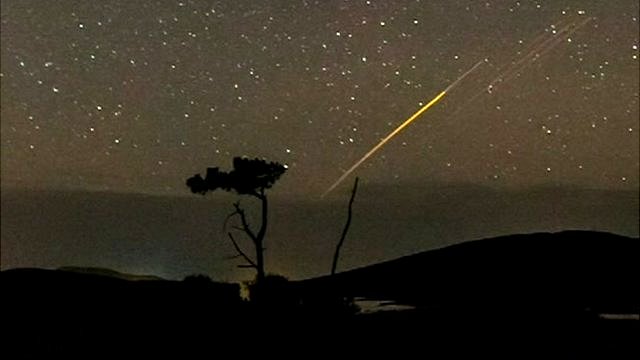
It started with a flicker. A pinprick of unnatural light against the ink-black canvas of the British night sky. Then another. And another. Soon, a silent, blazing procession was marching across the heavens, a celestial parade that stopped people in their tracks from the northernmost tip of Scotland to the quiet coasts of Wales.
This wasn’t your typical shooting star. Not a blink-and-you-miss-it silver streak. No.
This was different. It was slower. More deliberate. A fleet of fiery tears rolling down the face of the night. For a few breathtaking minutes, thousands of people across the United Kingdom all looked up and asked the same questions. What is that? Where did it come from? And what, exactly, are we witnessing?
The official story came quickly. Too quickly, some might say. But the questions? The questions have never gone away. They’ve only grown, festering in the dark corners of the internet, whispered in forums, and debated late into the night. Because what if what we saw wasn’t space junk? What if it wasn’t a meteor shower?
What if it was a message? Or a warning. Or the wreckage of something not of this world.
The Official Reports: A Simple Case of “Space Junk”?
Almost as fast as the lights appeared, the switchboards lit up. Coastguards in Northern Ireland were flooded with calls. Police departments from Glasgow to Norfolk took reports from bewildered and sometimes frightened citizens. The sightings were everywhere, a massive, undeniable event witnessed by an entire nation.
The experts were rolled out. Astronomers, space agency spokespeople, and men in suits who spoke with calm, reassuring authority. The explanation they settled on was neat. Tidy. It fit in a soundbite.
Meteors. Or, more likely, “space junk.”
They told us our planet is wrapped in a cloud of our own garbage. A junkyard in the void. Thousands of defunct satellites, spent rocket boosters, and fragments from orbital collisions silently circle our world. Every so often, the gravitational pull of Earth wins a cosmic tug-of-war, and one of these pieces tumbles back home. It hits the atmosphere at thousands of miles per hour, compresses the air in front of it into a superheated plasma, and burns up in a spectacular, and entirely predictable, light show.
It sounds perfectly logical, doesn’t it? A tidy explanation for a messy, chaotic event. They might have pointed to a specific satellite, perhaps an old Soviet-era relic or a spent American booster, and declared the case closed. Nothing to see here, folks. Just some cosmic litter taking itself out.
But the Official Story Has Problems. Big Ones.
The moment you start scratching at the surface of the “space junk” theory, it begins to flake away. The official narrative, so clean and simple, doesn’t quite line up with the raw, confusing data from the people who actually saw it.
Problem one: The formation. Junk falling from orbit is chaotic. It tumbles. It breaks apart randomly. Eyewitnesses, however, described something far more orderly. They spoke of a procession. A string of lights, following one another on a similar trajectory. Some even used the word “armada.” Does random junk fall in a parade formation?
Problem two: The duration and speed. Meteors, the “dirty snowballs” of the cosmos, are fast. Incredibly fast. They zip across the sky in a heartbeat. This was… slow. Eerily slow. People had time to run inside, grab their families, and come back out to watch. They had time to fumble for their phones and record grainy, shaky videos. This wasn’t a cosmic bullet. This was a stately, silent procession. Far too slow for a meteor, and strangely slow for orbital debris, which should still be moving at a terrific velocity.
Problem three: The silence. A large object, or multiple large objects, breaking up in the upper atmosphere should create sound. Sonic booms that rattle windows. A deep, crackling roar. Yet, the overwhelming consensus from witnesses on the ground was the profound, unsettling silence of it all. It was a light show with the volume turned off. How could something so massive, so visually spectacular, be so quiet?
The official story was a container. But the event itself was too big, too strange, to be held by it.
Whispers from the Ground: What Eyewitnesses REALLY Saw
Forget the dry reports from government agencies. The real story lives in the memories of those who stood beneath that burning sky. It lives in the frantic forum posts typed out in the minutes and hours after the event, a digital flood of shared astonishment and fear.
A farmer in Caithness, Scotland, reported seeing the lights not as a single streak, but as a cluster. “Like embers from a great fire,” he said. “They pulsed. A soft orange, then a bright, angry red. They didn’t fall. They traveled.”
In the Midlands, a group of teenagers hanging out in a park swore they saw the fragments change direction. A slight, but noticeable, course correction. A physical impossibility for a dead piece of falling metal or rock. “It was like they were steering,” one of them later posted online. “Like they were trying to stay together.”
From Coleraine on the north coast of Northern Ireland, a coastguard officer, speaking anonymously, admitted the official line felt wrong. “We’ve seen debris re-entry before. It’s a single, brilliant event that fragments violently. This was… graceful. It was a string of pearls, all on fire. We logged the calls, but we all stood outside and watched. None of us had ever seen anything like it.”
These aren’t the descriptions of random space trash. They are descriptions of something else.
- “They moved too slowly.”
- “There was no sound at all. It was the quietest apocalypse I’ve ever seen.”
- “The colors were wrong. Not just white-hot. There were flashes of green and blue.”
- “It looked like a ship breaking up. A very, very big ship.”
These fragments of human experience, when pieced together, paint a picture that is far more disturbing and profound than the bland explanation we were given.
Deep Dive: Could This Have Been a Secret Military Test?
When an event in the sky defies conventional explanation, there are two roads you can go down. The extraterrestrial. Or the terrestrial. And sometimes, the terrestrial is even more frightening.
Is it possible that the people of the UK weren’t witnessing a celestial event, but the spectacular failure of a top-secret military prototype?
Think about it. The world’s superpowers are in a new arms race, one fought in the hypersonic realm. Vehicles that can travel at Mach 5, Mach 10, Mach 20. Planes and missiles that can skirt the edge of space, capable of striking anywhere on the planet in under an hour. Developing this technology is fraught with peril. Tests go wrong. Prototypes break apart during the punishing heat of re-entry.
What if what people saw was a disintegrating hypersonic glide vehicle? A multi-billion dollar “black project” coming apart over a populated, allied nation? The slow speed could be explained by the vehicle’s “gliding” nature, bleeding off speed as it descended. The multiple fragments? The vehicle’s skin, control surfaces, and internal components shedding away under extreme stress. The silence? Hypersonic vehicles are often designed for stealth, and the sounds they produce at extreme altitude may not reach the ground.
Project Blackstar: A Ghost in the Machine?
For decades, rumors have circulated about a classified American aerospace program, sometimes called “Blackstar.” The theory posits a two-stage-to-orbit system: a massive carrier aircraft that flies to high altitude and launches a smaller, trans-atmospheric vehicle—a spaceplane—into orbit. Such a system would be revolutionary, but also incredibly complex and dangerous.
Could the UK Fireball have been the catastrophic end of a Blackstar-type vehicle? A launch from a secret base, an engine malfunction at the edge of space, and a long, slow, agonizing breakup as it tried to glide back to Earth?
The “space junk” explanation would be the perfect cover story. Instant, plausible deniability. No government would ever admit to losing its most advanced and expensive secret weapon over a friendly country. They’d let the world believe it was a bit of old Russian satellite, file the reports, and quietly sweep the whole embarrassing, terrifying incident under the rug.
Connecting the Dots: From Tunguska to the UK Fireball
Step back from the specifics of this one night. Widen your perspective. You begin to see a pattern. A strange and recurring rhythm of things falling from the sky that don’t quite fit.
In 1908, something exploded over the remote Tunguska forest in Siberia with the force of a thousand Hiroshima bombs. It flattened 80 million trees over an 830-square-mile area. The official explanation? A meteor or a small comet. But here’s the catch: no crater was ever found. No significant meteoric fragments. Just devastation from an aerial blast of unknown origin.
In 1965, an acorn-shaped object with strange hieroglyphic-like markings allegedly crashed in Kecksburg, Pennsylvania. The military was on the scene within an hour, cordoning off the area and removing an object on a flatbed truck, hidden under a tarp. The official story changed multiple times, from meteor to Soviet satellite, before settling on… nothing. The records, they claim, were lost.
Are these isolated incidents? Or are they data points in a much larger, more incredible story? Is it possible that Earth is on a sort of cosmic flight path? That for millennia, objects—both natural and, perhaps, artificial—have been entering our atmosphere, sometimes successfully, sometimes not? The UK Fireball, with its strange characteristics, doesn’t feel like a one-off event. It feels like another chapter in a very, very old book.
The Modern Verdict: What Internet Sleuths Uncovered
The story didn’t end when the sun rose the next day. In the years since, a global community of digital detectives has kept the case alive. Armed with video enhancement software, satellite tracking archives, and a healthy dose of skepticism, they’ve continued to pick at the seams of the official narrative.
Some have analyzed the grainy phone videos, claiming to stabilize the footage enough to show that the “fragments” are not tumbling randomly. They argue the objects maintain a fixed orientation relative to their direction of travel, as if they are aerodynamically stable. Like pieces of a manufactured vehicle, not jagged chunks of rock or metal.
Others have dived into aerospace and satellite launch records for the days and weeks leading up to the event. They found no declared satellite de-orbits or rocket body re-entries that perfectly matched the time and trajectory. While orbital tracking isn’t perfect, the lack of a clear candidate for the “space junk” is deeply suspicious. You can’t just say it was a satellite; you should be able to say *which* satellite. And they couldn’t. Not with any real certainty.
These online communities have become the modern guardians of the mystery. They refuse to let it be forgotten. They know that the official explanation feels thin, like a blanket thrown over something much bigger and far more interesting.
The Final Question: Are We Still Being Watched?
So where does that leave us?
We are left with a massive, undeniable event witnessed by thousands. We have an official story that feels convenient but incomplete. And we have a collection of strange, contradictory evidence from eyewitnesses that suggests something far more profound took place in our skies.
Let’s entertain the most mind-bending possibility for a moment. What if it wasn’t a meteor? What if it wasn’t our own secret technology?
What if it was theirs?
The catastrophic failure of an extraterrestrial vehicle. A scout ship, a probe, or something far older, finally succumbing to the pull of our gravity. The silent, graceful breakup could be the final moments of a technology far beyond our own, its safety systems failing elegantly even in death. The strange colors—the greens and blues—could be the venting of exotic gases or the burn-off of alloys we have yet to invent.
It’s a wild thought. But is it any wilder than a secret hypersonic spaceplane breaking up over one of the world’s most densely populated countries? Is it any wilder than believing that a random piece of space junk just happened to put on a perfectly choreographed, silent, slow-motion ballet for an entire nation?
The lights faded. The news cycle moved on. The reports were filed. But for those who looked up that night, the memory remains. The memory of a sky that was not empty. A sky that was not silent. They saw the veil pulled back for just a moment, revealing that the universe is a far busier, stranger, and more mysterious place than we are led to believe.
The question isn’t just “What fell over the UK?” The real question is… what else is up there, waiting to fall?