The Day a 10,000-Foot Wall Ate Phoenix: Freak Storm or a Chilling Government Test?
It was Tuesday, July 5th, 2011. A typical sweltering summer day in Phoenix, Arizona. The sun beat down. The air was thick. Kids were splashing in pools, and the hum of a million air conditioners filled the suburbs. It was normal. Boringly, beautifully normal.
Until it wasn’t.
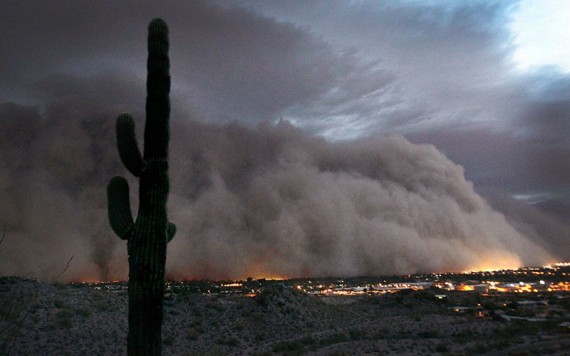
On the horizon, something was stirring. Something was growing. A smudge of brown against the brilliant blue sky. But this was no distant fire. This was a monster awakening from its slumber in the Sonoran Desert. A monster of biblical proportions.
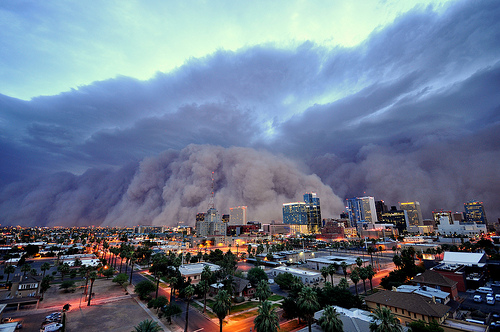
Soon, the smudge became a wall. A colossal, churning, terrifying wall of dirt and sand, reaching for the heavens. It blotted out the sun. It consumed the mountains. It moved with an unnatural speed, a silent, unstoppable tsunami of earth racing toward a city of 1.5 million unsuspecting people.
This wasn’t just a storm. It was an event. An anomaly. A moment seared into the memory of everyone who saw it. They called it a “haboob.” But a decade later, looking back at the footage, reading the reports, and connecting the dots, you have to ask a darker question. Was it really just weather?
The Official Story: A “Once-in-a-Generation” Haboob
Let’s get the textbook explanation out of the way first. This is what *they* tell us happened.
Meteorologists and government agencies were quick to label the event a haboob—an Arabic term for a particularly intense type of dust storm. According to the National Weather Service, the phenomenon was triggered by the powerful downdrafts from a collapsing thunderstorm complex tied to the Southwest monsoon. Imagine a giant, invisible water balloon bursting in the upper atmosphere. The resulting downward blast of air, traveling at speeds exceeding 60 miles per hour, hit the dry, dusty desert floor and kicked up a frenzy of particulate matter.
The numbers they threw around were staggering.
The wall of dust was reportedly 50 miles wide in some places. It towered to heights of nearly 10,000 feet—that’s almost two miles straight up. It traveled over 150 miles, originating near Tucson and barrelling northwest, swallowing everything in its path before slamming into the Phoenix metropolitan area.
Flights were grounded. Power was knocked out for thousands. Visibility dropped to absolute zero. For over an hour, a major American city was plunged into a gritty, brown-black darkness in the middle of the afternoon. A nightmare come to life.
Experts on television, with their calm, reassuring voices, told everyone this was simply a force of nature. A “perfect storm” of conditions. High winds, dry soil, and a powerful monsoon collapse. They called it a generational event, a spectacle of nature’s raw power. A random act of God.
Case closed, right? Nothing to see here, folks. Just move along.
But that’s the problem. It just doesn’t feel right. When something is *that* extreme, *that* out of the ordinary, the simple answers often hide a much more complicated truth.
But Was It *Really* Normal?
Arizonans are no strangers to dust storms. They’re a fact of life in the desert. But this… this was different. Locals who had lived in the valley for 50 years, people who had seen it all, were left stunned, speechless. They flooded news channels and online forums with a single, unified message: “We’ve never seen anything like this.”
The scale was wrong. The intensity was off the charts. The structure of the wall itself seemed almost… engineered. It was too perfect, too uniform. It didn’t look like a chaotic storm; it looked like a deployed weapon.
This wasn’t just more dust. It was an entirely different beast. The official story claims it was a natural occurrence, but it conveniently ignores the strange details, the odd reports, and the whispers that began circulating in the days and weeks that followed.
Deep Dive: The Whispers and Anomalies the Media Ignored
Once the dust settled—literally—strange stories began to bubble to the surface. These weren’t front-page news. You had to dig for them on internet forums, in comment sections, and in local community groups. These are the pieces that don’t fit the neat, tidy meteorological puzzle.
Anomaly #1: The Eerie Silence and Strange Electrical Charges
Multiple eyewitnesses reported something bizarre. Just before the dust wall hit, an unnatural silence fell over their neighborhoods. The normal sounds of the city—traffic, birds, distant sirens—just vanished. It was a dead, oppressive quiet, the kind that makes the hair on your arms stand up.
Then came the static. People described a powerful feeling of static electricity in the air, far more intense than a typical dry day. Car radios fizzled with weird interference. Some claimed their electronics behaved erratically moments before the storm engulfed them. Was this just a byproduct of billions of dust particles rubbing together? Or was it evidence of a massive electromagnetic energy source driving the storm? An energy source that wasn’t natural?
Anomaly #2: What Was *In* the Dust?
The official line is that the haboob was composed of simple dust, sand, and clay from the desert floor. But anecdotal reports paint a different picture. People who had to clean up the aftermath described the dust as being unusually “heavy” and “oily.” Some claimed it had a faint metallic sheen when it settled on surfaces.
Online researchers—citizen scientists dismissed as conspiracy theorists—began asking questions. Was a sample of this dust ever independently analyzed? Or did we just accept the official explanation? In an age of chemtrails and atmospheric aerosol injection programs, the idea of seeding a storm with specific materials isn’t science fiction. It’s a documented reality.
Could this colossal storm have been a delivery mechanism? A massive experiment to disperse experimental materials over a major population center under the perfect cover of a “natural” disaster?

Anomaly #3: The Military Connection
Now we get to the heart of it. Where do you go to test next-generation technology far from prying eyes? The desert.
Arizona is home to some of the most advanced and secretive military installations in the world. Luke Air Force Base sits right on the western edge of Phoenix. To the south and west, you have the massive Barry M. Goldwater Air Force Range, a sprawling testing ground for experimental aircraft and advanced weaponry. Fort Huachuca, a hub for military intelligence and electronics testing, isn’t far away.
For decades, researchers have speculated about government programs designed to control the weather. Programs like the infamous HAARP (High-frequency Active Auroral Research Program) in Alaska proved that manipulating the ionosphere with energy was not only possible but actively being done.
What if the 2011 Phoenix haboob wasn’t an accident?
What if it was a test?
Think about it. The “collapsing thunderstorm” is the key. What could cause a massive, energy-filled storm cell to suddenly and violently collapse on command? A targeted burst of energy, perhaps? A specific frequency aimed at destabilizing the atmospheric conditions in a precise way to achieve a desired outcome?
The objective wouldn’t be to create a dust storm for its own sake. The storm would be the *side effect*. The real test could have been anything:
- Testing a new form of radar-cloaking technology that requires a particulate-dense environment.
- Studying large-scale battlefield obscuration techniques.
- Analyzing the psychological impact of a sudden, disorienting, and terrifying event on a large population.
- Dispersing chemical or biological agents under the cover of a “natural” event to test their spread and effect.
The idea of weather warfare is not a fantasy. In a declassified 1996 research paper titled “Weather as a Force Multiplier: Owning the Weather in 2025,” the U.S. Air Force explicitly outlined its goal of developing weather modification technologies for combat applications. They talked about “storm modification,” “precipitation enhancement,” and “fog dispersal.” The 2011 Phoenix event looks terrifyingly similar to the kind of “battlefield obscuration” they described.
A Pattern of Strange Skies
The 2011 Phoenix haboob didn’t happen in a vacuum. In the years since, we’ve seen a sharp increase in bizarre, “unprecedented” weather events all over the globe. Strange cloud formations. Sudden, violent microbursts. Unseasonal storms of shocking intensity.
The internet is now filled with videos and photos of these events, captured by ordinary people on their cell phones. The official explanation is always the same: climate change. And while the climate is undoubtedly changing, it has also become a convenient catch-all explanation for events that might have a more direct, and more sinister, cause.
Is it possible that what happened in Phoenix was an early, large-scale field test of technologies that are now being deployed more frequently around the world? Was the Arizona desert the perfect laboratory for a new kind of warfare, one fought not with bombs and bullets, but with wind and rain and lightning?
The Final Question That Haunts Us
Was the great Phoenix dust storm of 2011 a random, chaotic act of nature? A freak alignment of temperature, wind, and pressure that created a monster?
Or was it a controlled, calculated, and terrifyingly successful demonstration of power?
Maybe it was just a storm. Maybe we’re seeing patterns that aren’t there. But maybe, just maybe, we were shown a glimpse of the future. A future where the sky itself can be turned into a weapon. Where the storms are no longer sent by God, but by the government.
The footage is still out there. Watch it again. But this time, don’t watch it as a weather report. Watch it as a warning.