Wednesday, August 12, 2026

Shroud Of Turin Mystery

The Shroud of Turin: History’s Oldest Photograph or Its Most Audacious Hoax?

It lies silent in a climate-controlled, bulletproof case in Turin, Italy. A long, yellowish strip of linen cloth. Faint. Ghostly. To the naked eye, it’s almost unimpressive. Just a few sepia stains that seem to resolve into the faint outline of a man.

But this is no ordinary cloth.

This is the Shroud of Turin.

It’s a 14-foot-long enigma that bears the full, front-and-back image of a bearded, crucified man. A man whose wounds mirror, with terrifying precision, the suffering of Jesus of Nazareth as described in the Gospels. For millions, it is the authentic burial cloth of Christ, a silent witness to the most pivotal moment in Christianity. A holy relic saturated with divine power.

For skeptics, it’s the most brilliant and enduring forgery ever conceived. A masterpiece of medieval deception.

The truth? The truth is far more complicated, far more confusing, and infinitely more fascinating than either side wants to admit. Forget everything you think you know. We’re going down a rabbit hole where cutting-edge science collides with ancient faith, and every answer only spawns a dozen more questions. This isn’t just a story about a piece of cloth. It’s a story about a mystery that refuses to die.

A Forensic Nightmare: The Wounds on the Man in the Shroud

Before we touch the science, the history, or the controversy, you have to look closer at the image itself. Because the details are chilling. This isn’t a simple artistic rendering. It’s a brutal, forensic snapshot of a man who has been systematically tortured to death.

The image shows a man, about 5’10” to 6’0″ tall, with a beard and long hair. His body is covered in marks. Not random marks. Specific, patterned marks. Pathologists and medical examiners who have studied the Shroud are consistently stunned by its anatomical accuracy.

More Than a Crown of Thorns

Forget the simple circlet of thorns you see in most religious art. The man on the Shroud has dozens of puncture wounds all over his scalp, consistent with a cap or helmet of thorns being pressed down onto his head. Blood has trickled down his forehead, matting in his hair, following the natural paths gravity would dictate.

The Scourging

His back, chest, and legs are covered with over 100 small, dumbbell-shaped wounds. These aren’t just random lacerations. They are consistent with the signature mark of a Roman *flagrum*—a vicious whip with multiple strands tipped with small pieces of bone or metal designed to gouge and tear flesh. The angles of the wounds suggest two men, one on either side, carried out the beating.

The Nails Weren’t in His Hands

This is a big one. For centuries, artists have depicted Christ crucified with nails through the palms of his hands. It’s an iconic image. But it’s anatomically wrong. A nail in the palm cannot support the weight of a body; it would tear right through the flesh. The man on the Shroud has a large, round wound on his wrist, in an area known as Destot’s Space. A nail driven through this point would be medically perfect—it would secure the hand to the crossbeam without fracturing major bones and would strike the median nerve, causing indescribable pain and forcing the thumb to clench into the palm. The thumbs of the man on the Shroud are not visible. Who, in the Middle Ages, would have known this precise, gruesome anatomical detail, contradicting centuries of established religious iconography?

Then there’s the spear wound in his side, between the ribs. Post-mortem blood and a watery fluid (blood serum) are seen flowing from it, a detail that matches the Gospel of John’s account of “blood and water” pouring from Christ’s side. The blood on the cloth, by the way, has been tested multiple times. The consensus is that it is real, human blood. Type AB, a relatively rare blood type, but more common in the Middle East.

The 1898 Photo That Changed Everything

For centuries, the Shroud was an object of veneration, but its faint image was hard to truly appreciate. Then came May 28, 1898. The cloth was being publicly exhibited, and an amateur Italian photographer named Secondo Pia was given permission to photograph it for the first time.

He set up his heavy, primitive equipment. He took the pictures. Later that night, in his darkroom, he submerged the glass plate negative into the developing chemicals. And he nearly dropped it in shock.

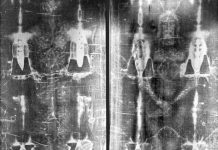
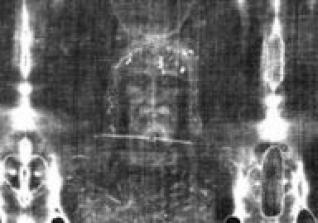
As the image slowly appeared on the plate, something impossible was happening. The faint, ghost-like figure on the cloth was transformed. On the photographic negative, the image was a stunningly detailed, lifelike positive portrait. The hollow eyes gained depth. The flat beard became full. The strange stains became a clear, coherent image of a man.

Think about that for a second.

The image on the Shroud of Turin is, in effect, a photographic negative. The light and dark areas are inverted. How could a medieval forger, centuries before the invention of photography, create a large-scale, anatomically perfect negative image on cloth?

It’s a question that stumped everyone. This single discovery transformed the Shroud from a simple relic into a profound scientific mystery. The photograph revealed details no one had ever seen before and launched a century of intense investigation.

Case Closed? The Carbon-14 Bombshell of 1988

For decades, the debate raged. Then, in 1988, the Vatican agreed to what many believed would be the final, definitive test. A small sample of the Shroud’s linen would be subjected to radiocarbon dating. The world held its breath.

Three of the world’s most prestigious laboratories—in Oxford, Zurich, and Arizona—were each given a tiny swatch of the cloth, along with control samples. The process was meticulously documented. The goal was to determine the age of the linen itself.

The results were an earthquake.

All three labs, working independently, came to the exact same conclusion. The linen of the Shroud of Turin was not from the 1st century. Not even close. The data placed its origin squarely between 1260 and 1390 AD.

The headlines were brutal. “FAKE!” “HOAX!” “SHROUD OF TURIN IS A MEDIEVAL FORGERY.” For the scientific community and the general public, the case was closed. The Shroud was a clever fake, a religious prop created to inspire the faithful during the Middle Ages. The mystery was solved.

Or was it?

Not So Fast: The Fight to Discredit the Dating

Almost immediately after the 1988 announcement, pro-Shroud researchers cried foul. They didn’t just question the results; they attacked the very sample that was tested. And their arguments weren’t just based on faith. They were based on chemistry and history.

Was the Sample a Medieval Patch?

The single sample cut for the C-14 test was taken from a corner of the Shroud. A corner that, critics argue, was the worst possible place to sample. Why? Because the Shroud has a violent history. In 1532, a fire broke out in the chapel in Chambéry, France, where the Shroud was kept. The silver casket holding it melted, and drops of molten silver burned through the folded cloth. The Poor Clare nuns who rescued it attempted to repair the damage, dousing the flames with water and sewing patches over the holes.

The theory, championed by chemist Raymond Rogers of the Los Alamos National Laboratory, is that the corner sampled in 1988 was not part of the original cloth. He argued it was part of an expert “invisible reweave”—a medieval repair blending newer material with the original linen to fix damage.

The Telltale Clue of Vanishing Vanillin

How did Rogers support this wild claim? With some clever chemistry. He tested fibers from the main body of the Shroud and fibers from near the C-14 sample area. He was looking for vanillin. Vanillin is a chemical compound in linen that breaks down over time. Think of it like a clock. The older the linen, the less vanillin it should have. Rogers found that the main body of the Shroud had no vanillin, consistent with material that is thousands of years old. But the fibers from the C-14 sample area? They had significant amounts of vanillin, consistent with medieval fabric.

He also found cotton intertwined with the linen fibers in the sample area—but not on the main body of the cloth. This suggested a repair, as cotton was commonly used in the Middle Ages to blend with linen for reweaving.

The implication was staggering: the labs in 1988 had perfectly dated the piece of cloth they were given. The problem is, they were given a piece of a medieval patch, not the original Shroud.

This controversy still rages. Other scientists have disputed Rogers’ findings, and the debate over the C-14 dating is as fierce today as it was in 1988.

If It’s a Fake, How on Earth Was It Made?

Let’s play devil’s advocate. Let’s assume the C-14 date is correct. The Shroud is medieval. Now the mystery gets even deeper. How did a 14th-century artist *create* it?

Researchers have tried for decades to replicate the Shroud’s image using medieval techniques. All have failed.

Is it a painting? Absolutely not, according to every microscopic analysis. There are no brush strokes. There is no directionality to the image. The pigment, if there is any, doesn’t sit on top of the fibers like paint would; it’s a discoloration of the top few microfibers themselves. It’s so superficial you can’t even scrape it off. No known paint or dye behaves this way.

Is it a rubbing? Some skeptics, like investigator Joe Nickell, proposed it was created by rubbing a cloth over a heated bas-relief sculpture. He’s produced images that look vaguely similar from a distance, but they fail to replicate the key features of the Shroud: the negative image properties, the lack of directionality, and the 3D information encoded in the image.

Wait, 3D information? Yes. In the 1970s, NASA scientists using a VP-8 Image Analyzer—a device used to map planetary surfaces like Mars—ran a photo of the Shroud through it. They were stunned. The Shroud’s image contained three-dimensional data. The intensity of the image relates directly to the distance the cloth was from the body. Areas that would have been closer to the cloth (the nose, forehead) are darker, while recessed areas (eye sockets) are lighter. A normal painting or photograph is flat and produces a distorted mess in the VP-8. The Shroud produces a perfect 3D relief of a human form.

How does a medieval forger embed 3D data into a piece of linen?

What about a proto-photograph? Some have theorized that a brilliant medieval mind, perhaps even Leonardo da Vinci (though the timeline doesn’t quite work), invented a primitive form of photography using a camera obscura and light-sensitive chemicals. It’s a fascinating idea, but it requires a level of scientific knowledge that seems impossible for the period, not to mention a giant lens and a human subject willing to remain perfectly still for an extremely long exposure.

Whispers from the Dust: Pollen, Coins, and Jerusalem Dirt

The cloth itself contains more clues that fly in the face of the medieval forgery theory. Criminologists have analyzed the dust and particles trapped in the weave of the linen for decades.

In the 1970s, Swiss criminologist Max Frei took sticky-tape samples from the Shroud’s surface. Under his microscope, he found pollen grains. Many were from plants native to France and Italy, as expected. But he also identified several species that are unique to the desert regions around Constantinople and, most importantly, Jerusalem. One species, *Gundelia tournefortii*, is a thorny plant that blooms in the Jerusalem area only in the spring.

Then there are the coins. Researchers using advanced image processing techniques claim to have spotted faint outlines over the eyes of the man on the Shroud, consistent with the ancient Jewish burial practice of placing coins on the eyes to keep them closed. They believe they can identify one of them as a “lepton” coin minted by none other than Pontius Pilate in Jerusalem around 29 AD. The markings are faint, and skeptics dismiss this as a classic case of pareidolia—seeing patterns where none exist. But if they are right, it’s a stunning piece of evidence.

Perhaps most compelling is the dirt. Analysis of soil particles found on the Shroud, particularly around the nose, knees, and feet, revealed a specific type of travertine aragonite limestone. According to geologists, the chemical signature of this limestone is a perfect match for the limestone found in ancient tombs just outside the old city walls of Jerusalem. And nowhere else on earth.

The Final Verdict: A Mystery That Refuses to Die

So where does that leave us? Trapped in a paradox.

One single, powerful piece of scientific evidence—the 1988 radiocarbon dating—points to a medieval forgery. But that evidence is now hotly contested.

Meanwhile, a mountain of other evidence—the forensically perfect wounds, the photographic negative properties, the 3D information, the absence of paint, the presence of real human blood, the pollen from Jerusalem, and the unique soil from ancient tombs—all point to something far older, far more complex, and far more difficult to explain away.

Could the Shroud be a product of a natural chemical process? Some scientists propose the “Maillard reaction,” where vapors from a decomposing body slowly scorch an image onto the cloth. Others, bridging science and faith, suggest a “coronal discharge”—that a burst of intense radiation at the moment of Resurrection burned the image onto the linen with the flash of a million cameras.

The Shroud of Turin asks us a question we may never be able to answer. Is it the authentic burial cloth of Jesus Christ, a silent relic holding a miraculous image of the Resurrection? Is it a work of unparalleled human genius, a forgery so brilliant that our most advanced 21st-century science still cannot figure out how it was made? Or is it something else? A natural phenomenon we simply don’t understand yet?

The cloth remains silent. Waiting. And holding onto its secrets.

Amit Ghosh
Amit Ghoshhttps://coolinterestingnews.com
Aloha, I'm Amit Ghosh, a web entrepreneur and avid blogger. Bitten by entrepreneurial bug, I got kicked out from college and ended up being millionaire and running a digital media company named Aeron7 headquartered at Lithuania.
RELATED ARTICLES
- Advertisment -

Most Popular

Recent Comments

Warren Pan Abbott on The legend of the Devil Monkey !
chris davies on The McPherson Tape Mystery
Reed Reedly on ET has Internet!
Bea Houseoffashion on Proof Of Time Travellers – Gallery
Marcus2012 on ET has Internet!
Reed Reedly on ET has Internet!
LaughsAtConspiracyNuts on The 9/11 Conspiracy – Myths and Facts
Alex Sliverman on Did the ancients fly?
Doctor Wholigan on Time Traveler in 1938 film
chris davies on The McPherson Tape Mystery
Archie1954 on 10 secret UFO hideouts
chris davies on Ghosts of flight 401
Marcus2012 on ET has Internet!
jason Macdonald on Proof of Time Travel? – China
chris davies on Long-Lost Pyramids Found?
Reed Reedly on ET has Internet!
Milkman on Connected Universe
Tenmiles on Baigong Pipes Mystery
Simon Foster on Sirius – The Documentary
From the 1st April on 2013 – Alien Contact date ?
SkyWatcher on Is ET ignoring us?
I Come From The Future on Obama to make UFO Alien disclouser soon ?
ÛñK?øWn on 2013 – Alien Contact date ?
Just another person on 2013 – Alien Contact date ?
Malcolm Windowcleaner on The strange case of Rudolph Fentz
Mason Servio on Strange Things on Mars
Marke Wisdom Seeker on What will we find as arctic melts?
Andrea A Elisabeth Levyne on Aliens Captured in Varginha, Brazil
Mitch Grouyeki on Amazing Space Shuttle pictures