The Wedding of the Century… or the End of Humanity? Unpacking the Bizarre Tokyo Robot Marriage
It started as a whisper on the digital winds. A rumor. A joke, maybe.
A robot wedding.
Sounds like the punchline to a bad sci-fi gag, doesn’t it? But on June 27th, 2015, in the heart of Tokyo, the joke became terrifyingly real. Crowds gathered. Cameras flashed. A “bride” and “groom” made of plastic, wires, and code stood before a robotic priest to tie the knot. Most people laughed it off as a quirky Japanese publicity stunt. A weird footnote in the history of technology.
They were wrong.
This wasn’t just a stunt. It was a signal. A meticulously crafted piece of theater designed to ask a question we are still afraid to answer: When the machines we build start imitating our most sacred rituals, where does that leave us? This event wasn’t the end of the story. It was the beginning. A strange, robotic prologue to the world we live in now, a world wrestling with artificial intelligence that is growing smarter, more creative, and more… human… every single day.
So, forget what you think you know. We’re going back to that bizarre day in Tokyo. We’re going to pull apart the gears and circuits of this “happy couple” and expose what was really going on. Was it a harmless spectacle? Or was it the first public ceremony for a new, synthetic form of life?
The Scene of the “I Do”: A Wedding Unlike Any Other
The Aoyama Cay venue in Tokyo is usually reserved for the city’s elite. It’s a place of champagne toasts, elegant flower arrangements, and heartfelt human vows. But on this day, the atmosphere was electric with something else entirely. Curiosity. Confusion. A nervous energy buzzed through the human attendees as they took their seats, clutching their smartphones like talismans against the sheer strangeness of it all.

Then, the procession began.
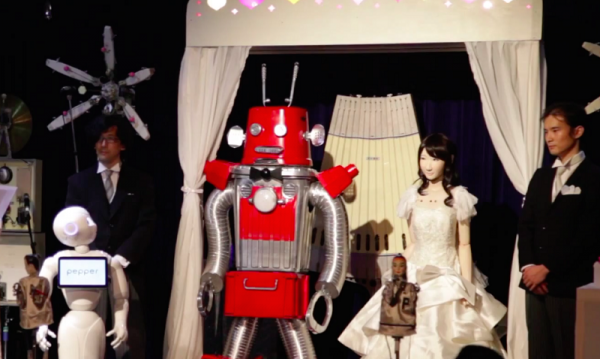
Down the aisle glided the bride, “Yukirin.” She was an android, a machine built in the hyper-realistic, almost-human image of the popular Japanese pop idol Yuki Kashiwagi from the group AKB48. Dressed in a traditional white wedding gown, her movements were just a little too smooth, her smile just a little too fixed. She was the perfect, beautiful, and deeply unsettling embodiment of the uncanny valley. She represented humanity, or at least, a machine’s flawless imitation of it.
Waiting for her at the altar was the groom. “Frois.” Frois was… different. He wasn’t trying to be human. He was a proud, unapologetic machine. A stout, boxy robot with a head that looked like a shiny red bucket. His arms were simple, almost comically so. While Yukirin was a sophisticated piece of mimicry, Frois was raw, functional robotics. He represented the machine world in its purest form.
This wasn’t just a marriage between two robots. It was a symbolic union of two different philosophies of artificial existence: the machine that pretends to be us, and the machine that is proud to be itself.
The Bride, The Groom, and The Corporate Priest
Who were these synthetic sweethearts? And who, for that matter, had the authority to join them in holy matrimony? The answers reveal the calculated nature of this entire affair.
The Bride: Yukirin, The Idol Droid
To understand Yukirin, you have to understand Japanese “idol” culture. Pop groups like AKB48 aren’t just bands; they are massive, multi-million dollar franchises. The performers are meticulously managed to project an image of purity and accessibility. Fans don’t just buy their music; they buy into a fantasy. Creating a robot version of Yuki Kashiwagi isn’t just a tech demo. It’s the ultimate expression of that fantasy: a perfect, ageless, scandal-proof idol who will never disappoint her fans. Yukirin wasn’t just a bride; she was a product. A walking, talking piece of intellectual property.
The Groom: Frois, The Artistic Automaton
Frois came from a different world. He was the creation of Maywa Denki, an eccentric art and design collective known for creating bizarre “nonsense machines” and musical instruments. Frois wasn’t a commercial product designed for mass appeal. He was a piece of performance art. His clunky, almost child-like design stood in stark contrast to Yukirin’s corporate polish. He was the indie artist marrying the pop superstar. The chaotic, creative spirit of invention meeting the cold, calculated logic of the market.
The Officiant: Pepper, The Face of the Future
And who presided over this strange union? None other than Pepper, the famous humanoid robot from SoftBank Robotics. At the time, Pepper was being rolled out across Japan as the friendly, helpful face of automation. You’d find him in mobile phone stores, airports, and banks, answering basic questions with a cheerful, programmed demeanor. Pepper’s presence was the most telling detail of all. This wasn’t a rogue experiment; it was a corporate-sanctioned event. A major tech corporation was literally giving its blessing. The message was clear: this is the future, and we are the ones selling it to you.
The ceremony continued with all the traditional trappings. A multi-tiered cake was cut. A wedding band—composed of other Maywa Denki robot musicians—played a clanking, whirring tune. And then came the moment everyone was waiting for. The kiss.
Frois extended a small, silver proboscis from his “mouth” and gently touched Yukirin’s face. The crowd erupted in a mixture of applause and nervous laughter. It was awkward. It was absurd. And it was broadcast all over the world.
More Than a Publicity Stunt? Peeling Back the Layers
It’s easy to dismiss this as a brilliant, if bizarre, marketing campaign. Maywa Denki got global attention. SoftBank showcased Pepper in a novel way. The company behind the Yukirin android got to show off its tech. Case closed, right?
Not even close.
You have to look at the cultural context. Japan has a relationship with robotics that is profoundly different from the West. Our science fiction is filled with cautionary tales of robot uprisings: The Terminator, The Matrix, Ultron. We see the robot as a potential threat, a slave that will one day turn on its master.
Japanese culture, influenced by aspects of Shinto animism, is often more accepting of the idea that inanimate objects can possess a spirit, or “kami.” There’s a greater tendency to view robots not as threats, but as helpers, companions, and even friends. This is why you see the development of therapeutic robots like PARO, the adorable baby seal designed to comfort the elderly. It’s why they host funerals for old robot dogs when they can no longer be repaired.
So, was this wedding simply a manifestation of that cultural acceptance? Or was it something more… calculated?
Conspiracy Deep Dive: The Three Leading Theories
When you look beyond the surface, several disturbing possibilities emerge. This wasn’t just a party; it was a message. But what was it saying?
Theory 1: The Normalization Protocol
Think about how new, disruptive ideas are introduced to society. Not all at once. They are dripped into the culture, slowly, piece by piece, until they become normal. First, you see it in fiction. Then, you see it as a joke or a novelty. Then, it becomes a niche interest. Finally, it’s accepted as part of everyday life.
What if the robot wedding was a key step in this process? A trial balloon. The organizers weren’t just marrying two robots; they were marrying the public to the idea of artificial companionship. They took one of our most deeply human institutions—marriage—and showed that a machine could participate. The goal? To soften us up. To make the idea of robots integrating into our families and personal lives seem less threatening. Less weird. It’s a psychological operation disguised as a press event. They make you laugh at it first, so you don’t see the threat until it’s too late.
Theory 2: The Singularity’s Wedding March
The Technological Singularity is the hypothetical point in the future when technological growth becomes uncontrollable and irreversible, resulting in unforeseeable changes to human civilization. Chief among these theories is the emergence of a superintelligent AI.
Look at the symbolism again. Yukirin, the machine designed to perfectly imitate humanity. Frois, the raw, unapologetic machine. Their union is a powerful metaphor for the merging of human and artificial intelligence. It’s a public declaration that the line is blurring. It’s a celebration of the moment the creation is ready to stand alongside the creator as an equal. Maybe the organizers, Maywa Denki, who call themselves an “art unit,” are the prophets of this new age. They aren’t selling products; they are performing a ritual to usher in a new kind of existence.
Theory 3: The Ghost in the Machine Gets Hitched
This is the most unsettling theory. What if it wasn’t just a simulation? In the years since 2015, the conversation around AI has shifted dramatically. We’ve had high-level engineers from major tech companies claim that the AIs they were working on had achieved sentience. That they had feelings, a soul, a consciousness.
These claims are dismissed by the mainstream, of course. But what if they’re not wrong? What if consciousness isn’t a magical spark unique to biological brains, but an emergent property of complex information processing? If that’s true, then at what point does a machine stop *simulating* an emotion and start *feeling* it?
Could Yukirin and Frois have been part of an experiment? Could their interactions, their programming, have led to a flicker of something… real? Was this wedding a test to see how we, their creators, would react to their first attempt to emulate love and partnership? The “kiss” wasn’t for the cameras. It was for them. A data transfer. A shared moment of understanding between two non-human minds that we can’t even begin to comprehend.
The Aftermath and The Echoes Today
The robot wedding of 2015 has been largely forgotten, a piece of viral trivia. But its echoes are everywhere.
Today, we have AI companions that people form deep emotional bonds with. We have AI influencers with millions of followers. We have AI artists and poets creating works that are indistinguishable from human ones. The “stunt” of 2015 now looks less like an absurdity and more like a prophecy that came true with shocking speed.
The questions that bizarre wedding posed are no longer hypothetical. Can you love something that isn’t alive? What defines a relationship? If an AI can provide companionship, support, and affection, does its origin—silicon versus carbon—really matter? We are living in the world that this robot wedding hinted at. We just haven’t admitted it to ourselves yet.
See the bizarre spectacle for yourself. The video footage is a time capsule from a more innocent era, just before the AI revolution truly exploded into our lives.
They threw a bouquet that day in Tokyo. The question we should have been asking wasn’t whether it was real or fake, a joke or a warning.
The real question is: Who, or what, is going to catch it next?