The Silent Lander: What REALLY Happened to Britain’s Beagle 2 on Mars?
Christmas Day, 2003. A tense silence hangs in the air at the National Space Centre in Leicester. The world is watching. Waiting. A tiny, clamshell-shaped probe, no bigger than an open umbrella, is supposed to be calling home from the surface of another planet.
The call sign isn’t some robotic string of data. No. It’s a song. A piece of Britpop art by the band Blur, chosen by artist Damien Hirst to be the first sound beamed back from Mars by a British craft. It was meant to be a moment of triumph, a quirky celebration of ingenuity. A testament to a dream.
But the signal never came.
The minutes turned to hours. The hours to days. The days to years. For more than a decade, the fate of the Beagle 2 lander was one of the greatest mysteries in modern space exploration. It simply vanished. Swallowed whole by the vast, red emptiness of Mars. Did it burn up in a fiery blaze? Did it crash and shatter into a million pieces? Or did something else happen out there in the silent plains of Isidis Planitia?
The official story is one of tragic, heroic failure. But as new evidence has slowly trickled in, a different picture emerges. A picture of a mission that was agonizingly close to success. So close, in fact, that it makes the silence even more haunting. The truth, pieced together from blurry images taken from orbit, is more bizarre and frustrating than anyone could have imagined.
The Dreamer and the Dog
You can’t talk about Beagle 2 without talking about Professor Colin Pillinger. He wasn’t your typical, clean-cut space agency official. With his wild mutton-chop sideburns and infectious, almost chaotic enthusiasm, Pillinger was a force of nature. He was the driving force, the heart and soul behind the United Kingdom’s first-ever solo mission to another world.
The project was quintessentially British. It wasn’t born from a multi-billion dollar government program. It was cobbled together with a shoestring budget of around £50 million, a fraction of the cost of its NASA counterparts. Pillinger and his team were mavericks, relying on clever design, private funding, and sheer willpower to get their dream off the ground. The lander’s name itself was a stroke of genius, evoking a legacy of bold exploration: “Beagle 2,” a successor to HMS Beagle, the ship that carried Charles Darwin on his revolutionary journey.
This wasn’t just about planting a flag. Beagle 2 was designed to do groundbreaking science. It was built to hunt for the very thing we all wonder about. Life.
Deep Dive: The Ghost in the Machine
Tucked inside this little probe was a suite of instruments that were years ahead of their time. The main event was the Payload Adjustable Workbench (PAW), a robotic arm designed to do the work of a field geologist.
But the real star was a tiny, ingenious device nicknamed “the mole,” or PLUTO (Planetary Undersurface Tool). This self-burrowing probe was designed to crawl across the surface, find a promising spot, and then hammer its way up to a meter into the Martian soil. Why? Because the surface of Mars is blasted with sterilizing radiation. If any signs of past or present life exist, the best place to look is underground. The mole would have collected samples and delivered them to a gas analysis package, a miniature chemical lab that would sniff for the organic signatures of life.
It was an incredibly ambitious plan. Maybe too ambitious. The entire thing was a high-wire act, a cosmic gamble fueled by passion and a very tight budget.
A Christmas Day Nightmare
On June 2, 2003, the European Space Agency’s Mars Express orbiter lifted off, with little Beagle 2 tucked away like a passenger. For six months, it sailed through the blackness of space. On December 19, the moment of truth arrived. The lander was successfully released from its mother ship, programmed to coast for six days before hitting the Martian atmosphere like a stone.
The entry, descent, and landing sequence was a perfectly choreographed dance of physics and fire. It would hit the atmosphere at over 12,000 miles per hour. A heatshield would protect it from the initial inferno. Then, a series of parachutes would deploy to slow its fall. Finally, a cocoon of giant airbags would inflate, allowing the probe to bounce to a safe stop on the surface. The whole violent process would take less than ten minutes.
Back on Earth, the team could only wait. On Christmas morning, the Jodrell Bank Observatory’s telescope was pointed at Mars, listening for that jaunty Blur tune. The landing was scheduled for 02:45 UTC. The first window for a signal was a few hours later, as Mars Express passed overhead to act as a relay.
Nothing.
Another window opened later that day when NASA’s Mars Odyssey orbiter passed by. Still nothing. Panic began to set in. The team ran every simulation. They double-checked every calculation. Days turned into weeks. They tried listening for a direct signal, a faint whisper from the surface. But the universe remained stubbornly, maddeningly quiet.
By February 2004, the mission was officially declared lost. The dream was over. Colin Pillinger, heartbroken but defiant, told the press, “We are not failures. We did everything we were supposed to do.”
Twelve Years of Silence and Wild Theories
What happens when a spacecraft just… disappears? A vacuum of information is created. And into that vacuum rushed a flood of theories, ranging from the plausible to the outright bizarre.
The most common theory was a catastrophic crash. Maybe the Martian atmosphere was thinner than predicted, and the parachutes weren’t effective enough. Maybe the heatshield failed. Or perhaps it landed in a deep, treacherous crater and was smashed to pieces. This was the simple, tragic explanation.
Others wondered if it had landed perfectly but suffered a critical communication failure. A single fried wire, a broken antenna, and the probe would be sitting silently on Mars, perfectly functional but unable to ever phone home. A cosmic message in a bottle that was intact but sealed forever.
And then there were the whispers. The internet buzzed with more… creative ideas. Did the probe land in a region of some unknown Martian geological activity? A dust storm so violent it buried the lander in minutes? Some even posited that the shoestring budget, a point of pride for the team, was also its downfall. Had corners been cut? Were there critical design flaws that were overlooked in the rush to launch? This wasn’t a conspiracy about aliens, but about human error and institutional pressure.
For twelve long years, it was a ghost story. A cautionary tale. A mystery written in the red dust of a distant world.
Found! A Blip on a Barren Plain
The game-changer was NASA’s Mars Reconnaissance Orbiter (MRO). Circling Mars since 2006, its High-Resolution Imaging Science Experiment (HiRISE) camera is one of the most powerful ever sent to another planet. It can spot objects on the surface just a few feet across. The team that found Beagle 2 wasn’t even officially looking for it. Michael Croon of Germany, a former ESA employee working on the Mars Express team, was meticulously scanning HiRISE images of the landing zone in his spare time, driven by an obsessive need for answers.
Then, in late 2014, he saw it.
A few blurry pixels. A glint of reflected sunlight that shouldn’t have been there. It was right in the middle of the predicted 100-mile-long landing ellipse. The team at HiRISE directed the camera to take more pictures from different angles to confirm the finding. And there it was. Not a crater. Not a rock. It was unmistakably the debris of a landing.
The images released in January 2015 were stunning. You could make out the main lander, the discarded parachute, and the heatshield’s back cover scattered across the plain. The mystery wasn’t over, but a huge piece had just slammed into place. Beagle 2 hadn’t burned up. It hadn’t smashed into a million pieces.
It had landed.
That single fact changed everything. It transformed the story from one of total failure to one of profound, almost unbearable tragedy. The little probe had survived the fiery plunge. It had survived the parachute deployment. It had survived the impact. It was sitting on the surface of Mars, a silent monument to a dream that was almost realized.
But why was it silent?
The Pixelated Clues Unlock the Truth
The initial images were proof, but they didn’t provide the final answer. They were still just blurry shapes from hundreds of miles up. This is where a team from University College London and De Montfort University came in. Using a groundbreaking technique called “stack and scale” or super-resolution imaging, they took multiple low-resolution images of the landing site and layered them, using sophisticated software to create a single, much sharper view.
The results, released in 2016, were breathtaking. They finally solved the riddle.
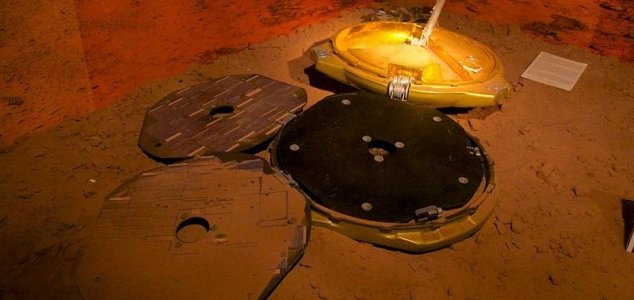
The Beagle 2 lander was designed like a flower. After the airbags deflated, it was supposed to open four “petals.” These petals were covered in solar panels to power the spacecraft. Once fully open, they would expose the radio antenna, allowing it to communicate with Earth.
The new, enhanced images showed the lander, clear as day. One petal was open. Maybe two. But it looked like at least one, possibly two, of the four solar panels had failed to deploy. They remained partially closed. And that was the fatal flaw. The unopened panels were physically blocking the radio antenna. Beagle 2 was on Mars, it was powered up, it was ready to work… but it couldn’t get a signal out. It was effectively gagged.
Mark Sims of the University of Leicester, who was the mission manager for Beagle 2, put it best: “What it does show is that it is on the surface and it is at least partially deployed.”

It was the single most frustrating outcome imaginable. Not a crash, not an explosion. A simple, mechanical snag. A stuck hinge, 140 million miles from home, was the difference between a historic triumph and a decade of silence.
What If? The Timeline That Never Was
Let yourself imagine it for a moment. What if that last petal had opened?
Imagine Christmas morning, 2003. The tinny, infectious sound of Blur’s “Uptown Girl” suddenly crackles through the speakers at Jodrell Bank. Cheers erupt. News headlines flash across the globe: “The British Have Landed!” Colin Pillinger, sideburns and all, becomes a national hero overnight.
In the weeks that follow, the first stunning images arrive. The robotic arm deploys, a marvel of engineering. The mole begins its slow, methodical crawl into the red soil. Then, the big one. The gas analyzer detects something. A puff of methane. A gas that, on Earth, is overwhelmingly produced by living organisms.
It wouldn’t be definitive proof of Martian microbes, but it would have been the single most electrifying discovery in the history of space exploration. It would have re-written our understanding of the solar system and our place in it. All of this, achieved by a tiny, underdog probe built in a British university on a shoestring budget.
The entire trajectory of Mars exploration might have changed. The focus would have shifted immediately to the search for life in that specific region. The UK would have cemented itself as a major player in planetary science. It’s an almost painful “what if” scenario because we now know just how close it was to becoming reality.
The Legacy of a Glorious Failure
Colin Pillinger sadly passed away in May 2014, just months before the probe he championed was finally found. He never got to know for certain that his mission had, in fact, reached the surface of Mars. The discovery was a bittersweet vindication for his wife, his family, and the entire Beagle 2 team.
Beagle 2 is no longer seen as a simple failure. It’s now viewed as a glorious, audacious, and incredibly unlucky attempt. The lessons learned from its near-success have been invaluable. Future missions have incorporated more redundancies in their communication and deployment systems. The tragic end of Beagle 2 highlighted just how many things have to go perfectly right for a mission to succeed, and how a single, tiny mechanical error can doom the entire enterprise.
The story of Beagle 2 isn’t just about space hardware. It’s a human story. It’s about ambition, passion, and refusing to give up on a dream, no matter how impossible it seems. It’s a reminder that exploration is hard, that the universe is unforgiving, and that sometimes, you can do everything right and still fall just short.
Out there, right now, sitting in the red dust of Isidis Planitia, is a small, silent machine. It’s a time capsule. A monument to a brilliant team that dared to reach for another world. And perhaps, one day, decades from now, the first human explorers on Mars will walk over to that silent lander, brush the dust from its panels, and finally pop open that last, stubborn petal.