Tuesday, June 9, 2026
HomeUnexplained MysteriesHistorical MysteriesNine unopened Dead Sea Scrolls found

Nine unopened Dead Sea Scrolls found

History’s Lost and Found: The Secret Dead Sea Scrolls Hiding in Plain Sight

Some secrets aren’t buried under miles of sand. They’re not locked in a vault or guarded by ancient curses. Sometimes, the most explosive secrets in history are simply forgotten.

They sit on a shelf. In a box. Gathering dust.

For nearly sixty years, nine penny-sized pieces of ancient parchment did just that. They were artifacts of immense historical importance, fragments of the legendary Dead Sea Scrolls. And they were lost. Not in the sun-scorched caves of the Judean Desert where they were first unearthed, but in the climate-controlled, meticulously organized storerooms of the Israel Antiquities Authority (IAA). A historical needle in a haystack of history.

It’s a story that sounds ripped from a Hollywood script. But it’s real. A scholar, one man with a hunch, stumbled upon them, setting in motion a chain of events that could potentially reshape our understanding of ancient faith.

Pnina Shor, who heads the IAA’s artefact treatment and conservation, put it plainly. “Either they didn’t realize that these were also scrolls, or they didn’t know how to open them.” Think about that. The original excavators from the 1950s saw these tiny, tightly-wound objects and, for whatever reason, set them aside. A puzzle for another day. A day that took six decades to arrive.

The Discovery Inside the Discovery

The man who pulled back the curtain on this sixty-year-old mystery was Dr. Yonatan Adler. He wasn’t digging in a cave; he was digging through archives. His search led him to three unassuming phylacteries—small leather boxes known in Hebrew as tefillin.

These weren’t just any boxes. They were ancient. Recovered from the same Qumran caves that gave us the rest of the Dead Sea Scrolls. For two millennia, they had kept their contents safe. But what were those contents?

Adler had a powerful suspicion. He believed these tiny leather capsules, worn by Jews during morning prayers for thousands of years, might still contain the miniature biblical verses they were designed to hold. But how could he know for sure without destroying the 2,000-year-old artifacts in the process? You can’t just pry them open.

The solution was brilliantly modern. He took the ancient artifacts to a hospital. A CT scanner, a machine designed to peer inside the human body, was used to peer back in time. The scans cut through the hardened leather, revealing the ghostly outlines of what lay within. Adler was right.

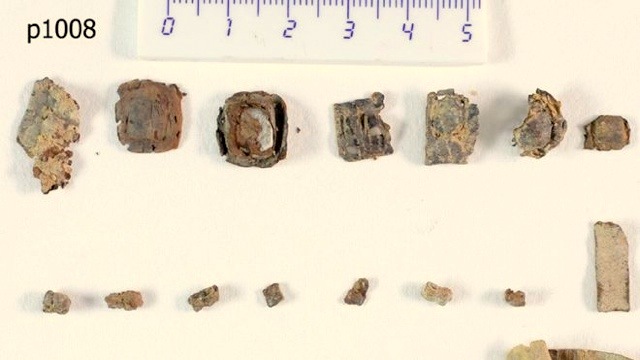
There, tucked inside, were nine tightly rolled slips of parchment. Waiting.

2

Adler himself recounted the moment he sifted through the archives. “[I] found a number of fragments of tefillin cases from Qumran Cave 4, together with seven rolled-up [phylactery] slips,” he told the Times of Israel. Those slips, along with two more found separately, became the focus of intense excitement.

Deep Dive: What Makes the Dead Sea Scrolls So Earth-Shattering?

To get why this is such a big deal, you have to understand the gravity of the Dead Sea Scrolls themselves. We’re talking about the single greatest archaeological find of the 20th century. Hands down. No contest.

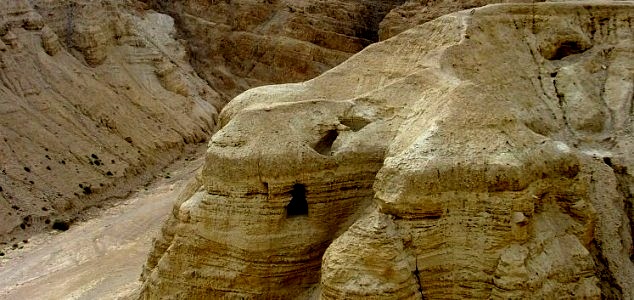
The story begins in 1947. A young Bedouin shepherd, chasing a stray goat near a cliff face at a site called Qumran, chucks a rock into a cave. He doesn’t hear a thud. He hears the unmistakable sound of shattering pottery.

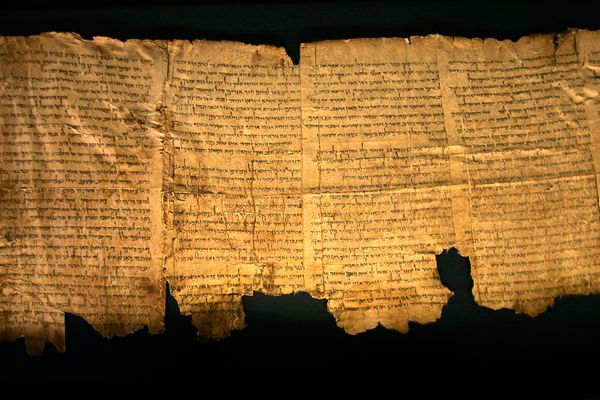
Curiosity got the better of him. Inside that cave, and later in ten other nearby caves, he and his fellow tribesmen found large clay jars. Stuffed inside were bundles of leather and papyrus, brittle with age and covered in strange writing. They had no idea they had just stumbled upon a library that had been sealed away from the world for almost two thousand years.

What did they find?

  • The Oldest Bible on Earth: The scrolls contain fragments from every book of the Old Testament (except for the Book of Esther). Before this, the oldest complete Hebrew Bible dated to the 10th century AD. The scrolls turned the clock back a full 1,000 years, landing us squarely in the time of Jesus and the Second Temple.
  • “Deleted Scenes” from the Bible: They also found texts that *didn’t* make it into the final version of the Bible, known as apocryphal and pseudepigraphical works. Books like Enoch, Jubilees, and the Genesis Apocryphon give us a wild, unfiltered look at the religious ideas swirling around at the time.
  • A Secret Society’s Playbook: Many texts, like the “Community Rule” and the “War Scroll,” seem to be the internal documents of a mysterious, ultra-devout Jewish sect that lived a communal, monastic life in the desert.

These weren’t just old books. They were a time machine. They showed that the text of the Old Testament was incredibly well-preserved over a millennium, but they also revealed a Judaism that was far more diverse and vibrant than anyone had ever imagined.

The Qumran Enigma: Who Were the People of the Scrolls?

So who were these desert dwellers who painstakingly copied these texts and hid them away before the Roman legions came to destroy Jerusalem in 70 AD?

The mainstream theory points to a group known as the Essenes. The ancient writers Josephus and Pliny the Elder described them as an ascetic, almost monastic community who had separated themselves from what they saw as the corruption of the Temple in Jerusalem. They moved to the desert at Qumran to live a life of ritual purity, study, and prayer, awaiting a final apocalyptic battle between the “Sons of Light” and the “Sons of Darkness.”

Sounds like a perfect match, right? The scrolls’ contents line up beautifully with what we know about the Essenes. Their obsession with purity, their strict community rules, their belief in a coming cosmic war—it’s all there in the texts.

But What If The Mainstream Is Wrong?

This is where it gets spicy. Not everyone buys the Essene theory. Alternative history circles and even some credentialed scholars have floated other ideas for years.

  • The Jerusalem Library Theory: Could the caves have been a hiding place for the official Temple library? As the Roman army advanced on Jerusalem, maybe priests frantically gathered up the most sacred texts and smuggled them out to the desert for safekeeping, intending to come back for them. That would make Qumran less of a monastery and more of a safe deposit box.
  • The Multi-Source Theory: Maybe it wasn’t one group at all. The texts show different writing styles and different—sometimes conflicting—theological ideas. Perhaps the caves were a genizah, a sacred storeroom for texts from various Jewish groups and synagogues across the land, all hidden away to protect them from the invading Romans.

The truth is, we don’t know for sure. The scrolls don’t come with an “About the Author” page. That’s why every new fragment, no matter how small, is a potential Rosetta Stone for this enduring mystery.

new-dead-sea-scrolls-theory_24016_600x450

Deep Dive: What’s the Big Deal About Tiny Tefillin?

Okay, so we have nine new, unopened scrolls. But they’re tiny. Microscopic, almost. What could they possibly tell us?

Everything.

These aren’t just any scrolls; they are tefillin slips. Tefillin are a central part of Jewish ritual observance, based on a commandment in the Torah to bind the words of God “as a sign on your hand and as a symbol on your forehead.” For thousands of years, Jewish men have worn these small leather boxes—one on the arm, one on the head—containing specific verses from the books of Exodus and Deuteronomy.

Here’s the explosive part: the rabbinic tradition that governs Judaism today has a very specific, standardized set of four passages that must be included. But was it always that way?

The few tefillin that have been previously found at Qumran and opened show a surprising diversity. Some contain the standard passages. Others contain different passages, including the Ten Commandments. Some even have the passages in a different order.

This suggests that during the Second Temple period—the era when Jesus lived and rabbinic Judaism was just beginning to form—there wasn’t one single, universally accepted way to perform this ritual. Different Jewish groups had their own customs, their own traditions, their own ideas about which biblical verses were the most important to bind to their bodies.

These nine new scrolls are another roll of the dice. Will they conform to the modern rabbinic standard? Will they match the other “unorthodox” scrolls found at Qumran? Or will they reveal yet another, entirely unknown tradition?

Every single word on these tiny slips is a direct window into the evolution of faith. They are a snapshot of a religion in flux, before the rules were set in stone. The very arrangement of verses could confirm or complicate everything we thought we knew about religious practice in ancient Judea.

The Challenge: Unrolling Time Itself

Now comes the hard part. The unimaginably delicate, nerve-wracking process of unrolling scrolls that have been wound tight for 2,000 years. The parchment is not like paper; it’s animal skin. Over the centuries, the collagen within it has degraded and become brittle. In many cases, it has the consistency of a burnt potato chip.

The IAA has to do this without turning the priceless artifacts to dust. It’s a job that requires the patience of a saint and the steady hands of a surgeon.

“We’re going to do it slowly, but we’ll first consult with all of our experts about how to go about this,” said Pnina Schor at the time of the discovery. “We need to do a lot of research before we start doing this.”

This isn’t a simple matter of just unspooling them. The team will likely use controlled humidification to try and make the parchment pliable again. They’ll work under microscopes, with specialized tools, teasing apart layers that have been fused together for two millennia. It’s a slow, painstaking process. One wrong move, one breath too heavy, and a word that could rewrite history might be lost forever.

In the years since this discovery, this kind of work has advanced even further. Teams working on similarly fragile scrolls, like those carbonized by the eruption of Mount Vesuvius at Herculaneum, are now using advanced AI and high-powered scans to “virtually unwrap” the texts, reading the ink without ever physically opening the scroll. It’s a race between technology and decay, with history’s secrets hanging in the balance.

What Will They Say? The Lingering Question

This is the question that keeps scholars and conspiracy theorists up at night. What secrets are inked onto those nine tiny slips of parchment?

Maybe it will be something simple, another copy of a Deuteronomy passage, which would still be an amazing find. But what if it’s something else?

A single unknown word? A different spelling of a divine name? A verse that we’ve never seen before? In the world of biblical scholarship, these are not small things. They are doctrinal earthquakes. These tiny fragments from a forgotten box in a dusty storeroom remind us of a powerful truth: history is not a closed book. It’s a living, breathing thing. And sometimes, its greatest secrets are still out there, hiding in plain sight, just waiting for the right person to come along and ask the right question.

Amit Ghosh
Amit Ghoshhttps://coolinterestingnews.com
Aloha, I'm Amit Ghosh, a web entrepreneur and avid blogger. Bitten by entrepreneurial bug, I got kicked out from college and ended up being millionaire and running a digital media company named Aeron7 headquartered at Lithuania.
RELATED ARTICLES
- Advertisment -

Most Popular

Recent Comments

Warren Pan Abbott on The legend of the Devil Monkey !
chris davies on The McPherson Tape Mystery
Reed Reedly on ET has Internet!
Bea Houseoffashion on Proof Of Time Travellers – Gallery
Marcus2012 on ET has Internet!
Reed Reedly on ET has Internet!
LaughsAtConspiracyNuts on The 9/11 Conspiracy – Myths and Facts
Alex Sliverman on Did the ancients fly?
Doctor Wholigan on Time Traveler in 1938 film
chris davies on The McPherson Tape Mystery
Archie1954 on 10 secret UFO hideouts
chris davies on Ghosts of flight 401
Marcus2012 on ET has Internet!
jason Macdonald on Proof of Time Travel? – China
chris davies on Long-Lost Pyramids Found?
Reed Reedly on ET has Internet!
Milkman on Connected Universe
Tenmiles on Baigong Pipes Mystery
Simon Foster on Sirius – The Documentary
From the 1st April on 2013 – Alien Contact date ?
SkyWatcher on Is ET ignoring us?
I Come From The Future on Obama to make UFO Alien disclouser soon ?
ÛñK?øWn on 2013 – Alien Contact date ?
Just another person on 2013 – Alien Contact date ?
Malcolm Windowcleaner on The strange case of Rudolph Fentz
Mason Servio on Strange Things on Mars
Marke Wisdom Seeker on What will we find as arctic melts?
Andrea A Elisabeth Levyne on Aliens Captured in Varginha, Brazil
Mitch Grouyeki on Amazing Space Shuttle pictures