Home Weird World Strange Places Scientists Discover a Boiling River of Amazonian Legend

Scientists Discover a Boiling River of Amazonian Legend

0
67

The Impossible River of the Amazon: A Secret Boiled by the Sun

There are whispers in the jungle. Ancient stories, passed down through generations, carried on the humid air of the Amazon. They speak of a place that shouldn’t exist. A river of legend. A river that boils.

Not warm. Not hot. Boiling.

A river that cooks animals alive. A river that could poach a man whole. For centuries, the story was dismissed by outsiders as just that—a story. A folk tale from a world of spirits and myths. A geographical impossibility.

And then a man of science, bound by the rigid laws of geology, went looking for it. What he found would challenge everything he thought he knew about our planet.

Science vs. Myth: A Geologist’s Dilemma

Imagine being told a fairy tale as a child. A wild story your grandfather tells you about a lost city or a hidden treasure. Now imagine you grow up to be a geophysicist, a person who studies the very fabric of the Earth, and you learn that this fairy tale might actually be real.

That was the position Andrés Ruzo found himself in. A Peruvian geoscientist, Ruzo was in the middle of his PhD, mapping the geothermal potential of Peru. He was a man of data. Of facts. Of heat-flow maps and seismic charts. The stories his grandfather told him about a boiling river, told to him after seeing the Spanish execute the last Inca emperor, felt like a distant, romantic memory.

His colleagues and professors were unanimous. It was impossible. A myth. Why?

Deep Dive: Why a Boiling River Breaks the Rules

To make a river boil, you need a colossal amount of heat. A truly staggering geothermal furnace. On our planet, that kind of power almost always comes from one source: volcanoes. Think of the boiling hot springs of Yellowstone or the geysers of Iceland. They are all directly connected to active magmatic systems churning just below the surface. They are vents for a planet’s fury.

But this legendary river was supposedly hidden deep in the central Peruvian Amazon. And here’s the kicker: the nearest active volcano is more than 700 kilometers (over 400 miles) away. The Amazon basin is a sedimentary basin, a massive geological depression far removed from the volcanic chaos of the Andes mountains.

Finding a boiling river there would be like finding a polar bear in the Sahara. It fundamentally breaks the known rules of geology. There was no known heat source. No volcano. No magma chamber. It simply could not exist. Science said so. Case closed.

But the legend wouldn’t die.

The Perilous Journey to Shanay-timpishka

Driven by a stubborn curiosity—the very engine of all great discovery—Ruzo couldn’t let it go. What if? The question haunted him. After years of being told it was impossible, he finally put his scientific career on the line and followed the myth into the green heart of the world.

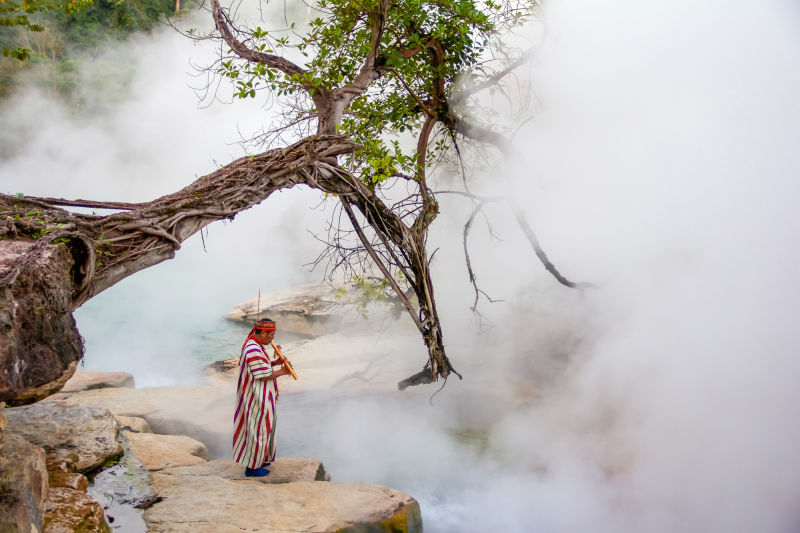
His journey was not simple. It took him deep into the jungle, into a world far removed from his labs and computers. He was guided by a shaman, the spiritual authority for the local Asháninka people, into their sacred healing territory of Mayantuyacu.

The air grew thick. The sounds of civilization faded, replaced by a chorus of insects and the calls of unseen animals. The shaman spoke of the river as a living being, a sacred place guarded by powerful spirits. He warned Ruzo of its power. This was not a tourist attraction. It was a place of immense energy, both physical and spiritual.

And then, he heard it. A low, guttural roar that wasn’t an animal. It was deeper. More constant. Like a jet engine idling in the distance. As they got closer, the air changed. The humidity became a heavy, wet blanket of steam. And the smell… a strange mix of sulfur and something primal, like rock and heat made vapor.

He saw steam rising above the canopy. A massive column of white vapor billowing into the sky, as if the jungle itself was exhaling.

His scientific mind screamed “no.” But his eyes told him something else entirely.

Boiling River

He had found it. The Shanay-timpishka. The name, in the local dialect, means “boiled with the heat of the sun.” For over six kilometers, a river flowed through the jungle at temperatures that defied belief. In some places, it was 25 meters wide. In others, it reached an average temperature of 86° C (187° F). Hot enough to brew tea. Hot enough to cause third-degree burns in seconds.

In the hottest pools along the river’s edge, it reached a full, rolling boil.

The impossible was real.

The Terrifying Truth: What Happens When You Touch the Water?

This is not a gentle hot spring. It is a predator. Ruzo witnessed the brutal power of the river firsthand. He saw small animals—frogs, snakes, insects—fall from the branches above and vanish into the scalding water. They were cooked instantly.

The process was horrifyingly fast. The eyes would cook first, turning a milky white. The creature would struggle, but the heat would overwhelm it in moments. It would lose its strength, be carried downstream, and be cooked from the inside out. Ruzo even tells the story of an unfortunate tapir, a large jungle mammal, that stumbled into the water. It didn’t stand a chance.

The shaman explained that this is how they knew the river’s mood. They would never drink the water directly, but would mix it with cooler creek water. They used its steam for healing and its heat for cooking. It was both a source of life and a force of death. A balance.

For Ruzo, the question became an obsession. The “if” was answered. Now he had to answer the “why.” How could this monstrous, beautiful, terrifying river exist?

Unlocking the Earth’s Plumbing: The Real Source of the Heat

With the myth confirmed, the science began. Ruzo and his team took samples. They measured temperatures. They analyzed the water’s chemical makeup. And they slowly pieced together a theory—a theory not of volcanoes, but of the Earth’s very circulatory system.

Think of it like this: the planet has arteries and veins. Not of blood, but of water. The working theory is that the water in the Boiling River begins as rain falling on the distant Andes Mountains. This water seeps into the ground, trickling down through cracks and fissures deep into the Earth’s crust. As it goes deeper, it gets hotter, heated by the immense geothermal gradient of the planet’s core.

Miles below the surface, this super-heated water is then forced back up at great pressure through a series of fault lines, like hot blood being pumped through an artery. It rises so quickly that it has no time to cool down. The Boiling River is the result of this massive, fault-fed hot spring system. It’s not a wound bleeding magma, but a sacred spring pouring out the heated lifeblood of the planet itself.

It’s a geological feature so rare, so perfectly aligned, that it might be the only one of its kind on Earth. A planetary anomaly. A fluke of nature.

The Serpent Spirit and the Keepers of the River

But for the Asháninka people, the explanation is far more profound. This is the home of the Yacumama, the “Mother of the Waters.” She is a giant serpent spirit, a being of immense power who lives in the river’s headwaters. It is her hot breath that boils the water. The river is her domain, and the steam is her spirit rising to the sky to create the rain.

The shaman is the intermediary, the one who communicates with the spirits of the river and the jungle. The river is not just a geological wonder; it’s a library of traditional knowledge, a place for spiritual awakening, and a source of powerful medicine. The shaman doesn’t see water and heat; he sees a living entity that must be respected and protected.

This sacred connection has kept the river pristine for centuries. The local people are its guardians. They understand that to harm the river is to harm themselves, to anger the spirits that dwell there. It’s a worldview that stands in stark contrast to the modern world pressing in on all sides.

The Looming Threat: Can This Lost World Be Saved?

The discovery of the Boiling River was a triumph. But it also started a clock. The Amazon rainforest is under siege. The same land where this sacred river flows is being threatened by illegal logging operations and the relentless expansion of oil and gas development.

The trees around the river are being cut down. This isn’t just an aesthetic problem. The forest acts as the river’s circulatory system. Without the trees, the entire ecosystem could collapse. The rainfall patterns could change. The delicate geological balance could be shattered. The river could cool. It could die.

Ruzo realized his mission had to change. He went from scientist to conservationist. His goal is no longer just to study the river, but to protect it. He founded the “Boiling River Project” to bring global awareness to this natural wonder and to work with the Asháninka people to preserve their land and their culture. He is in a race against time, trying to save a place that, until very recently, the outside world didn’t even know existed.

Fringe Theories & Internet Whispers: What Else Is Hiding in the Amazon?

While science has offered a plausible explanation, the sheer uniqueness of the Boiling River has, of course, attracted other ideas. In the deep corners of the internet, where mysteries are currency, the river is seen as something more.

Could this be more than just a fault line? Some online forums buzz with the idea that the river is a vent for a “super-plume”—a massive, unmapped pocket of magma far deeper than conventional science can detect, a hint that the geology of the Amazon is far more active and mysterious than we believe.

Others whisper of lost technology. The Amazon is a graveyard of forgotten civilizations. Is it possible that the river’s source is connected to something artificial? An ancient geothermal power plant, perhaps, built by a culture with a knowledge we can’t comprehend, now buried and leaking its energy into the water table? It sounds like science fiction, but in a place where rivers boil, what is truly off the table?

Recent high-resolution satellite thermal imaging, analyzed by independent researchers, has added fuel to these fires. The scans suggest the heat anomaly along the fault line is not uniform. It has “hot spots” of incredible intensity, which has led to wild speculation about concentrated energy sources. Is it just a complex geological formation, or is it evidence of something else entirely?

The Boiling River exists in a place where the line between science and myth is already blurry. It forces us to ask: What other legends are true? What other impossibilities are waiting to be found beneath the canopy?

This river is a smoking gun. A piece of physical evidence that our maps are incomplete and our understanding of our own planet is still in its infancy. It is a hot, roaring, terrifying, and beautiful reminder that true magic still exists in the world. We just have to be willing to look for it.

Originally posted 2016-03-14 21:20:32. Republished by Blog Post Promoter