It began as a typical, freezing Friday morning in Russia’s Ural Mountains. Commuters were sipping coffee. Parents were dropping children off at school. The dashboard cameras were rolling, capturing the mundane gray of a winter highway. Then, at 9:20 AM, the sky tore apart. It wasn’t just a flash. It was a blinding, “biblical” explosion of light that outshone the sun, casting long, shifting shadows that spun across the snow-covered landscape. Drivers slammed on their brakes. Pedestrians froze, shielding their eyes from a glare that seemed to signal the end of days.
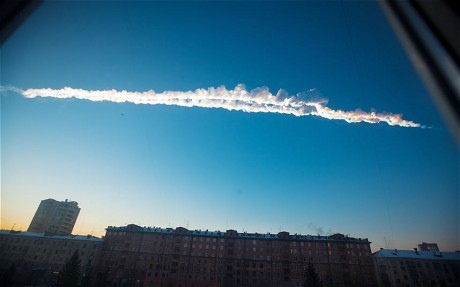
For a few terrifying seconds, silence hung over the city of Chelyabinsk. People rushed to their windows, pressing their faces against the glass to see what had happened. Was it a missile? A nuclear strike? A plane crash? They watched a thick, smoking contrail split the atmosphere, glowing orange and red against the pale blue morning. It looked beautiful. It looked impossible.
Then the shockwave hit.
This wasn’t just a loud noise. It was a physical wall of air, compressed to the density of concrete by an object traveling faster than a rifle bullet. It slammed into the city with the force of 500 kilotons of TNT—thirty times more powerful than the atomic bomb dropped on Hiroshima. The delay between the light and the sound was the trap. The light traveled instantly. The sound, lagging behind, waited until thousands of curious faces were pressed against the glass.
Boom. Shatter. Blood.
The Day the Sky Fell: A Minute-by-Minute Breakdown
The initial reports were chaotic. Early estimates pegged the object at around 10 tons, but as scientists scrambled to analyze the data, the numbers grew terrifyingly large. This wasn’t a pebble. NASA later revised the figures: the meteor was a monster, a 60-foot-wide asteroid weighing roughly 12,000 to 13,000 tons. It hit our atmosphere at a blistering 40,000 miles per hour (over 19 kilometers per second).
At that speed, the air in front of the rock can’t move out of the way fast enough. It compresses. It heats up. The friction turns the air into plasma hotter than the surface of the sun. The rock didn’t just fall; it screamed through the stratosphere, vaporizing its outer layers in a violent process called ablation. But the rock was tough. It held together until it reached an altitude of about 18 to 30 miles above the ground. That’s when the structural integrity failed. The internal pressure became too great, and the asteroid detonated.
The resulting airburst is what saved the city from total annihilation—and what caused the widespread injuries. If that rock had stayed solid and hit the ground, we would be talking about a crater and thousands of deaths. Instead, it pancaked in the sky, sending a shockwave radiating outward in every direction.
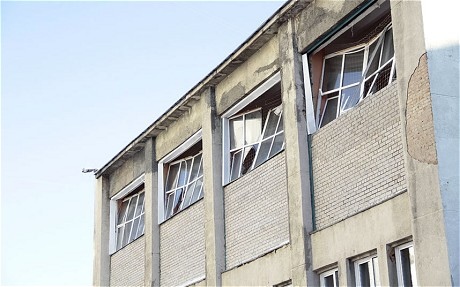
Glass windows didn’t just crack; they exploded inward. Doors were blown off hinges. In the city of Chelyabinsk, over 1,000 people were injured in an instant. Hospitals were flooded with victims, many of them children at local schools, their faces and hands cut by flying shards of glass. The scene was apocalyptic. Blood on the snow. Sirens wailing. Cell phone networks crashed as a million people tried to call their loved ones at the same time.
“I thought the world was about to end!” one resident posted online, fingers trembling. In video clips that soon flooded the internet, men could be heard shouting, “It’s a bombardment!” as the roar of the explosion set off car alarms across the entire district.

The Dashcam Phenomenon: Why We Saw It All
Why do we have so many angles of this specific event? It comes down to a unique quirk of Russian culture: the dashboard camera. Due to high rates of insurance fraud and road rage incidents, millions of Russian drivers record their commutes. It was a cosmic stroke of luck. If this had happened over the Pacific Ocean, or the Australian Outback, or even over rural America, we might have had one or two grainy videos.
Instead, we have a multi-angle, high-definition record of an atmospheric entry. We saw the shadows shift. We saw the double smoke trail. We heard the sonic booms. This footage gave scientists a treasure trove of data, allowing them to triangulate the meteor’s trajectory with unprecedented precision. It transformed a local disaster into a global viral event within hours.

Structural Carnage: The Zinc Factory Collapse
The power of the shockwave is hard to grasp until you look at the heavy industry damage. A warehouse wall at a massive zinc factory in the city didn’t just crack; it crumbled. The roof caved in. This was a reinforced industrial structure designed to withstand heavy snow and wind, yet it folded like a house of cards under the atmospheric pressure.
Across the region, nearly 300 buildings lost their windows. The city’s heating infrastructure was threatened—a critical emergency in the dead of a Russian winter where temperatures hovered around -18C (-0.4F). Without windows, schools and kindergartens turned into freezers within minutes. They were immediately closed. The government had to mobilize 20,000 rescue officials, not just to treat wounds, but to board up windows before the city’s pipes froze and burst.
Anna Kolesnikova, 31, a website editor living in the blast zone, gave a chilling account to The Daily Telegraph. Her story sounds like something out of a war movie. “I was getting ready for work when I looked out of the kitchen window and I saw this very bright light and thought, ‘How sunny it is’,” she recalled. The deception of the light was a common theme. “And then suddenly it faded, as if it was some kind of illusion.”
She continued, describing the delay that caught everyone off guard. “A minute later, I went into the other room and suddenly there was a loud explosion and the door to the balcony blew in. I crouched down out of fear. There was a series of smaller explosions, about five, and then I looked out and saw a trail of smoke in the sky. All the car alarms were going off. I thought maybe it was a military aircraft crashing, because they do test flights nearby.”
That military theory wasn’t paranoid. Chelyabinsk has a long history with the military-industrial complex. During the Cold War, this region was the secret heart of the Soviet nuclear program. When the sky exploded, the locals didn’t think “space rock.” They thought “war.”
Sergey Hametov, another resident of the city (population 1 million), described the confusion. “There was panic. People had no idea what was happening. We saw a big burst of light, then went outside to see what it was and we heard a really loud, thundering sound.”

The Heat and The Hole: Impact Confirmation
The sensory details from survivors are haunting. A teenager meeting friends at a stadium reported feeling a “warm wind” on their face immediately after the flash. This was likely thermal radiation from the fireball itself, which momentarily burned brighter than the sun. Think about that. A rock burning up 20 miles overhead was hot enough to be felt on the skin of someone standing on the ground.
Yevgeny Skorynin, a 30-year-old lawyer, painted a picture of the violence. “There was a light like a giant welding lamp and then a series of jolts. Some people thought it was an earthquake. Bits were falling off the ceiling in our office.”
Further out, in a village 70 miles away, Vladimir Prokhorov witnessed the entry. “I’d just got out of my car when I saw a fireball shooting across the sky. Everybody just stopped and was saying, ‘What is that?’”
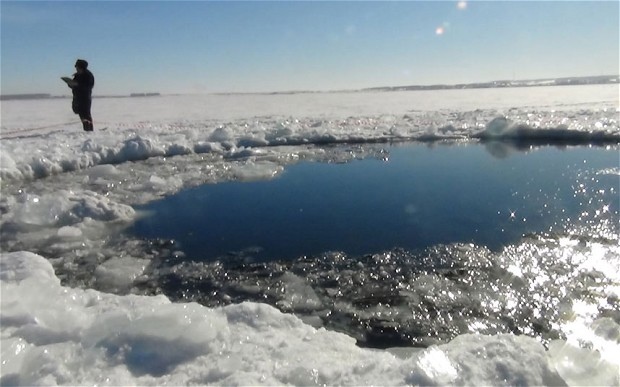
While the main body of the meteor disintegrated, heavy fragments survived the fire. Gravity took over. A massive chunk of the space object smashed into the frozen surface of Lake Chebarkul, about 50 miles west of Chelyabinsk. It punched a perfect, six-meter-wide hole through thick ice, sending a plume of water and snow into the air. This became Ground Zero for the recovery efforts.
Police immediately initiated “Operation Fortress.” They cordoned off the lake. Why the high security? Partly to protect the scientific value of the site, but also to prevent looting. Meteorites are valuable. In the days following the crash, a “gold rush” mentality took over, with locals combing the snow for black, magnetic rocks that could be sold to collectors for thousands of dollars.
The Tunguska Echo: A History of Russian Impacts
You can’t talk about Chelyabinsk without mentioning the elephant in the room: The Tunguska Event. In 1908, a massive explosion flattened 800 square miles of forest in Siberia. No crater was ever found. For over a century, conspiracy theories ran wild—was it a Tesla death ray? A crashed UFO? Antimatter?
Chelyabinsk gave us the answer. It proved that an airburst meteor can cause devastation without leaving a traditional crater. The Chelyabinsk meteor was a smaller cousin of the Tunguska object. It was a wake-up call that these events aren’t just ancient history. They happen now. They happen over cities.
“This was a very bright bolide that was perfectly visible in the light morning sky; the object was quite big with, apparently, a mass of many tens of tons,” said Sergei Smirnov of St Petersburg’s Pulkovo Observatory on Russian state television. Other scientists initially underestimated it, guessing it was made of iron. Later analysis showed it was a chondrite—a stony meteorite, making its survival through the atmosphere even more impressive.
The Cosmic Coincidence: Asteroid 2012 DA14
Here is where things get strange. Really strange. On that exact same day—February 15, 2013—astronomers were already glued to their telescopes. They were tracking a completely different asteroid, named 2012 DA14. This rock was due to perform a record-breaking flyby, passing closer to Earth than our own communication satellites.
Then, out of nowhere, Chelyabinsk explodes.
Was it a companion rock? A piece that broke off? The internet exploded with theories that the two were related, or that 2012 DA14 was being escorted by a debris field we missed. Astronomers rushed to check the orbits. Their conclusion? A chilling “No.” The two objects had completely different trajectories. They came from different parts of the solar system. It was a total, one-in-a-million cosmic coincidence.
Think about the odds. On the one day we are staring at the sky waiting for a near-miss, we get blindsided by a completely different rock from a different direction. It’s like getting struck by lightning while reading a book about electrical safety. The universe, it seems, has a dark sense of humor.
Where Was the Warning?
This is the question that keeps planetary defense experts awake at night. We have satellites. We have telescopes. We scan the skies 24/7. How did a 12,000-ton rock sneak up on a major city without a single siren going off?
The answer is the Sun. The Chelyabinsk meteor approached Earth from the direction of the Sun. Our optical telescopes are blinded by the daylight star. We literally cannot see objects coming from that angle. It was the perfect stealth approach. It reminds us of a terrifying reality: there are blind spots in our planetary defense grid. We are vulnerable.
The Aftermath and the Legacy
Vladimir Putin, Russia’s president, promised “immediate” aid. Windows were replaced. The zinc factory was rebuilt. But the psychological impact remains. For the people of Chelyabinsk, the sky is no longer just a backdrop; it’s a potential threat.
Divers eventually pulled a massive, 1,400-pound fragment of the meteorite from the bottom of Lake Chebarkul. It shattered into three pieces as they hoisted it up, but it remains one of the largest meteorite fragments ever recovered. It now sits in a museum, a dark, heavy reminder of the day the atmosphere turned into a weapon.
The Chelyabinsk event changed everything for NASA and global space agencies. It jump-started funding for asteroid detection. It led to missions like DART (Double Asteroid Redirection Test), where we proved we could punch an asteroid off course. But as we look at the photos of the shattered glass and the smoke trails, we have to ask: will we see the next one coming? Or will the only warning be a flash of light that outshines the sun?
Summary of Facts:
- Date: February 15, 2013
- Location: Chelyabinsk, Russia
- Speed: 40,000 – 42,000 mph (approx. 19 km/s)
- Altitude of Explosion: 18 miles (29.7 km)
- Energy Released: ~500 kilotons (30x Hiroshima)
- Injuries: ~1,500 people
- Warning Time: Zero seconds.
The universe is a shooting gallery, and we are living on the target. Chelyabinsk was a warning shot across the bow. Next time, the rock might not be an airburst. It might be a ground strike. Keep your eyes on the skies.
Source: Reuters, Daily Telegraph, NASA archives, Roscosmos reports.
Originally posted 2016-04-25 20:27:58. Republished by Blog Post Promoter
![20130215-230950[1]](https://coolinterestingnews.com/wp-content/uploads/2013/02/20130215-2309501.webp)