The Great Silence is a Lie: 15 Clues That We Are Not Alone
Look up. What do you see? Stars? Empty darkness? A void that goes on forever? For most of human history, we have stared into that abyss and asked the same terrifying question: Is anybody else out there?
The mainstream narrative tells us space is dead. They tell us it’s just rocks, gas, and silence. But if you dig through the archives, ignore the official press releases, and look at the raw data, a different picture starts to form. A picture that is crowded. Noisy. And maybe a little bit scary.
Aliens. Extraterrestrials. Visitors. Whatever you want to call them, the evidence isn’t just in fuzzy photos from the 1950s. It’s in the biological anomalies of our own solar system. It’s in the radio whispers we catch and lose. It’s in the transcripts of the brave men who walked on the Moon.
We are going to rip apart the “official” story. We are going to look at five specific instances—smoking guns—that suggest the universe is teeming with life. Buckle up. It gets weird.

1. The Apollo 11 Encounter: What Buzz Aldrin Saw
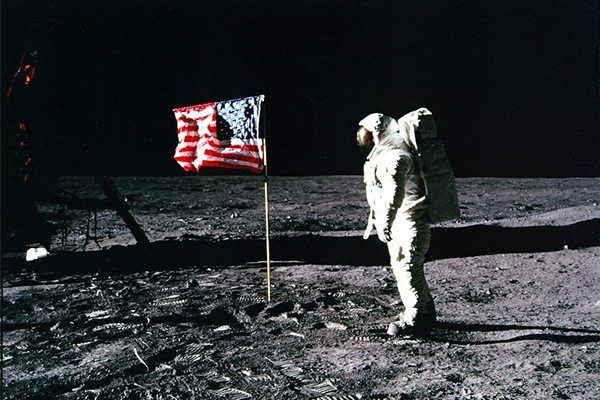
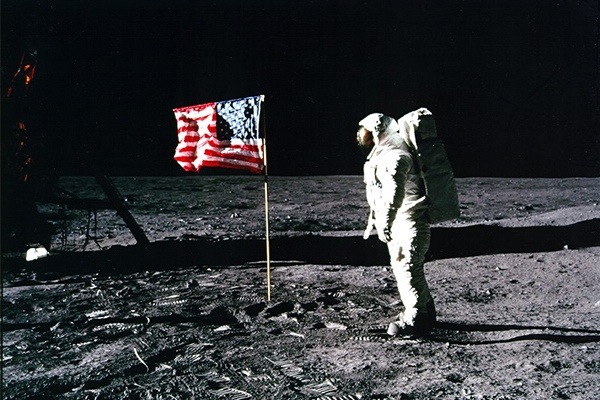
Let’s start with the big one. The holy grail of space exploration. Apollo 11. 1969. Neil Armstrong and Buzz Aldrin are about to make history. But three days into the mission, something happened that didn’t make the nightly news.
They were 200,000 miles from Earth. Alone. The silence of the vacuum outside their tiny command module was absolute. Then, they saw it.
The “L-Shaped” Intruder
The crew spotted a strange light outside the window. It wasn’t a star. It was moving alongside them. At first, the logic of the situation seemed simple. They had just separated from the S-IVB rocket stage—the massive booster that pushed them toward the moon. Surely, this glistening object tumbling in the dark was just a piece of their own discarded technology, right?
Wrong.
Aldrin and the crew did something smart. They radioed Houston. They asked for the telemetry data on the S-IVB stage. They needed to know where the booster was.
Mission Control came back with an answer that changed everything: The rocket stage was 6,000 nautical miles away.
That is not “nearby.” That is a quarter of the way around the world in Earth terms. If the rocket was 6,000 miles away, then what was floating right outside their window?
The Unexplained “Bogey”
Buzz Aldrin, a man of science and strict military training, has spoken about this publicly. He described seeing an object that appeared “L-shaped.” The crew stared at it. They used the onboard optics to get a better look. It was there. It was physical. And it was watching them.
Why didn’t they scream about it over the public radio channel? Fear. Not fear of the aliens, but fear of the bureaucracy. Aldrin admitted later that they decided not to make a huge scene about it because they feared Mission Control might scrub the moon landing. Imagine coming all that way, only to be told to come home because you reported a UFO. So, they kept it professional. They asked where the rocket was. When they got the answer, they knew.
To this day, NASA has no official explanation that satisfies the critics. They’ve tried to say it was a panel. A reflection. Paint flakes. But highly trained fighter pilots know the difference between a paint flake and a structured craft. Someone else was on the way to the Moon that day.

2. The Blood-Red Moon: Europa’s Secret
Forget Mars for a second. Let’s look further out. Jupiter. The giant. Orbiting this gas behemoth is a moon that has captivated astrobiologists for decades: Europa.
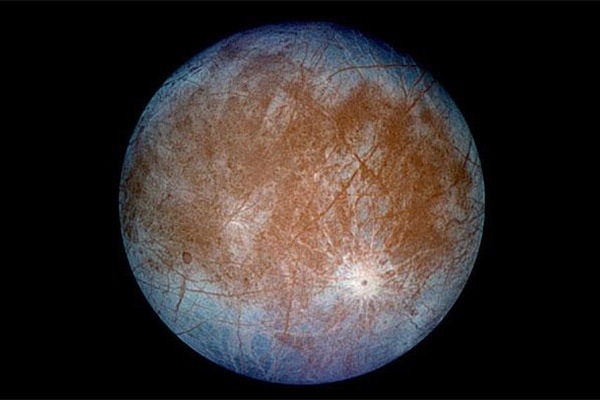
At first glance, Europa looks like a cracked eggshell. It is encased in a thick layer of ice. But it’s what is under the ice that keeps scientists up at night. We are virtually certain that beneath that frozen crust lies a massive, global ocean of liquid water. More water than all of Earth’s oceans combined.
But in 2001, NASA threw a curveball into the mix that changed the conversation from “Is there water?” to “Is there something swimming in it?”
The Red Bacteria Theory
Take a close look at the image above. See those long, dark red scars crisscrossing the surface? For years, astronomers thought this was just mineral deposits. Maybe magnesium salts. Maybe sulfur from Jupiter’s other moon, Io.
Then came the spectral analysis.
A study surfaced suggesting that the infrared signature of those red streaks matched something shocking. It didn’t look like salt. It didn’t look like rock. It looked like frozen bacteria. specifically, a type of red bacteria found in extreme environments on Earth.
This blew the doors off the discussion. If those cracks are filled with frozen bacteria, how did it get there? The theory is terrifyingly simple. Tidal forces from Jupiter squeeze and stretch Europa, creating heat. This heat melts the subsurface ice, and the pressurized ocean shoots up through the cracks—like a geyser. If that ocean is filled with microbial life, it gets sprayed onto the surface and flash-frozen.
The red stains on Europa might be the frozen remains of an alien ecosystem, waiting for us to come and thaw it out. NASA is planning the “Europa Clipper” mission right now. Why? Because they know. They need to verify if that red dust is what we think it is.

3. The Messenger from Mars: ALH84001
Sometimes, we don’t need to go to space. Sometimes, space throws a rock at us and says, “Look at this.”
In 1984, explorers in the Allan Hills region of Antarctica found a meteorite. It was a potato-sized rock, dark and unassuming. They named it ALH84001. It sat in a storage bin for years. Nobody realized it was a time capsule from another world.
Eventually, geologists realized this rock wasn’t from Earth. It wasn’t from an asteroid. It was a piece of Mars. Billions of years ago, something slammed into Mars, blasted this rock into space, and it drifted through the void until it crashed here.
The Presidential Announcement
In 1996, this rock became the most famous stone in history. NASA scientists cracked it open and put it under a high-powered electron microscope. What they found caused President Bill Clinton to give a televised address on the White House South Lawn.
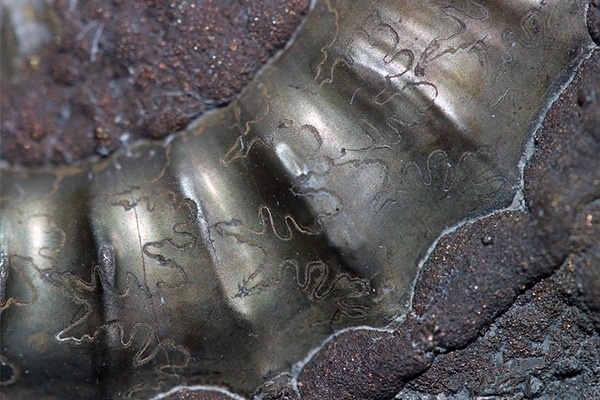
Inside the rock were tube-like structures. Tiny, segmented shapes. They looked exactly like fossilized bacteria. Worms. Life.
The scientific community exploded. Half of them cheered; the other half attacked the findings with vicious intensity. The skeptics argued the shapes were too small. “Nano-bacteria,” they scoffed. “Too small to hold DNA.” They claimed it was just a geological crystal formation that looked like life.
But here is where it gets interesting. Modern re-analysis has chipped away at the skeptics’ arguments. We have since found life on Earth that is incredibly small. We have found that the magnetite crystals inside the rock are chemically pure in a way that usually only happens when biology—life—creates them.
If those little squiggles are fossils, it means one thing: Mars was alive. And if Mars was alive billions of years ago, where did that life go? Did it die out? Or did it move underground?

4. Conan the Bacterium: The Organism That Shouldn’t Exist
Let’s talk about a creature that defies all logic. It exists right now, on Earth. It’s a microbe called Deinococcus radiodurans.
Scientists call it “Conan the Bacterium.” Why? Because you can’t kill it. It is the toughest life form known to man. You can freeze it. You can boil it. You can dip it in acid. It survives.
But its superpower is radiation resistance. You can blast this thing with gamma rays strong enough to glass a city, and it just shrugs. It can withstand a dose of radiation 3,000 times higher than what would kill a human being.
The Evolutionary Puzzle
Here is the mystery that makes biologists scratch their heads. Evolution works by necessity. You only evolve a shield if you are constantly getting hit with swords. You only evolve fur if it is cold. Organisms adapt to their environment.
Earth has a magnetic field and a thick atmosphere. We are protected. The natural radiation levels on Earth have never, in the history of the planet, been high enough to force a bug to evolve this level of protection. It is like evolving bulletproof skin on a planet where guns haven’t been invented yet. It makes zero sense.
So, where did it come from?
In 2002, Russian astrobiologists proposed a theory that sounds crazy, but fits the data perfectly: It didn’t evolve here.
They suggest that Deinococcus radiodurans evolved on Mars. Mars lost its atmosphere and magnetic field billions of years ago. The surface of Mars is bombarded with heavy radiation constantly. Any life on Mars would have to evolve exactly this kind of super-armor to survive.
The theory is called “Panspermia.” It suggests that an asteroid hit Mars, knocked some rocks (containing these microbes) into space, and they landed here. We might be looking at a Martian refugee every time we put this bug under a microscope.

5. The Signal That Got Stronger
We send messages. We listen. The SETI Institute (Search for Extraterrestrial Intelligence) has been scanning the skies for decades, looking for a techno-signature. A beep. A pattern. A mathematical sequence that nature couldn’t produce.
Most of the time, it’s just cosmic static. Background noise from the Big Bang. But sometimes, the needle jumps.
The SHGb02+14a Mystery
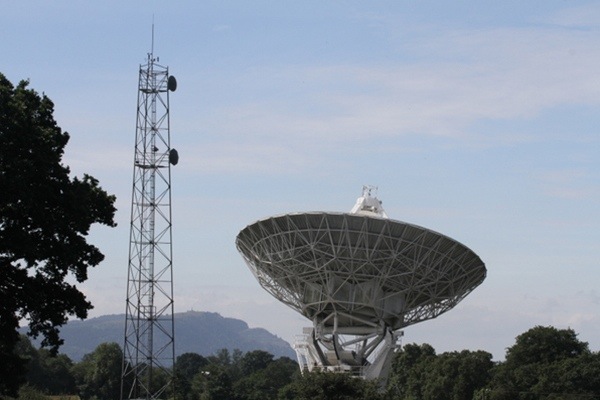
In 2003, the massive Arecibo telescope in Puerto Rico (may it rest in peace) picked up something weird. It was a radio signal coming from a spot in the sky where there are no planets and no stars within 1000 light-years. Just empty darkness between the constellations Pisces and Aries.
The signal was on the hydrogen line frequency—1420 MHz. This is important. Physicists have long theorized that intelligent aliens would use this specific frequency as a “hailing channel” because hydrogen is the most common element in the universe. It’s the universal water-cooler channel.
Researchers looked at the signal in 2004. It wasn’t just a blip. It persisted. And here is the part that gives you chills: It was drifting. The signal’s frequency was changing rapidly, in a way that mimics the motion of a rotating planet. But there is no planet there.
Even stranger, the signal strength ramped up. It got stronger. Then, like a phantom, it vanished.
Calling Collect?
Skeptics say it could be a glitch. A reflection of Earth radar. But the signature doesn’t match known interference patterns. It looked like a focused beam. Someone, somewhere, turned on a flashlight, pointed it at Earth, and then turned it off.
Are they calling us? Or was it just a sweeping radar form a passing ship that didn’t even know we were here? The “Wow!” signal gets all the fame, but the 2003 signal is the one that keeps astronomers awake.
The Verdict
We have astronauts seeing crafts. We have moons bleeding red bacteria. We have rocks with fossils. We have unkillable microbes that act like Martians. And we have radio waves screaming through the void.
Any one of these things could be dismissed as a coincidence. But all of them? Together?
The puzzle pieces are on the table. The picture is forming. We are not alone in the dark. The only question left is: When they finally land on the White House lawn, will we be ready to say hello?
Keep Your Eyes on the Skies.
Originally posted 2013-11-24 03:17:25. Republished by Blog Post Promoter
![20131124-050823[1]](https://coolinterestingnews.com/wp-content/uploads/2013/11/20131124-0508231.webp)