Home Weird World Space UFO That crashed 3 years ago found in Antarctic – claims Russian!

UFO That crashed 3 years ago found in Antarctic – claims Russian!

0
67

Antarctic UFO

The Frozen Graveyard: Secrets at the Bottom of the World

Antarctica. Just the word sends a shiver down your spine. It is the most hostile, isolated, and alien place on Earth. It is a continent of silence. A white void. But is it empty?

For decades, we’ve been told there is nothing down there but penguins, ice scientists, and wind that can strip the flesh off a bone. But the internet changed the game. It gave us eyes where we aren’t supposed to look.

Google Earth.

Suddenly, you didn’t need a billion-dollar budget or a military clearance to scout the South Pole. You just needed a laptop. And a lot of free time. This digital revolution birthed a new kind of explorer. The Armchair Archaeologist. The Virtual Ufologist. And one of them, a man from the heart of Russia, stumbled upon something that defies explanation. Something that shouldn’t be there.

Valentin Degterev. Remember that name.

Hailing from the industrial city of Nizhny Tagil, Degterev calls himself a “researcher of the unknown.” He isn’t a government agent. He isn’t a scientist on a government grant. He is a guy looking for the truth. And on a cold digital afternoon, scanning the endless white wastes of the Antarctic continent, he saw it. A scar on the ice. A shape so geometric, so massive, and so clearly artificial that it stopped him cold.

The Discovery: A Metal Monster in the Ice

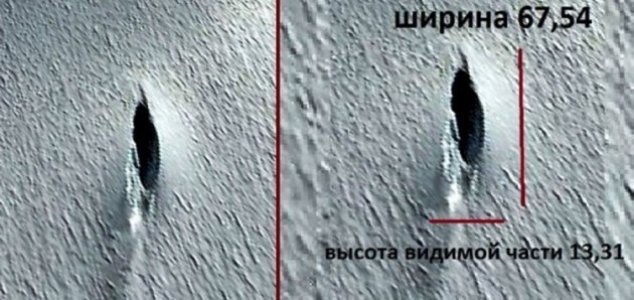
It wasn’t a rock. It wasn’t a trick of the light. According to Degterev, what lies half-buried in the frozen wasteland is a crash site.

“In among the endless ice desert, it is the most genuine UFO in its most classic shape,” he wrote. His excitement was palpable. You could feel the adrenaline in his typing. This wasn’t a vague smudge. To him, it was smoking gun evidence of a catastrophic event.

The satellite imagery, captured by Google Earth on February 15, 2012, had been sitting there. Unnoticed. Ignoring us. Until Degterev zoomed in. The coordinates he dropped were a digital bomb: 80°34’08.4″S 30°05’19.3″W.

Go ahead. Copy that. Paste it. See for yourself.

Degterev didn’t just point and scream. He measured. Using the scale tools available in the software, he estimated the dimensions of this anomaly. The numbers are staggering. We aren’t talking about a weather balloon or a small drone.

204 feet wide.

40 feet tall.

Let that sink in. That is two-thirds the length of a football field. It is wider than a Boeing 747 is long. It is a leviathan. If this object is a machine, it is a monster-sized ship capable of interstellar travel, now resting in a frozen tomb.

“I think there is very large disc-shaped flying machine amongst the frozen ice,” Degterev stated flatly. He is convinced. The hole surrounding the object—a massive gash in the landscape measuring 20 meters wide and 70 meters long—looks violent. It looks like an impact crater. It looks like something slammed into the ice at Mach speeds and skidded to a halt, waiting to be found.

The Skeptics Strike Back: Pareidolia or Cover-Up?

Of course, the moment this went viral, the “official” narrative arrived to tidy things up. Enter the debunkers. Enter the establishment.

Andrew Fleming works for the British Antarctic Survey. He knows the ice. He knows the terrain. And when the media came knocking, asking about the giant saucer in his backyard, he didn’t blink.

“The object is a gap,” Fleming declared. A crevasse. A crack in the ice. “They can be tens of meters deep. Nothing unusual, but they are spectacular. It is certainly not a UFO.”

Fleming’s explanation relies on the behavior of blue ice and shadows. In the polar regions, the sun sits low on the horizon. It casts long, distorted shadows that can play tricks on the eyes. The dark area? Just a shadow. The metallic sheen? Just exposed blue ice, which is harder and clearer than the snowy surface.

Case closed?

Not even close.

This is where the battle lines are drawn. On one side, you have the scientific explanation of pareidolia—the psychological phenomenon where the human brain forces random patterns into recognizable shapes (like seeing a face on Mars or a bunny in a cloud). On the other side, you have the “eyes don’t lie” crowd.

Look at the symmetry. Crevasses are jagged. They fracture. They follow the stress lines of the glacier flow. They rarely form perfect, symmetrical ovals that stand out distinct from the surrounding texture. This anomaly looks manufactured. It stands alone.

Why Antarctica? The History of High Strangeness

To understand why Degterev’s find is so explosive, we have to look at the bigger picture. Why are we so ready to believe there are crashed ships in Antarctica? Because history is full of weird whispers about the South Pole.

This isn’t just about ice and penguins. This is about New Swabia.

Let’s rewind to 1938. The world is on the brink of war. Nazi Germany sends an expedition to Antarctica. They didn’t just go to plant a flag. They were looking for something. They mapped huge swaths of the continent, dropped thousands of metal stakes with swastikas to claim the land, and allegedly set up “Base 211.”

Rumors have persisted for eighty years that they found something. Massive underground caverns. Geothermal vents that created warm oases in the ice. Did they build a secret base? Did they find ancient technology left behind by a pre-human civilization?

Then comes 1947. Operation Highjump.

The United States Navy, led by the legendary Admiral Richard E. Byrd, rushes to Antarctica. The official story? A “training exercise.”

Bull.

You don’t send 4,700 men, an aircraft carrier (the USS Philippine Sea), destroyers, and a submarine just to practice wearing parkas. They were hunting something. And they came back early. Limping.

Admiral Byrd gave an interview to a Chilean newspaper on his way back. He warned of a new threat. He spoke of “enemy aircraft that can fly from pole to pole with incredible speed.”

Who was the enemy? The war was over. The Nazis were defeated. Or were they? Did Byrd encounter the occupants of the very type of craft Valentin Degterev spotted on Google Earth?

The Hollow Earth and The Entrance

It gets weirder. The coordinates Degterev found are just one piece of the puzzle. For centuries, mystics and fringe scientists have proposed that the Earth is not solid. The Hollow Earth theory suggests that openings exist at the poles.

Could this “crashed disc” actually be a guardian? A sentry? Or perhaps a vessel that failed to make the entrance?

When you look at the 2012 satellite image, the object looks stranded. But maybe it’s not crashed. Maybe it’s parked. The sheer size—204 feet wide—aligns with reports of “motherships” seen in other parts of the world. It’s too big for conventional aerodynamics, but perfect for the gravity-defying propulsion systems described by whistleblowers like Bob Lazar.

Google Earth: The Accidental Whistleblower

We live in a unique time. Secrecy is dying.

Governments used to be able to hide entire cities. Now, a kid in Nebraska or a researcher in Russia can spot a secret bunker from space. But Google Earth has a history of censoring things. There are patches of the ocean floor that are blurred. There are military bases pixelated into oblivion.

The fact that this image from 2012 slipped through is a miracle. Or a mistake.

Notice how Fleming and the skeptics are quick to dismiss it as “nothing unusual.” That is the standard operating procedure. Deny, ridicule, dismiss. They did it with Roswell. They did it with the Phoenix Lights. They are doing it with the “Tic Tac” videos confirmed by the Pentagon.

But the anomaly remains.

Degterev is convinced that the hole, which is 20 meters wide and 70 meters long, can not be explained as something of this planet. He isn’t looking for fame. He’s pointing a finger at a glitch in the matrix.

A Modern Perspective: The Soft Disclosure

Why does this matter now? Because the conversation has shifted. In the last few years, the US government has admitted that UAPs (Unidentified Aerial Phenomena) are real. They are in our skies. They are tracking our military.

If they are flying here, they are crashing here. It’s a statistical certainty. No technology is perfect. Not even alien tech.

If a craft goes down in the middle of New York City, it’s global news. It’s panic. It’s chaos. But if it goes down in Antarctica? It’s gone. Buried. Hidden by the fiercest weather system on Earth. The ice is the perfect vault. It freezes history in place.

This object could have been there for three years, as Degterev suggests. Or it could have been there for three thousand years. The ice moves, shifts, and occasionally spits things out. Maybe the glacier receded just enough in 2012 to give us a peek.

The Technical Breakdown: Why “Ice Shadow” Doesn’t Fit

Let’s get technical for a second. We need to dismantle the “shadow” argument.

Shadows rely on a caster. To have a shadow that distinct, you need a ridge or a wall of ice standing 40 feet tall directly adjacent to it. Looking at the surrounding terrain in the Google Earth imagery, the area is relatively flat. It’s a slope, yes, but not a jagged cliff face capable of casting a perfect, metallic-looking elliptical shadow.

Furthermore, shadows are black or dark grey. They lack texture. The object in the image appears to have a structure. A rim. A dome. There is a dimensionality to it that shadows simply do not possess.

And then there is the material.

Degterev points out the color. It stands out against the white and the blue. It looks rigid. Nature builds in fractals—chaos, branching patterns, jagged lines. Intelligence builds in geometry—circles, squares, triangles. This thing is pure geometry.

What If We Go There?

The coordinates are public. 80°34’08.4″S 30°05’19.3″W.

So why hasn’t anyone gone to check?

Because you can’t. Antarctica is the most regulated continent on Earth. You can’t just rent a Cessna and fly over the South Pole. The Antarctic Treaty System governs all activity. It is a “zone of peace,” but it is also a zone of control. Civilian expeditions are tightly monitored. Flight paths are restricted.

If you tried to fly a private drone to those coordinates, you’d likely lose signal. Or worse. There are stories of pilots reporting “magnetic anomalies” that mess with instrumentation near the pole. Is it natural interference? or is it a defense mechanism?

The Verdict: Keep Your Eyes Open

We may never know for sure what Valentin Degterev saw. The ice may have already swallowed it back up. Snowstorms in Antarctica can bury a two-story building in 24 hours. The window to see these things is fleeting.

But the image exists. It is burned into the digital record.

Is it a rock? A shadow? A crevasse? Or is it a 204-foot wide vessel from another world, silently waiting in the freezer of the Earth?

Fleming and the British Antarctic Survey want you to look away. They want you to see a shadow. But Degterev wants you to see the possibility. He wants you to question what is lying in the blind spots of our planet.

“In amongst the endless ice desert, it is the most genuine UFO in its most classic shape.”

The universe is vast. We are small. And sometimes, the evidence of that vastness crashes right into our backyard. Or, in this case, our freezer.

Don’t take their word for it. Fire up the software. Type in the numbers. Hunt for the truth yourself.

Summary of the Anomaly

  • Location: Antarctica
  • Coordinates: 80°34’08.4″S 30°05’19.3″W
  • Finder: Valentin Degterev
  • Estimated Width: 204 Feet (62 Meters)
  • Estimated Height: 40 Feet (12 Meters)
  • Date of Image: Feb 15, 2012
  • Official Explanation: Crevasse / Shadow / Blue Ice
  • Alternative Theory: Crashed Disc / Extraterrestrial Craft / Secret Military Tech

Stay curious. Stay skeptical. But never stop looking up—or down.

Originally posted 2015-07-20 05:49:33. Republished by Blog Post Promoter

Originally posted 2015-07-20 05:49:33. Republished by Blog Post Promoter