Does a Hidden Giant Really Stalk the Frozen Edges of Our Solar System?
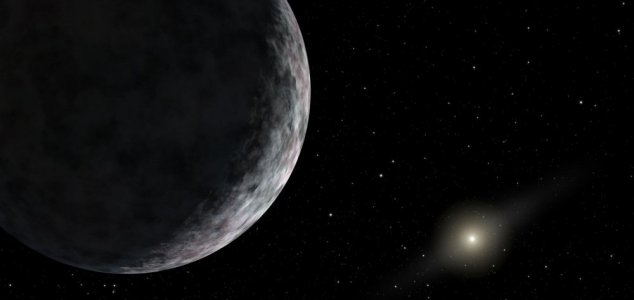
Look at the picture above. It looks peaceful, doesn’t it? A lonely world floating in the void. But what if I told you that the map of our solar system—the one you memorized in grade school with the colorful little balls spinning around the sun—is wrong? Not just a little bit wrong. Completely incomplete.
For decades, we’ve been told a simple story: Mercury to Neptune. That’s the neighborhood. Maybe throw in Pluto if you’re feeling nostalgic. But astronomers have started noticing something strange. Something unsettling. The math isn’t adding up. The gravity in the deep, dark outer zones is acting weird. And now, a series of strange detections has reignited the most explosive debate in modern astronomy.
Is there a massive, unseen planet lurking in the shadows? A “Planet X”?
Researchers have identified what could be two new large planets in the outer reaches of our solar system. And the implications are absolutely mind-melting.
The ALMA Anomalies: A Glitch or a Ghost?
Let’s rewind to where this specific firestorm started. The idea that there could be a previously undiscovered world located far out beyond the orbit of Pluto has been the subject of heated debate among astronomers for years. It’s the Loch Ness Monster of astrophysics. Everyone wants to believe, but the photos are always blurry.
Then came the data drop that shook the forums.
Recently, separate teams of researchers from Sweden and Mexico submitted two new papers claiming the alleged discovery of not one, but two new planets in the outer solar system. This wasn’t just a hunch. They had data. The release followed on from a similar discovery earlier that year of two ‘trans-Neptunian objects’ by scientists in Madrid.
Here is where it gets crazy. They weren’t using a standard optical telescope. You can’t just point a lens at the dark and hope to see a reflection. The sun is too far away. Out there, planets are invisible ghosts. They don’t shine. They are frozen dead rocks. So, the teams used the Atacama Large Millimeter Array (ALMA). This is a beast of a machine in the high deserts of Chile. It sees the universe in radio waves, heat, and dust.
Both of the objects were picked up by ALMA. One appeared in the sky near the star W Aquilae. The other was lurking adjacent to Alpha Centauri. They weren’t stars. They moved.
In the world of astronomy, if a point of light moves against the background stars, it’s usually close. It’s inside our house. The Swedish and Mexican teams crunched the numbers and suggested these could be massive worlds—maybe Super-Earths—orbiting way, way out in the black.
The “Impossible” Statistics: Why Scientists Are Freaking Out
Despite indications that these could be two new planets within our solar system, the response to the findings by other astronomers has been one of considerable skepticism. And by “skepticism,” I mean they basically threw the papers across the room.
Why the hate? It comes down to probability.
Right now, it’s difficult to completely rule out the possibility that the objects aren’t, for example, nearby asteroids or even a pair of brown dwarf stars located in nearby interstellar space. But the critics point to the “field of view.”
Think of it like this. Imagine you lose a contact lens on a football field. You look down at a random patch of grass the size of a postage stamp. If you immediately find the contact lens in that tiny spot, you have to ask yourself a question. Did you get wildly lucky? or is the entire field covered in millions of lost contact lenses?
It’s also possible that the findings are due to nothing more than random blips of noise. ALMA is sensitive. Super sensitive. Sometimes it sees ghosts in the machine.
The Mike Brown Factor
California Institute of Technology astronomer Mike Brown certainly has his doubts. You need to know who Mike Brown is. His Twitter handle is @plutokiller. He is the man responsible for demoting Pluto. He knows the outer solar system better than almost anyone alive.
“If it is true that ALMA accidentally discovered a massive outer solar system object in its tiny, tiny, tiny, field of view, that would suggest that there are something like 200,000 Earth-sized planets in the outer solar system,” he said. “Which, um, no.”
That quote is devastating. 200,000 Earths? The solar system would be crowded. It would be a chaotic mess of gravity. We would have noticed. The planets we know—Mars, Jupiter, Saturn—would be wobbling all over the place if there were that much mass out there.
However, despite his skepticism, Brown does admit that “the idea that there might be large planets lurking in the outer solar system is perfectly plausible.”
And this is the twist. Mike Brown himself is actually hunting for one.
The Ghost in the Gravity: The Modern Hunt for Planet Nine
While the ALMA blips might have been a false alarm, the search has shifted gears. It’s no longer about accidental snapshots. It’s about the crime scene evidence left behind.
Modern internet theories and rigorous academic papers have converged on a new suspect: Planet Nine.
This is where the story gets really good. We aren’t looking for the planet directly anymore. We are looking at the victims of its gravity. Beyond Neptune lies the Kuiper Belt—a ring of icy debris, comets, and dwarf planets. It’s a junkyard. For a long time, we thought the junk just floated randomly.
But it doesn’t.
Astronomers, including the skeptical Mike Brown and his partner Konstantin Batygin, noticed that a bunch of these distant rocks are clustered together. They orbit in the same weird angle. They are all swinging out to one side of the solar system like a flock of birds turning in the wind.
What turns a flock of birds? A predator.
The math suggests there is a massive gravitational “shepherd” out there. A planet about five to ten times the mass of Earth. A Super-Earth. It’s on an elongated orbit that takes it thousands of years to circle the sun just once. It swings way out into the darkness, pulling the Kuiper Belt objects with it, and then dives back in.
Why Haven’t We Seen It?
This is the question that drives everyone crazy. If it’s big, and it’s there, why isn’t it on Google Sky?
1. The Distance is Unfathomable.
We aren’t talking about “far” like Pluto. Pluto is the front porch. This thing is down the street and around the corner. Planet Nine could be 20 times farther away than Neptune. At that distance, the sun is just a slightly bright star. There is almost no sunlight reaching it, which means there is almost no sunlight reflecting back to us.
2. It’s Cold.
Because it doesn’t reflect light, we have to look for heat (infrared). But a planet that far out is frozen solid. It blends in with the background radiation of the universe.
3. The Sky is Huge.
Finding a dim, slow-moving object in the vastness of space is harder than finding a needle in a haystack. It’s like finding a specific black grain of sand on a black beach at midnight.
The “Nemesis” Theory: Is It Even a Planet?
Let’s get weird for a second. What if the object isn’t a planet at all?
For decades, fringe researchers and some serious scientists have toyed with the “Nemesis” theory. The idea is that our sun has a companion. A twin. Most stars in the galaxy come in pairs (binary systems). The sun being single is actually kind of odd.
The theory suggests Nemesis could be a “Brown Dwarf”—a failed star that didn’t have enough mass to ignite. It would be dark, dense, and lurking in the Oort Cloud (the shell of comets surrounding us). Every 26 million years or so, its orbit might disturb comets, sending a rain of death into the inner solar system. Some have tied this to the extinction of the dinosaurs.
While NASA’s WISE survey scanned the sky for brown dwarfs and came up empty nearby, the possibility of a smaller, colder object hasn’t been totally killed. The ALMA detections mentioned earlier—the ones near W Aquilae—hinted at this. Could a brown dwarf be passing through?
The Black Hole Hypothesis
If you want to stay awake at night, try this theory on for size. A paper published recently proposed that “Planet Nine” might actually be a Primordial Black Hole.
Not a stellar black hole that eats stars. A tiny, ancient black hole formed at the very beginning of the universe. It would be roughly the size of a grapefruit but have the mass of five Earths. It would be invisible. Completely. The only way to find it would be to watch for “lensing”—seeing it bend the light of stars behind it.
Is there a grapefruit-sized monster orbiting our sun? It sounds like science fiction, but the math allows it. It would explain the gravity weirdness without needing a large reflective surface we should have seen by now.
The Verdict: The Solar System is Still a Mystery
What the 2015 ALMA findings and the ongoing Planet Nine hunt prove is that we are arrogant. We think we know our neighborhood. We have mapped the continents of Earth, we have driven rovers on Mars, and we have flown past Pluto.
But the solar system is massive. The volume of space between the Kuiper Belt and the next star is a terrifyingly large ocean of nothingness. And in that ocean, things are hiding.
Whether it’s the two planets from the Swedish/Mexican study, the “Planet Nine” of Batygin and Brown, or a wandering rogue world captured by our sun’s gravity, one thing is clear: We are not alone in this system.
There is a heavy hitter out there. It is pulling the strings. It is warping the orbits of minor planets. It is waiting.
New telescopes are coming online soon. The Vera Rubin Observatory in Chile will scan the entire sky every few nights. If Planet X is out there, that machine will find it. Until then, keep watching the shadows. The map is about to be redrawn.
Originally posted 2015-12-31 15:42:33. Republished by Blog Post Promoter