The Silence of the Void: Why Searching for Neighbors Might Be Our Final Mistake
It’s the ultimate question. The one that keeps you awake at 3 AM, staring at a ceiling fan that spins just a little too rhythmically. Are we alone? Is this big, cold, dark room of a universe empty, or is the house actually full, and everyone else is just… hiding?
For decades, we’ve been the loud kid in the library. We blast radio waves. We send golden records on Voyager probes. We shout “Hello!” into the abyss. But recently, the smartest minds on Earth decided it was time to stop shouting and start listening harder than we ever have before. A massive, $100 million chip has been pushed to the center of the cosmic poker table.
But there’s a catch. A terrifying one.
What if the phone rings, and we don’t like who’s on the other end? What if picking up that receiver triggers a sequence of events that ends with the human race being wiped off the galactic map? This isn’t science fiction. This is the very real fear keeping astronomers up at night.
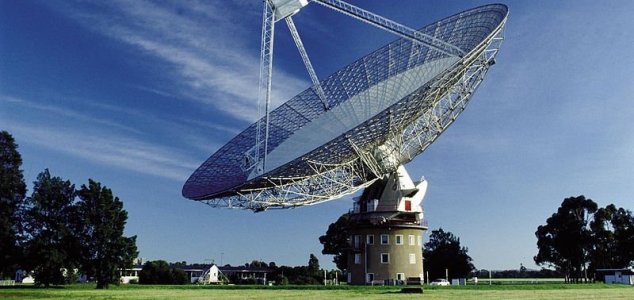
Above: The eyes and ears of the search. CSIRO’s Parkes Radio Telescope in Australia, scanning the heavens for a whisper.
The 100 Million Dollar Gamble
Let’s rewind. A few years back, the world of astrophysics got a jolt of electricity that would make Frankenstein jump. Professor Stephen Hawking—the man who understood the cosmos better than perhaps anyone in history—stood alongside a cadre of elite scientists and dropped a bombshell. They announced the launch of the most aggressive, well-funded alien hunting initiative in human history.
This wasn’t some government grant project that would run out of cash in six months. This was serious money. Silicon Valley money. A cool $100 million poured into an endeavor designed to do one thing: find evidence of intelligent extraterrestrial life. The goal? To sift through the cosmic static and find a pattern. A beat. A sequence of prime numbers. Anything that says, “We are here.”
The scope is mind-bending. The initiative was built to cover ten times more sky than previous programs. It covers five times more of the radio spectrum. It scans 100 times faster. Basically, if ET sneezes in our general direction, this gear is supposed to catch it.
The Warning from Down Under
While the champagne corks were popping and the press releases were flying, one man stood in the corner, looking at the floor with a worried expression. That man was Professor Matthew Bailes of Swinburne University in Melbourne.
Bailes isn’t a skeptic. He isn’t a naysayer. In fact, he is leading the Australian arm of this massive search. He is the guy in charge of the machinery that listens. And yet, he dropped a warning that chilled the scientific community to the bone.
He advised, in no uncertain terms, against attempting to correspond with an extraterrestrial race.
Think about that. The guy paid to find them is terrified of talking to them. Why? Because he understands the brutal math of evolution and history. Bailes maintains that establishing two-way communications with an alien race—specifically one capable of sending signals over the vast, crushing distances of space—could lead humanity to absolute ruin.
His exact words? “The history of weak civilizations contacting more advanced civilizations is not a happy one.”
The “Cortes” Effect
Let’s break down what Bailes is saying here. He’s talking about the “Colonial Trap.” Look at our own history. Look at what happened when the European powers “discovered” the New World. Did they sit down for tea and exchange technology peacefully?
No.
It was a slaughter. Disease, conquest, and total cultural erasure followed. And that was between members of the same species. That was human-on-human contact. Now, imagine a species that views us the way we view ants. If you want to build a parking lot, you don’t ask the anthill for permission. You pave over it. You don’t hate the ants. You just don’t care. That is the danger Bailes is pointing at.
The Silicon Valley Approach to Alien Hunting
Despite the existential dread, the project moves forward. To search for this elusive signal, Professor Bailes and his team are utilizing the legendary Parkes radio telescope. This isn’t your backyard satellite dish. This is a monster of engineering, a massive ear turned toward the center of the galaxy.
The strategy has been described as a “Silicon Valley approach to the search for intelligent life.” What does that mean? It means Big Data. It means taking the brute force of modern computing and throwing it at the sky. We are processing petabytes of data, looking for anomalies that the human eye would miss.
“The difficulty is to know what sort of signal we are looking for,” Bailes admitted. And this is the tricky part. We are assuming aliens communicate like us. Radio waves. Lasers. Binary code.
“There is no manual on how to find aliens,” he said. “We’ll have to imagine the sort of transmissions an alien race might send.”
It’s a game of cosmic charades. We are guessing the clues before they are even given. We are looking for a needle in a haystack, but we don’t know if the needle is made of metal, or if the haystack is even a haystack.
The “Transmission Grunt” and the Kardashev Scale
Here is where the physics gets scary. Bailes noted that “The signal is likely to be quite feeble after coming vast distances. We’ll need to be looking for advanced civilizations that have significantly more transmission grunt than we are capable of.”

Transmission grunt. I love that phrase. But let’s look at what it implies.
For a signal to travel hundreds or thousands of lightyears and still be detectable by our little dish in Australia, the power behind that signal has to be massive. We aren’t talking about a radio station broadcasting Top 40 hits. We are talking about the energy output of a star.
This brings us to the Kardashev Scale. This is how scientists rank alien civilizations:
- Type I: A civilization that can use all the energy available on its home planet. (We aren’t even here yet. We are like, Type 0.7).
- Type II: A civilization that can harness the total energy of its home star. Think Dyson Spheres—massive structures wrapping around a sun to catch every photon.
- Type III: A civilization that controls the energy of its entire galaxy. God-like power.
If we hear a beep from deep space, it’s not coming from a Type I civilization. They are too quiet. It’s coming from a Type II or III. A civilization that can manipulate stars like we manipulate lightbulbs.
If a Type II civilization looks at us, we are bugs. If we are lucky, they will ignore us. If we are unlucky, they might decide our resource-rich solar system looks like a nice place to strip-mine.
The Petition to Stay Silent
Professor Bailes isn’t a lone wolf howling at the moon. His sentiments echo those of dozens of top-tier researchers and scientists who signed a petition earlier this year. Their message was simple: Shut up.
They warned that intelligent extraterrestrials are just as likely to be hostile as they are to be peaceful. The “friendly alien” trope is a Hollywood invention. Evolution on Earth favors the predator. It favors the aggressive. Why would space evolution be any different? The nice guys get eaten. The conquerors survive to build spaceships.
There is a massive debate in the scientific community right now between SETI (Search for Extraterrestrial Intelligence) and METI (Messaging Extraterrestrial Intelligence). SETI wants to listen. METI wants to shout. The petition signers think METI is suicidal.
The Dark Forest Theory
This brings us to the most disturbing theory in all of sci-fi and futurism: The Dark Forest.
Imagine a dark forest at night. It’s quiet. deathly quiet. Is it quiet because there is no life? No. It’s quiet because the forest is full of armed hunters stalking through the trees like ghosts. If a hunter makes a noise, another hunter shoots him. In this forest, hell is other people. The only way to survive is to stay silent.
Now, look at Earth. We are a goofy kid walking into that dark forest, lighting a bonfire, and screaming, “IS ANYONE HERE?”
The Hawking/Bailes initiative is trying to listen for the snap of a twig in that forest. But Bailes is warning us not to shine a flashlight in the direction of the noise. If we find them, we verify that the forest is indeed full of wolves. And if they find us…
What If We Receive a Message Tomorrow?
Let’s play out the scenario. The Parkes telescope picks up a signal. It’s artificial. It’s prime numbers. It’s repeating. It’s from the Vega system, 25 lightyears away.
Step 1: Panic. The government tries to hide it. They fail. The internet figures it out. Social media melts down. Religions collapse or adapt overnight.
Step 2: The Translation. We spend years trying to decode it. Maybe it’s a greeting. Maybe it’s a math proof. Or maybe, as some darker theorists suggest, it’s a virus. Not a biological one, but an informational one. A code that crashes our networks, or a blueprint for a machine that, once we build it, enslaves us.
Step 3: The Response. This is the flashpoint. Half of humanity will want to say “Hello.” The other half, the Bailes half, will want to unplug the transmitter and hide under the bed. Who gets to decide? Who speaks for Earth? The US President? The UN? A billionaire with a radio dish?
The Paradox of Curiosity
We can’t help ourselves. It is in our DNA to look over the next hill. To sail across the ocean. To launch rockets into the black. Curiosity is our greatest superpower, but it might also be our fatal flaw.
Stephen Hawking himself said, “If aliens visit us, the outcome would be much as when Columbus landed in America, which didn’t turn out well for the Native Americans.”
Yet, he signed off on the project to find them. Why? Because the unknown is worse than the fear. We need to know. We need to know if we are orphans in the universe or if we have siblings.
Professor Bailes and his team at Swinburne are doing the work. They are crunching the numbers. They are staring at the screens. They are the watchmen on the wall. But deep down, every time a blip appears on the monitor, a part of them has to be hoping it’s just a pulsar, just a cosmic burp, and not a phone call from a predator.
A Final Thought
The universe is 13.8 billion years old. We have been broadcasting radio waves for about 100 years. That is a blink of an eye. We are babies. No, we are embryos.
The $100 million initiative is an incredible feat of human engineering and ambition. It represents the best of us. But it also represents the most dangerous roll of the dice in history. We are listening for the gods.
Let’s just hope the gods are benevolent.
Originally posted 2015-08-27. Updated with modern context and expanded analysis. Republished by Blog Post Promoter