The Piri Reis Map: A Secret History of a Lost World?
Some things just don’t fit. They’re like a glitch in the Matrix, a single line of code that breaks the entire program of accepted history. They sit in dusty museum archives, silent and patient, waiting for someone to ask the right question.
This is the story of one such object.
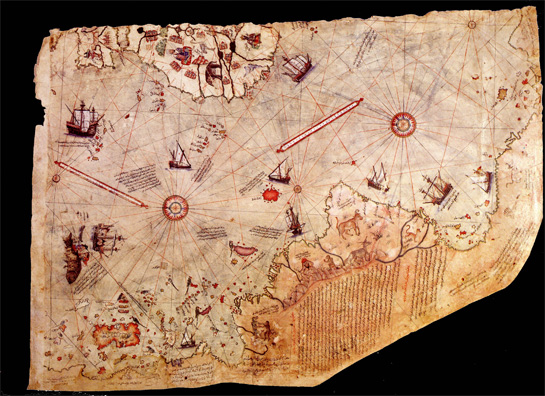
A simple piece of gazelle skin. Inked in 1513. A map.
But this is no ordinary map. This is a document that screams an impossible truth from across the centuries. It’s a map that shows a world that shouldn’t exist, drawn by a man who couldn’t have possibly known what he was drawing. It’s a map that suggests our history books are not just wrong, but missing entire chapters. Entire civilizations.
This is the mystery of the Piri Reis map. And it might just change everything you think you know about the ancient world.
A Discovery in the Sultan’s Palace
The year is 1929. The setting? The Topkapı Palace in Istanbul, Turkey. For centuries, this had been the heart of the mighty Ottoman Empire. Now, it was being converted into a museum, its vast libraries and forgotten storerooms being meticulously cataloged.
A German theologian named Gustav Deissmann was sifting through piles of discarded items in the archives. Most of it was mundane. Old ledgers. Forgotten scrolls. Then, his team found it. A rolled-up chart, drawn on the delicate but durable skin of a gazelle. It was immediately clear this was something special. The map was stunningly detailed, showing the coastlines of western Europe, North Africa, and a long, familiar-looking coastline of a continent to the west… Brazil.
The map was signed. It was compiled in the year 919 of the Moslem calendar—that’s 1513 AD to us—by an admiral of the Ottoman fleet. His name was Ahmed Muhiddin Piri, better known to history as Piri Reis.
Now, Piri Reis wasn’t just some desk-bound cartographer. He was a legend. A corsair, a warrior, a brilliant naval strategist who had battled the knights of St. John and the fleets of Spain. He was a man who lived and breathed the ocean. He knew the world as few men did. And in 1513, he compiled a great world map, a “Bahriye,” from all the knowledge he had gathered.
The piece found in the palace was only a fragment, perhaps one-third of the original masterpiece. But even this surviving sliver was a bombshell. It was one of the very first maps to show the Americas, created just 21 years after Columbus’s first voyage. And its accuracy was… unsettling.
It showed South America in its correct longitudinal position relative to Africa. Think about that. In the early 1500s, calculating longitude was the single greatest navigational challenge. It was a problem so difficult that it wouldn’t be reliably solved for another 250 years with the invention of the marine chronometer. Yet Piri Reis, somehow, had nailed it. How?
That question alone was a fascinating historical puzzle. But it was nothing compared to the real secret hidden at the bottom of the map.
The Continent That Shouldn’t Be There
Look south. Past the coast of Brazil, the map continues downward. It depicts a massive landmass extending eastward from the tip of South America.
A landmass we now call Antarctica.
Hold on. That’s impossible. Right? The official, accepted, taught-in-every-schoolbook history is clear: Antarctica wasn’t even sighted until 1820, by a Russian expedition. For the next century, it was a frozen, impenetrable mystery. Its true coastline, hidden beneath miles of solid ice, wasn’t mapped until the age of modern seismic survey technology in the mid-20th century.
So how is it on a map from 1513?
But the mystery gets deeper. So much deeper. The landmass shown on the Piri Reis map isn’t the Antarctica we know today—a formless white blob covered in ice. No. The map shows a coastline. A detailed one. With mountain ranges, river valleys, and bays. It shows Antarctica as it would look… without the ice.
Let that sink in.
Geologists and glaciologists tell us that the Antarctic ice cap has been in place for millions of years. The last time that coastline was clear, ice-free, and map-able was, at a minimum, over 6,000 years ago, and possibly much, much longer. We’re talking about a time before the pyramids of Giza. Before the rise of Sumeria. A time deep in the mists of prehistory, when mainstream archaeology says humanity was still chipping away at stone tools.
So we are faced with a question that shatters our understanding of the past: How could a 16th-century Turkish admiral possibly possess a map of a continent’s topography from an era thousands of years before maps even existed?
Deep Dive: The Hapgood Enigma
For decades, this “Antarctica question” was a niche curiosity. Then, in the 1950s, a history professor from New Hampshire named Charles Hapgood got his hands on it. Hapgood was no wild-eyed conspiracy theorist; he was a serious academic from Keene State College. And the map obsessed him.
He and his students spent years studying it, collaborating with cartographers and even the U.S. Air Force. Their conclusion was explosive. Hapgood argued that the map was not only genuine but that the depiction of the sub-glacial Antarctic coast—specifically Queen Maud Land—was shockingly accurate when compared to modern seismic survey results from 1949.
This was madness. It couldn’t be a coincidence. Hapgood theorized there was only one possible explanation: The Piri Reis map was not an original work of exploration from the 16th century. It was a copy. A copy of a copy, passed down through generations, originating from a source map created by a forgotten, highly advanced, global seafaring civilization that existed during the last Ice Age.
A lost civilization. One that mapped the entire world when Antarctica was warm and hospitable, before some cataclysm buried their world, and their continent, under a sheet of ice.
To explain how this could happen, Hapgood developed his now-famous “Earth Crust Displacement” theory. He proposed that the entire outer crust of the Earth could sometimes shift in one piece over the molten mantle below, like the skin of an orange slipping over the fruit. Such a shift, he argued, could move a continent like Antarctica out of the temperate zone and into the polar circle in a geological blink of an eye, flash-freezing it and everything on it.
It sounds like science fiction. But Hapgood’s work was compelling enough that he got one of the greatest minds in history to write the foreword to his 1958 book, *Earth’s Shifting Crust*. That mind? Albert Einstein.
The Source Code of a Forgotten Age
Piri Reis himself never claimed credit for discovering these lands. He was refreshingly honest. Written in his own hand, in the margins of the map, are his notes. He states that to create this master chart, he compiled and cross-referenced information from about 20 different source maps.
Some were contemporary, captured from Spanish and Portuguese explorers. No surprise there. But others, he claimed, were far older. He specifically mentions “maps drawn in the days of Alexander the Great,” dating back to the 4th century BC.
Think of the implications. This suggests a continuous, secret tradition of cartographic knowledge, passed down through the millennia. Knowledge that survived the burning of the Library of Alexandria, the fall of Rome, and the Dark Ages, eventually finding its way into the hands of an Ottoman admiral in Constantinople, the crossroads of the world.
And then there’s the biggest clue of all. Piri Reis explicitly states one of his most important sources was a map that had belonged to… Christopher Columbus.
A lost map of Columbus. For centuries, historians have searched for it. Columbus, it is rumored, possessed secret charts that showed him exactly where he was going. He wasn’t sailing blind into the unknown; he was following a map. A map that perhaps showed more than just the Caribbean islands. Could this lost Columbus map have been another copy, another fragment of this ancient global survey from a prehistoric civilization?
The Piri Reis map isn’t just a map. It’s a pointer. A reference to a library of lost knowledge that has vanished from history.
The Skeptics Fire Back
Now, before we rewrite every history book on the planet, it’s only fair to listen to the other side. Mainstream historians and cartographers have, of course, pushed back hard against these extraordinary claims. They have explanations. Simpler ones.
Is it really Antarctica? The skeptics say no. Look at the map again. The landmass is connected to South America. They argue it’s simply the coast of Patagonia and Tierra del Fuego, which 16th-century cartographers struggled to map accurately. They say the coastline was simply bent eastward by Piri Reis to make it fit on the limited space of the gazelle skin. It’s a distortion, not a discovery.
What about the “ice-free” detail? They argue this is pure imagination. For centuries, scholars believed in the existence of a massive southern continent, “Terra Australis Incognita” (the Unknown Southern Land), to balance the landmasses of the northern hemisphere. Mapmakers would often draw speculative, elaborate coastlines for this mythical land. Piri Reis, they say, was just following this tradition. He was guessing, not recording.
And the map’s famed accuracy? Critics point out that while some parts are good, others are wildly wrong. The Caribbean is distorted. Cuba is shown as part of the North American mainland. Proponents of the mystery, they charge, are guilty of cherry-picking: hyping the parts that look mysteriously accurate while conveniently ignoring the parts that are clearly 16th-century errors.
As for Hapgood’s Earth Crust Displacement? Modern geology has almost universally rejected it in favor of the slow, grinding, and well-evidenced theory of plate tectonics. The idea of the entire crust slipping in a single event remains firmly in the realm of pseudoscience.
Lingering Questions in a Digital Age
The debate rages on, mostly in the corners of the internet where history’s great mysteries are kept alive. But modern technology has added new fuel to the fire.
Internet forums and alternative history channels buzz with comparisons. Researchers overlay the Piri Reis map onto modern sub-glacial topographic scans of Antarctica, like the BEDMAP2 project. Do they match? Proponents scream “Yes!” They trace the outlines of bays and river inlets on the 1513 map and find eerie correspondences with the bedrock hidden beneath two miles of ice. Skeptics see only random squiggles and wishful thinking—a classic case of pareidolia, like seeing faces in the clouds.
What if, just for a moment, we entertain the idea that Hapgood was right? What would that mean? It would mean that everything we know about our past is a lie. That a sophisticated, globe-spanning civilization of master mariners and cartographers existed tens of thousands of years ago. A civilization that vanished in a global cataclysm, leaving behind only faint echoes. Ghosts. Fragments of maps passed down through a broken chain of custody until a Turkish admiral stitched them back together.
The questions remain, and they are profound.
What else was on the missing portions of Piri Reis’s great world map? Where is the lost source map of Columbus? And why is the original Piri Reis map, one of the most significant historical artifacts on the planet, kept locked away in the Topkapı Palace library, rarely, if ever, put on public display?
The gazelle skin from 1513 offers no easy answers. It just lies there, a cracked and faded portal to another version of history. A history of impossible knowledge, of forgotten explorers from an age we can barely imagine. It is a puzzle, a paradox, and a profound challenge to our own comfortable story of humanity. And the silence from the archives is the most unsettling clue of all.