Clouds Fell From the Sky: The Unsolved Mystery of the Moroccan Foam
Some days, the world makes sense. The sun rises. The tides ebb and flow. The sky is blue. And then there are other days. Days that break the rules. Days that leave you staring at something so utterly bizarre, so fundamentally wrong, that your brain struggles to even process it. For the people of the Doukkala region in Morocco, one day in 2016 was exactly that.
It began without warning.
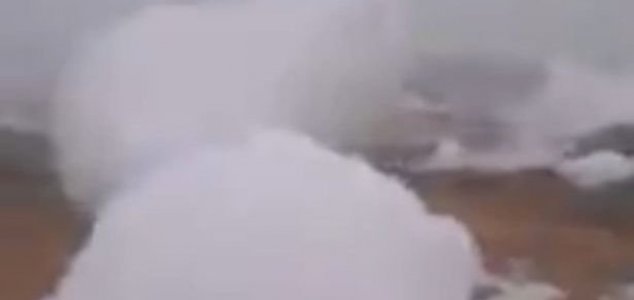
A normal day, under a normal sky. Then, it appeared. A strange, white, billowing substance started to cover the ground. It wasn’t snow. It wasn’t hail. It looked for all the world like mountains of soap suds, a phantom wave of foam washing over the landscape. It clung to trees, blanketed fields, and piled up in the streets. Locals emerged from their homes, bewildered, pointing their phones at the spectacle. They had no words for it. Some whispered it looked as though the clouds themselves had simply fallen out of the sky.
What was it? Where did it come from? And why, years later, do we still have no real answers?
Soon, the footage hit the internet. A video, shaky and raw, showed the sheer scale of the event. The man filming it, his voice a mix of awe and confusion, stated he had never, ever seen anything like it. And just like that, the Moroccan Foam Anomaly went viral. The world was watching. And everyone had a theory.
The “Sensible” Explanations: Trying to Tame the Weirdness
When something truly strange happens, our first instinct is to find a neat little box to put it in. We crave a logical, scientific reason. It’s comforting. And for the Moroccan foam, the internet’s armchair detectives offered up a few possibilities. But do any of them really hold water? Or are they just attempts to explain away something that defies easy answers?
Theory #1: A Freak Sea Foam Event
This was the go-to explanation for many. Sea foam is a real thing. It happens. Usually, it’s caused by the churning of the ocean, which agitates organic matter like algae and other tiny marine life. This creates surfactants—compounds that act a lot like the stuff in your dish soap, reducing the surface tension of the water and allowing bubbles to form and persist.
On the surface, this makes sense. The Doukkala region is a coastal area. A powerful storm with strong onshore winds could, in theory, whip up a massive amount of sea foam and blow it inland. We’ve seen it happen in other parts of the world, creating surreal scenes of coastal towns buried in suds.
But here’s where the theory starts to fray. The foam in Morocco didn’t seem to be concentrated solely at the coast. It appeared in fields and areas further inland. And while storms can carry foam, the sheer volume and distribution seen in the video raise serious questions. Was there a storm that day powerful enough to do this? Reports from the time are scarce. Furthermore, the foam’s consistency—thick, clumpy, and almost solid-looking in places—didn’t quite match the typical light, airy texture of sea foam. It was… different.
Theory #2: An Industrial Accident
What if this wasn’t a natural phenomenon at all? What if it was man-made? The second popular idea points the finger at an industrial spill. Perhaps a nearby factory, a chemical plant, or even a truck transporting some kind of concentrated detergent had a catastrophic failure.
Imagine a massive tank of industrial-grade soap getting mixed with water from a burst pipe or firefighting efforts. The resulting foam could be enormous, easily spilling out and covering a wide area. This theory accounts for the strange texture and the sheer quantity of the substance.
But it also comes with a big, gaping hole. An industrial accident of this magnitude would be news. There would be emergency crews, government agencies in hazmat suits, and official warnings to the public. There would be a paper trail. Yet, in the aftermath of the Moroccan foam event, there was… silence. No company came forward. No government agency issued a statement about a chemical spill. The story, as far as official sources were concerned, was a complete non-event. That silence is, for many, more damning than any admission of guilt could ever be.
Theory #3: The Sewer Overflow Scenario
This is the least pleasant explanation, but one that has to be considered. Heavy rainfall can sometimes overwhelm municipal sewer systems, causing them to back up and overflow. The combination of water, detergents from households, and other organic waste can absolutely create a frothy, unpleasant foam.
Could this explain the Moroccan event? It’s possible. But again, we run into the same problems. A sewer overflow of this size would be a public health crisis. There would be an unmistakable, foul odor. Yet, none of the witnesses in the video seem to be reacting to a terrible smell. They seem curious, not disgusted. And just like the industrial accident theory, a major infrastructure failure like this would almost certainly generate official reports and news coverage. Once again, there was nothing.
The “sensible” explanations all seem to fall apart under scrutiny. They leave too many questions unanswered. And when logic fails, that’s when the door opens to far stranger possibilities.
Beyond the Pale: Diving into the Conspiracy Rabbit Hole
This is where the story gets really interesting. When the mainstream explanations feel weak, people start looking for answers in the shadows. They start connecting dots that others ignore. For the Moroccan Foam Anomaly, the alternative theories are as vast and strange as the foam itself.
Deep Dive: The Chemtrail Connection
The original social media chatter mentioned “chemicals dumped from an airplane.” This is a direct line to one of the most persistent and sprawling conspiracy theories of the modern age: chemtrails.
For those unfamiliar, the core idea is that the long, white trails left by high-altitude aircraft are not just harmless water vapor (contrails). Instead, proponents believe they are deliberate and secret sprayings of chemical or biological agents for purposes ranging from weather modification and solar radiation management to more sinister goals like population control.
Could the Moroccan foam be linked to this? The theory goes something like this: what if this wasn’t a normal spraying? What if it was an experiment gone wrong? Perhaps a new chemical agent was being tested, one designed to interact with atmospheric moisture in a specific way. Maybe the atmospheric conditions on that day were unexpectedly perfect, causing the agent to over-react and “polymerize” into a massive foam that fell to the ground before it could properly disperse.
This would explain the sudden appearance and the lack of a clear ground-based source. The “plane” could have been flying at an altitude high enough to be unseen or unheard. It also explains the official silence. If a secret, unsanctioned geoengineering program had a very public failure, the last thing any government would do is admit to it. They would simply wait for the evidence to dissipate and pretend nothing ever happened. The foam was weird, but it was also temporary. It likely broke down and washed away, leaving no trace. A perfect, traceless screw-up.
A Bizarre Natural Phenomenon We Don’t Understand
Maybe the answer isn’t a secret plot, but a secret of nature itself. Our planet is a complex chemical soup, and we are constantly discovering new and bizarre interactions. Throughout history, there have been documented cases of “weird rain”—showers of frogs, fish, blood-red water, and gelatinous goo.
Science often dismisses these as waterspouts picking up animals or dust storms tinting the rain. But some events defy easy explanation, like the red rain of Kerala, India, which contained strange biological cells with no DNA.
What if the Moroccan foam was a similar type of event? A unique convergence of specific airborne pollens, dust from the Sahara, industrial pollutants, and a particular temperature and pressure inversion could have created a chemical reaction in the atmosphere. A chain reaction that produced a stable, lightweight foam that then fell to earth. It would be a one-in-a-billion meteorological fluke. A perfect storm of chemistry. It’s a possibility that science has never documented, but that doesn’t mean it’s impossible. Nature is, after all, far stranger than we give it credit for.
What if it Wasn’t From ‘Around Here’?
And now, we take the final leap. The one that separates the casual observer from the true seeker of unexplained mysteries. What if the source wasn’t on the ground, or even in our skies?
The UFO/UAP phenomenon is filled with reports of strange physical evidence left behind by unexplained aerial craft. “Angel hair,” a fibrous, cobweb-like substance, has been reported to fall from the sky after sightings. Strange metallic fragments have been recovered. Could the Moroccan foam be another example of this? A byproduct of an unknown technology?
Think about it. A craft entering or exiting our atmosphere, or perhaps using an unknown form of propulsion, could cause extreme and unusual chemical reactions in the air around it. It might dump a waste product or an atmospheric coolant. The resulting “foam” would be completely alien to our science. It would appear without a source, baffle all conventional analysis, and then disappear. It fits the pattern perfectly. While it may sound like science fiction, to those who saw the sky fall that day, was it any more fantastic than the other explanations?
The Loudest Clue: The Deafening Silence
Perhaps the most compelling piece of evidence in this whole affair is the lack of evidence. The story flared up. It went viral. For a week, the world was obsessed with the mysterious foam in Morocco. And then… nothing.
There was no follow-up report from a major news network. No scientific paper was published analyzing a sample of the substance. The Moroccan government issued no official explanation or warning. The story just died.
In the world of conspiracies, a cover-up is often identified not by what you see, but by what you *don’t* see. The absence of a logical follow-up is a massive red flag. If it were simple sea foam, a meteorologist would have explained it. If it were an industrial spill, a company or environmental agency would have been forced to comment. If it were a sewer backup, the city works department would have been on the scene.
The total lack of an official resolution suggests that *none* of the simple explanations were true. It suggests that whatever the foam was, the authorities did not want to talk about it. Maybe they didn’t understand it. Or, more chillingly, maybe they understood it all too well.
So what really happened in Doukkala? Were the locals witnesses to a freak weather event? The messy result of human carelessness? Or did they catch a glimpse of something far more profound—the fallout from a secret experiment or a technology not of this world?
The foam is long gone, washed away by the rains and broken down by the sun. But the questions remain. They hang in the air, unanswered and unsettling. It’s a potent reminder that even in our modern, hyper-connected world, some mysteries are not meant to be solved. Sometimes, the clouds just fall from the sky, and we are left to simply wonder why.