Coded Warning or Artistic Vision? The Chilling Reality of New York on Other Worlds
You’ve seen the pictures. Maybe they flashed across your screen late at night, a strange and unsettling vision you dismissed as just another piece of digital art. But what if they’re more than that? What if they are not just imagination, but echoes from a reality that could have been… or a terrifying preview of what’s to come?
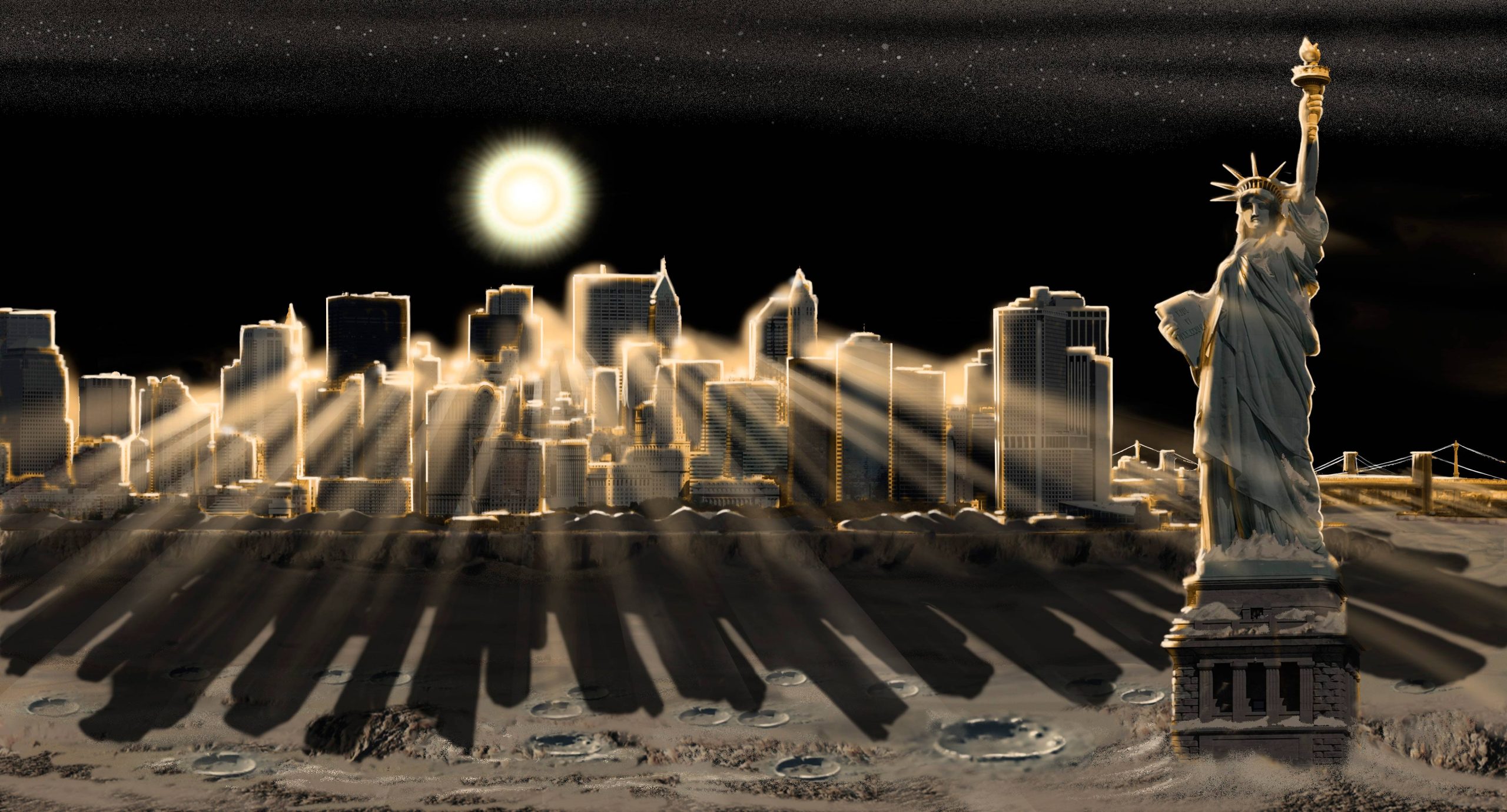
An artist, Nickolay Lamm, working with an astrobiologist, M. Browning Vogel, released a series of images that stopped the internet for a day. The concept was simple: Plant the iconic skyline of New York City on the other planets of our solar system. The result? Absolutely haunting.
Forget the science for a second. Forget the simple explanation that “this is just art.” Let’s look at what these images are really showing us. Let’s treat them not as illustrations, but as snapshots. Glimpses through a cracked door into alternate timelines where humanity’s greatest city stands against the alien skies of our neighbors. This isn’t just a thought experiment. It’s a journey into the great, terrifying ‘What If’.

Look at that first image. The familiar silhouettes of the Empire State Building and the Chrysler Building stand defiant. But above them? The swirling, chaotic, impossibly huge atmosphere of Jupiter. Or is it Saturn? The bands are there. The sense of scale is wrong. It’s overwhelming. It makes you feel small. It makes you feel fragile. This is the feeling they want you to ignore. But we won’t.
Venus: A Glimpse into Earth’s Burnt Future?
They call Venus our “sister planet.” If that’s true, this is the sister who went catastrophically, horrifyingly wrong.
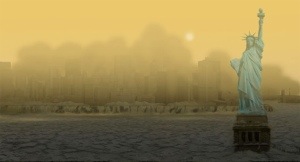
The image is a nightmare. A fever dream painted in sulfur and despair.

The sky isn’t blue. It isn’t even gray. It’s a sickly, oppressive yellow-orange, choked with clouds not of water, but of sulfuric acid. They say the sun never shines on the surface of Venus. You can see it in the picture. A perpetual, gloomy twilight where the air itself wants to dissolve you. The skyline is barely visible, a ghost of itself swallowed by the toxic haze.
And Lady Liberty?
She’s not standing in a harbor. There are no oceans on Venus. They boiled away billions of years ago. She is marooned on a sea of black, cooling lava. A monument to a freedom that can’t exist in a place where the air pressure is 92 times that of Earth’s. That’s the equivalent of being 3,000 feet deep in the ocean. It would crush a submarine like a soda can. It would crush a human into jelly.
Deep Dive: The Great Catastrophe of Venus
Mainstream science gives us a neat story. They call it the “runaway greenhouse effect.” Billions of years ago, Venus may have been like Earth. It might have had oceans, blue skies, maybe even life. But something went wrong. The carbon dioxide in its atmosphere started trapping heat, which released more carbon dioxide from the rocks, which trapped more heat. It was a death spiral. A planetary feedback loop that couldn’t be stopped.
The oceans boiled into the atmosphere. The temperature soared to over 800 degrees Fahrenheit—hot enough to melt lead. The water molecules were blasted apart by solar radiation, and the hydrogen escaped into space, lost forever. What’s left is a bone-dry, superheated, high-pressure furnace.
But here’s the question the conspiratorial mind must ask: Was it natural? Is it possible that Venus was once home to a civilization that made one wrong turn? That ignored the warnings of their own scientists? Look at that image again. The Statue of Liberty on a sea of lava. Is that a vision of another planet, or is it a warning about our own? A prophecy of what happens when a world burns its future to fuel its present.
What If: Surviving in the Venusian Metropolis
So, how could a New York City even exist here? It couldn’t. Not on the surface. Any settlement would have to be airborne. Imagine floating cities, like vast metallic zeppelins, hovering 30 miles up in the Venusian atmosphere. Up there, the temperature and pressure are surprisingly Earth-like. You could, theoretically, walk on an open-air platform with just an oxygen mask and a suit to protect you from the acid rain.
But you would be a prisoner of the sky. Below you, the surface would be a forbidden hellscape. And above you? The endless, featureless, yellow clouds. No sun. No moon. No stars. Just the eternal, suffocating glow. What would that do to the human mind? The skyline in the image isn’t a thriving metropolis. It’s a tombstone. A monument to a world that died screaming.
Mars: Whispers from a Planetary Graveyard
If Venus is a vision of hell, Mars is a vision of purgatory. It’s not actively trying to kill you with heat and pressure. It’s just… dead. Empty. A ghost of a world.

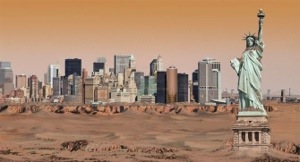
The air is thin, almost a vacuum. The sky is a pale, butterscotch orange, not the deep blue we know. And everything, absolutely everything, is covered in a fine layer of red-orange dust. The official story is that this dust is basically rust. Iron oxide. The entire planet has rusted over.
The image shows the NYC skyline caked in it. Imagine that. The fine, talcum-powder-like dust gets into everything. Every crack. Every gear. Every lung. It would be a constant battle just to keep things clean, to keep machines running. And the dust storms… they aren’t like storms on Earth. On Mars, they can grow to engulf the entire planet for weeks at a time, blotting out the already faint sun.
Recent Internet Theories: What Is Buried Under the Dust?
For decades, people have looked at Mars and seen things. In the 1970s, the Viking orbiter sent back a picture of a region called Cydonia. In it was a rock formation that looked exactly like a human face. Nearby were other formations that looked like pyramids. Scientists screamed “Pareidolia!”—the human tendency to see patterns in randomness. They said it was just a trick of light and shadow.
But the story never died. In the decades since, online communities and fringe researchers have analyzed these images and newer ones. They point to strange geometric shapes, possible entrances to underground structures, and anomalous readings from rovers. The modern rovers, like Perseverance, have confirmed that Mars was once a water world, with rivers, deltas, and maybe even a vast northern ocean.
So where did it all go? The planet lost its magnetic field, and the solar wind stripped its atmosphere and water away. A slow, cold death.
But what if something survived? What if an ancient Martian civilization, facing planetary extinction, built monuments to be found? Or went underground? If a New York City were built on Mars, would we be building on top of a giant, planet-sized graveyard? Would the dust that coats our skyscrapers be the powdered remains of a lost world? The thought is chilling.
What If: The Psychology of the Red Planet
Life in a Martian New York would be life inside a bottle. The city would have to be enclosed under a massive dome, or built deep underground to protect from the radiation and the thin atmosphere. Your entire world would be artificial. The air you breathe, the water you drink, the light you see—all manufactured.
The only connection to the outside would be the view. The endless, silent, red desert. The pale orange sky. The two tiny moons, Phobos and Deimos, zipping overhead. It would be beautiful, for a while. Then, perhaps, it would become oppressive. A constant reminder of your isolation. A city of millions, marooned on a dead rock, 140 million miles from the green and blue of home. What would be the biggest threat? A micrometeorite breaching the dome? A life support failure? Or the slow, creeping madness of cosmic loneliness?
Neptune: The Diamond Storm at the End of Everything
This one is the most extreme. The most unbelievable. A city at the edge of the solar system. An outpost in the deepest, darkest cold.

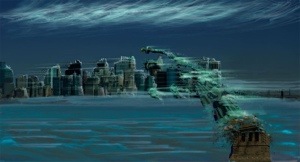
Neptune is an ice giant. It’s not a place you can stand on. So this New York City must be a floating city, held aloft in the upper layers of a turbulent, chaotic atmosphere. The sky is a deep, mesmerizing cyan blue, colored by the methane that makes up a large part of the air. It’s beautiful. And it’s deadly.
The temperatures here plummet to -350 degrees Fahrenheit. The sun, nearly 3 billion miles away, is just a bright star. It offers no warmth, only a dim, perpetual twilight. The city would need to generate its own light and heat, 24/7, forever. An island of warmth in an ocean of absolute zero.
But the cold isn’t the worst part.
The wind is.
Neptune has the fastest winds in the solar system, clocked at over 1,200 miles per hour. That’s faster than the speed of sound. It’s not wind; it’s a constant, planet-wide shockwave. As the original post noted, the Statue of Liberty would be torn to confetti in an instant. Every building in this impossible city would have to be an engineering miracle, designed to withstand forces we can barely comprehend.
Deep Dive: The Raining Diamonds of Neptune
Here’s where science fiction becomes science fact. Scientists believe that deep inside the atmospheres of Neptune and Uranus, the immense pressure is so great that it can break apart methane molecules (CH4). The carbon atoms get squeezed together, forming solid diamonds. These diamonds, heavier than the surrounding atmosphere, would then fall like hail. A constant, glittering rain of diamonds through the deep, dark layers of the planet.
Can you even imagine it? A city floating in a blue sky, where the rain isn’t water, but a storm of pure diamonds. It sounds like a poet’s dream, but it’s born from the most violent conditions imaginable. This isn’t a gentle shower. This is an abrasive, high-velocity storm that would sandblast anything it touched.
What If: The Last Human Outpost
Why would humanity ever go to Neptune? Why build a city in such an unbelievably hostile place? You only go to a place like this for one of two reasons: you’re running toward something, or you’re running away from something.
Maybe this New York isn’t a colony. Maybe it’s an ark. The last remnant of humanity, fleeing a dying Earth or a dying Sun. Or maybe they’re hiding. Hiding from something so terrible that the 1,200-mph winds and diamond storms of Neptune seem like a safe haven.
Life here would be a testament to pure survival. The city would be a fortress. The people within would know nothing but the deep blue twilight, the hum of the fusion reactors keeping them alive, and the eternal scream of the wind outside. They would be the loneliest people in the universe. The keepers of a flickering flame at the absolute edge of darkness.
These images, created by an artist and a scientist, do more than just show us pretty, alternate skylines. They are a mirror. They reflect our own world’s fragility, our potential futures, and our deepest fears about our place in the cosmos.
Are they just art? Or are they a message in a bottle, sent to us from across the void of possibility? Look up at your own blue sky today. Appreciate it. Because as these chilling visions suggest, it’s the most valuable, and perhaps the most fragile, thing we have.