The Impossible Photo That Changed Everything
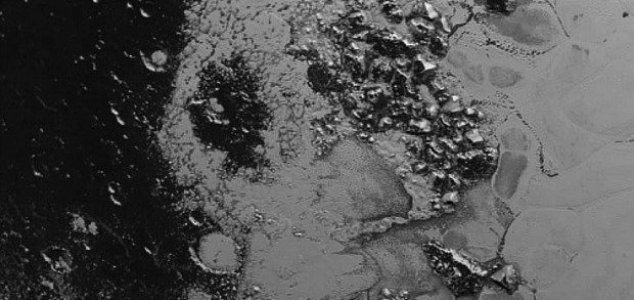
Stop. Look at that image above. Really look at it.
You are looking at a landscape that, according to every textbook written before July 2015, simply shouldn’t exist. For decades, we were told Pluto was a dead, frozen ice ball. A relic. A boring, static rock at the edge of the solar system where nothing ever happens. They told us it was too small to hold onto heat. They said it was too far from the Sun to have weather. They were wrong.
Dead worlds don’t have mountains.
This single frame, beamed back across billions of miles of empty void by the New Horizons probe, is the smoking gun. It proves that the solar system is far stranger, more active, and more terrifyingly alive than we ever dared to imagine. Those jagged peaks? They aren’t rock. They are water ice, frozen so hard by the absolute zero of deep space that they act like granite. And they are pushing up against a skyline that defies logic.
We need to rip up the old maps. We need to talk about what is really happening on Pluto.
The “Appalachians” at the Edge of Darkness
When the first high-resolution data packets trickled back to Earth—traveling at the speed of light but still taking hours to arrive—scientists at the Johns Hopkins Applied Physics Laboratory gasped. They weren’t looking at craters. They were looking at tectonic activity.
Earlier images had already teased us with mountain ranges comparable to the Rockies. Massive. Imposing. But this new scan? It revealed a second, distinct chain of peaks. These bad boys are rivaling the Appalachian Mountains in scale.
Think about that.
We are talking about mountains standing thousands of feet high. On Earth, mountains are formed by tectonic plates smashing together, driven by a molten core of magma. Pluto shouldn’t have a molten core. It should be a solid block of ice through and through. So what pushed these mountains up? What titan strength buckled the crust of a dwarf planet to create these jagged sentinels?
The mountains lie in a “twilight zone” area between two vastly different regions, acting as a chaotic border wall. On one side, you have the ancient, battered terrain that tells the story of the solar system’s violent birth. On the other? The smooth, eerily young nitrogen ice plains. The collision of these two worlds is creating geology that looks almost… alien.
The Heart That Should Be Broken
You’ve seen the memes. The “Heart of Pluto.” It looks cute on a t-shirt. But geologically? It is a monster.
This region, officially named Tombaugh Regio (after Clyde Tombaugh, the man who first spotted the dot in 1930), is the central mystery of the entire system. These remarkable geological features span the edge of this distinctive shape, which we now know isn’t just a surface stain. It is a massive basin.
The “Heart” is actually broken into several different regions with wildly varying textures and reflectivity. The western lobe, called Sputnik Planitia, is the most baffling. It is smooth. Too smooth.
In planetary science, smoothness is suspicious. It means something erased the craters. It means the surface is young. We are talking less than 10 million years old in a solar system that is 4.5 billion years old. It’s like finding a newborn baby in a retirement home for dinosaurs.
Scientists are still scrambling to figure out the processes responsible for the stark transition between the dark crater-marked region on one side and the smooth frozen plains on the other. But the leading theories are wild. We are talking about nitrogen glaciers. Not water. Nitrogen.
At these temperatures, nitrogen turns into a slushy solid that flows like toothpaste. It oozes from the highlands, fills in the craters, and wipes the history clean. Pluto is constantly repaving its own driveway.
Deep Dive: The Science of the “Dwarf”
Before we go further down the rabbit hole of subsurface oceans and alien skies, we need to ground ourselves in what we think we know.
Pluto (minor-planet designation: 134340 Pluto) is the King of the Kuiper Belt. This is the ring of frozen bodies beyond Neptune, the “junkyard” of the solar system construction project. Pluto was the first Kuiper belt object to be discovered, and it remains the largest and second-most-massive known dwarf planet.
It’s the ninth-largest and tenth-most-massive known object directly orbiting the Sun. But don’t let the “dwarf” label fool you. Size isn’t everything.
It is the largest known trans-Neptunian object by volume. However, Eris, another dwarf planet in the scattered disc, is slightly more massive. This rivalry with Eris is essentially what got Pluto “demoted” in 2006 (a controversy that still makes blood boil in astronomy clubs). Like other Kuiper belt objects, Pluto is primarily made of ice and rock.
It is relatively small—about one-sixth the mass of the Moon and one-third its volume. But its orbit? Its orbit is pure chaos.
The Chaos Orbit
Earth orbits the Sun in a nice, flat circle. Boring. Safe. Pluto? Pluto dances to its own beat. It has a moderately eccentric and inclined orbit. It doesn’t sit flat on the dinner plate of the solar system; it’s tilted at a wild 17-degree angle.
During its year (which takes 248 Earth years), it ranges from 30 to 49 astronomical units or AU (4.4–7.3 billion km) from the Sun. This leads to a bizarre game of cosmic chicken.
This means that Pluto periodically comes closer to the Sun than Neptune. For 20 years out of every orbit, Pluto cuts inside Neptune’s lane. You’d think they would crash, right? A massive celestial pile-up? No.
A stable orbital resonance with Neptune prevents them from colliding. They are locked in a gravitational waltz. For every three times Neptune goes around the Sun, Pluto goes around exactly twice. They never get near each other. It’s a perfect, clockwork mechanism that has kept them safe for billions of years. Who—or what—set that clock?
In 2014, Pluto was roughly 32.6 AU from the Sun, sitting right in the sweet spot for the New Horizons flyby.
The Texture of Mystery: Snakeskin and Dungeons
Let’s get back to the ground. “There is a pronounced difference in texture between the younger, frozen plains to the east and the dark, heavily-cratered terrain to the west,” said New Horizons geophysicist Jeff Moore. But that is the scientific understatement of the century.
What Moore is talking about is a landscape that looks like dragon scales. High-resolution contrasting reveals “snakeskin” terrain—miles upon miles of ridges that look like fingerprints. These are penitentes on steroids—blades of ice standing hundreds of feet tall, sculpted by sublimation.
And then there is the color. Pluto isn’t grey. It’s red. Brown. Orange. Blue.
The dark regions, dubbed “The Whale” (Cthulhu Macula), are covered in tholins. These are complex organic molecules. When sunlight hits methane and nitrogen in the atmosphere, it cooks them into a tar-like gunk that rains down on the surface. It’s literally raining organic compounds. The building blocks of life are falling from the sky and coating the mountains in red sludge.
“There’s a complex interaction going on between the bright and the dark materials that we’re still trying to understand,” Moore added. Translation: We have no idea what is going on.
The Sleeping Giant: Cryovolcanoes
Here is where it gets truly wild. The mountains might not just be uplifted crust. They might be volcanoes.
We aren’t talking about lava and fire. We are talking about cryovolcanism. Ice volcanoes. There are two massive peaks, Wright Mons and Piccard Mons, that have deep depressions in their centers. They look exactly like shield volcanoes on Earth, but they are made of water ice.
If these are volcanoes, it means Pluto was recently active. It might still be active. It means that somewhere deep below that frozen shell, there is a heat source. Is it radioactive decay? Is it leftover heat from formation? Or is it something stranger?
The Ocean Under the Ice
The most compelling theory gaining traction right now—one that keeps astrophysicists awake at night—is the Subsurface Ocean Theory.
The smooth plains of Sputnik Planitia are heavy. They are a “mascon” (mass concentration). To keep the dwarf planet from toppling over or wobbling out of control, physics dictates there must be something dense underneath to counterbalance it. The math points to a global ocean of liquid water mixed with ammonia, buried under 100 kilometers of ice.
Water. Liquid water. At the edge of the solar system.
If there is water, and there is heat (to keep it liquid), and there are organic materials raining down from the sky… do the math. Are we looking at a habitat? Could something be swimming in the dark, pressurized depths of Pluto?
Why Did We Go Back?
For years, people asked, “Why waste money on Pluto?” It’s just a rock. But the New Horizons mission wasn’t just a sightseeing tour. It was a reconnaissance mission to the edge of known space.
The probe didn’t stop at Pluto. It kept going. It flew past Arrokoth, a strange, flattened “snowman” object even further out. Every step deeper into the Kuiper Belt reveals that the outer solar system is not empty. It is crowded.
Some astronomers believe there is a “Planet Nine” out there. A true giant, ten times the mass of Earth, shepherding the orbits of these tiny worlds. The weird tilt of Pluto, the strange cluster of other Kuiper Belt Objects—they all point to something massive hiding in the dark. Pluto might just be the gatekeeper.
The Verdict
The mountains of Pluto are more than just pretty scenery. They are evidence of a living planetary engine where there should only be a corpse. They challenge our definitions of “habitable” and “planet.”
The New Horizons data is still being analyzed. It will take decades to fully parse. But one thing is certain: The solar system is not finished with us yet. Pluto was supposed to be the end of the line. Instead, it turned out to be the beginning of a whole new mystery.
So next time you look up at the night sky, look past Mars, past Jupiter, past the rings of Saturn. Look into the dark. There is a world out there with blue skies, red snow, and mountains made of ice that rise as high as the Rockies. And it is waiting for us to return.
Originally posted 2015-09-03 16:09:12. Republished by Blog Post Promoter