Sunday, September 13, 2026
HomeSpace & ScienceSpaceHas the NASA rover captured an image of a Crucifix on Mars

Has the NASA rover captured an image of a Crucifix on Mars

The Martian Cross: NASA’s Bombshell Photo of a Possible Alien Tomb

What if the first proof of intelligent alien life wasn’t a radio signal or a flying saucer blotting out the sun? What if it was something far stranger? Something quieter. Something… sacred?

For decades, we’ve scanned the heavens, listening for whispers from the cosmos. We’ve sent probes and rovers, our robotic eyes and hands, to sift the sands of other worlds. We’ve been looking for microbes, for fossils, for the chemical building blocks of life. But what if we’ve been looking for the wrong thing all along? What if the evidence has been sitting in NASA’s own public archives for years, dismissed as a trick of the light?

A single photograph. That’s all it took to ignite a firestorm across the internet. A grainy, rust-colored snapshot from the surface of Mars that shows something so impossible, so out of place, that it challenges everything we thought we knew about our silent, red neighbor.

It shows a cross.

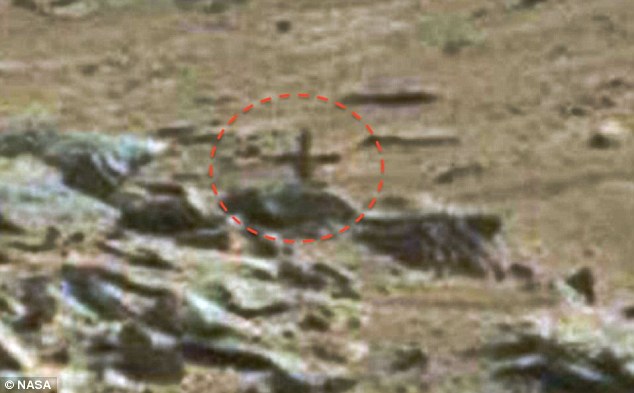
Not just any cross. A perfectly formed crucifix, standing defiantly against the Martian wind, next to what looks like the rubble of a collapsed building. A temple, perhaps. Or a tomb. A silent monument on a dead world.

The Photo That Broke the Internet

The date was January 10, 2014. NASA’s billion-dollar Curiosity Rover, a mobile geology lab the size of a small SUV, was dutifully trundling across the floor of Gale Crater. Its mission: to determine if Mars ever had the right environmental conditions to support microbial life. It drills rocks. It analyzes soil. It sends back stunning panoramic photos of the alien landscape.

And it sends back thousands upon thousands of raw, unedited images. These images are dumped onto public servers, a goldmine for scientists, researchers, and a new breed of digital prospector: the anomaly hunter.

These are the men and women who spend countless hours poring over every pixel, every shadow, every rock in NASA’s data feeds. They aren’t looking for geological formations. They’re looking for the things that don’t belong. The things the official narrative overlooks. And on that day, a French enthusiast named Christian Mace found something that made him stop cold.

There, in the middle of a desolate rock field, was a shape. An unmistakable shape.

He flagged it. Soon, the image was picked up by Scott C. Waring of the infamous blog UFO Sightings Daily, a hub for this kind of discovery. The analysis was electric, breathless. This wasn’t just a random rock. This was structure. This was intent.

“I would bet big money that this is a full size cross,” Waring wrote with conviction. “Near the cross there is the ledges of a beautifully carved roof that has since caved in. It has archways carved in its top and three thin layered sections.”

The internet did the rest. The image went viral. It was dissected on forums, debated in comment sections, and featured in countless YouTube videos. Was this it? The smoking gun? The final, undeniable proof that we are not alone?

A Digital Forensic Deep Dive: What Are We Really Seeing?

Let’s look at the evidence ourselves. Don’t take my word for it. Don’t take their word for it. Look at the photo. Really look.

Your eyes are immediately drawn to it, aren’t they? Slightly left of center. It’s small, but its geometry is perfect. A vertical shaft. A horizontal crossbeam. It appears to be planted in the ground, casting a small shadow in the thin Martian light.

It’s eerie. It feels ancient. It looks like a grave marker in a forgotten cemetery at the edge of the world.

Now, let your eyes drift to the right. See that large, flat slab of rock? The anomaly hunters claim this is the “fallen roof.” Look at its edges. They appear unnaturally straight, almost cut. Notice the layers. Are those the “archways” Waring described? A series of uniform, carved-out sections? It looks less like a random piece of bedrock and more like a slab of worked stone, a piece of ancient architecture toppled by some long-forgotten cataclysm.

Together, the two objects tell a story. A cross. A collapsed structure. It paints a picture of a place of worship, a tomb, a site of great meaning, now left to crumble in the red dust over millions of years.

Was Curiosity’s Mission Just a Cover Story?

To understand the weight of this, you have to understand where the photo was taken. The Curiosity Rover didn’t just land in a random spot. It was sent to Gale Crater, a 96-mile-wide basin with a massive mountain, Mount Sharp, rising from its center. Why there?

The official story is that the crater was once a giant lake. The layers of Mount Sharp are like the pages of a history book, detailing Mars’s transition from a warm, wet world to the frozen desert it is today. A perfect place to search for the chemical fingerprints of life.

A perfect story.

But what if there was another reason? For decades, researchers have pointed to strange formations on Mars. The infamous “Face on Mars” in the Cydonia region, captured by the Viking 1 orbiter in 1976. Nearby, a collection of five-sided “pyramids” seemed to mimic the layout of an ancient city. NASA dismissed it all as tricks of light and shadow.

Then came more. The “Martian woman” spotted by the Spirit rover. A supposed “thigh bone” found by Curiosity itself. A “floating spoon.” Each one is explained away officially as an odd-shaped rock. A coincidence. But how many coincidences does it take before it becomes a pattern?

Is it possible that NASA knows exactly what’s on Mars? That they sent Curiosity to Gale Crater not just to find microbes, but to discreetly survey the ruins of a civilization they have known about for decades? Are they slowly leaking these images to the public to prepare us for a revelation that will change human history forever?

What if It’s Real? The Terrifying & Awe-Inspiring Possibilities

Let’s play a game. Let’s assume for one moment that the object in the photo is exactly what it looks like: an artificial cross next to a ruined building. What would that mean?

Scenario 1: A Native Martian Civilization

This is the big one. This would mean that a complex, intelligent civilization arose on Mars, completely independent of Earth. They built structures. They developed tools. And, most shockingly, they developed a system of belief that used the same symbol of sacrifice and faith that would later arise on our own planet. How is that possible? Is the cross a universal archetype, a shape that all intelligent life eventually stumbles upon? Or does it suggest a shared origin, a story far older than we can possibly imagine?

Scenario 2: Ancient Astronauts and a Human Connection

What if the civilization wasn’t Martian at all? What if it was *us*? The ancient astronaut theory posits that humanity is far older and more space-faring than we are told. Could a long-lost human colony have settled on Mars thousands, or even millions, of years ago? Perhaps they fled a dying Earth, or perhaps Mars was our original home. This cross wouldn’t be an alien symbol; it would be a human one, a relic of a forgotten chapter of our own history, leaving us as the true aliens on our own planet.

Scenario 3: A Message from a Third Party

Perhaps neither humans nor Martians built this. Perhaps another, more advanced space-faring race visited our solar system eons ago. They may have seeded life on both Earth and Mars. They may have left these markers behind as a sign, a test, or a warning. The cross could be their symbol, and its appearance on two different worlds in the same system would be the ultimate calling card, a way of telling us that our entire history has been guided by an unseen hand.

Any of these scenarios would shatter our understanding of the universe. It’s a thought so profound it can make you dizzy. A simple rock formation? Or the key to everything.

The Official Explanation: A Convenient Scapegoat Called Pareidolia

Of course, there is an official explanation. A neat, tidy, and ultimately boring one.

Scientists and skeptics will point to a simple psychological quirk called pareidolia. This is the human brain’s tendency to see patterns, and especially faces and familiar objects, in random stimuli. It’s why we see animals in the clouds, a man in the moon, or the face of a religious figure on a piece of toast.

Our brains are hardwired for pattern recognition. It was a useful survival trait for our ancestors, helping them spot a predator hiding in the bushes. But in the modern world, it makes us see conspiracies in coincidences and faces in rocks.

According to this view, the “Martian Cross” is nothing more than two small, linear rock formations that happen to intersect at a roughly 90-degree angle. The “ruined temple” is just a fractured piece of sedimentary rock, its layers and straight edges the result of eons of wind erosion and geological stress. Nothing to see here. Move along.

Is Pareidolia the Perfect Cover Story?

It’s a clean explanation. Almost too clean.

Pareidolia is the ultimate get-out-of-jail-free card for any anomalous discovery. See a pyramid? Pareidolia. See a face? Pareidolia. See a perfectly symmetrical crucifix next to what looks like a collapsed building? You guessed it. Pareidolia.

It’s an intellectual shutdown. It requires no further investigation. It allows any evidence, no matter how compelling, to be dismissed without a second thought. But is it always the right answer?

The geometry of the cross is what gives people pause. Natural erosion can create strange shapes, but the clean intersection, the apparent vertical placement—it pushes the boundaries of coincidence. When you combine it with the adjacent slab that looks so much like a worked piece of stone, the pareidolia explanation starts to feel less like science and more like an excuse.

Modern online detectives have taken this a step further. Using AI-enhancement software, they’ve sharpened the image, adjusted the contrast, and claimed to find even more detail. Some say they can see inscriptions on the “tomb slab.” Others argue the cross isn’t rock at all, but petrified wood, or even metal glinting in the sun.

A Universe of Anomalies

The Martian Cross doesn’t exist in a vacuum. It’s one piece of a much larger puzzle. For decades, credible people—from astronauts to high-ranking military officials—have hinted that we are not alone. And the photographic evidence continues to pile up.

Strange structures in craters on the Moon. The bizarre, glowing lights of the dwarf planet Ceres. Unexplained geometric patterns on the surface of Venus. Everywhere we point our cameras, we find things that shouldn’t be there.

Are these all just tricks of light and shadow? Is the entire universe just a giant Rorschach test for our overactive imaginations?

Or are we like infants, staring at the complex machinery of the universe and seeing only pretty shapes, unable to comprehend the intelligent design staring back at us?

The photograph from Curiosity Rover remains unexplained in a way that truly satisfies everyone. It sits there, in the NASA archives, a digital ghost. A question mark carved onto the face of another world.

It could be a rock. A meaningless, random fluke of geology. Or it could be the most important photograph ever taken. A silent, lonely gravestone on Mars, a monument to a lost world, waiting for the day we finally come home to read the epitaph.

The truth is out there. Buried in the red sand. What do you see?

Arindam Mukherjee
Arindam Mukherjee
Arindam loves aliens, mysteries and pursing his interest in the area of hacking as a technical writer at 'Planet wank'. You can catch him at his social profiles anytime.
RELATED ARTICLES
- Advertisment -

Most Popular

Recent Comments

Warren Pan Abbott on The legend of the Devil Monkey !
chris davies on The McPherson Tape Mystery
Reed Reedly on ET has Internet!
Bea Houseoffashion on Proof Of Time Travellers – Gallery
Marcus2012 on ET has Internet!
Reed Reedly on ET has Internet!
LaughsAtConspiracyNuts on The 9/11 Conspiracy – Myths and Facts
Alex Sliverman on Did the ancients fly?
Doctor Wholigan on Time Traveler in 1938 film
chris davies on The McPherson Tape Mystery
Archie1954 on 10 secret UFO hideouts
chris davies on Ghosts of flight 401
Marcus2012 on ET has Internet!
jason Macdonald on Proof of Time Travel? – China
chris davies on Long-Lost Pyramids Found?
Reed Reedly on ET has Internet!
Milkman on Connected Universe
Tenmiles on Baigong Pipes Mystery
Simon Foster on Sirius – The Documentary
From the 1st April on 2013 – Alien Contact date ?
SkyWatcher on Is ET ignoring us?
I Come From The Future on Obama to make UFO Alien disclouser soon ?
Just another person on 2013 – Alien Contact date ?
Malcolm Windowcleaner on The strange case of Rudolph Fentz
Mason Servio on Strange Things on Mars
Marke Wisdom Seeker on What will we find as arctic melts?
Andrea A Elisabeth Levyne on Aliens Captured in Varginha, Brazil
Mitch Grouyeki on Amazing Space Shuttle pictures