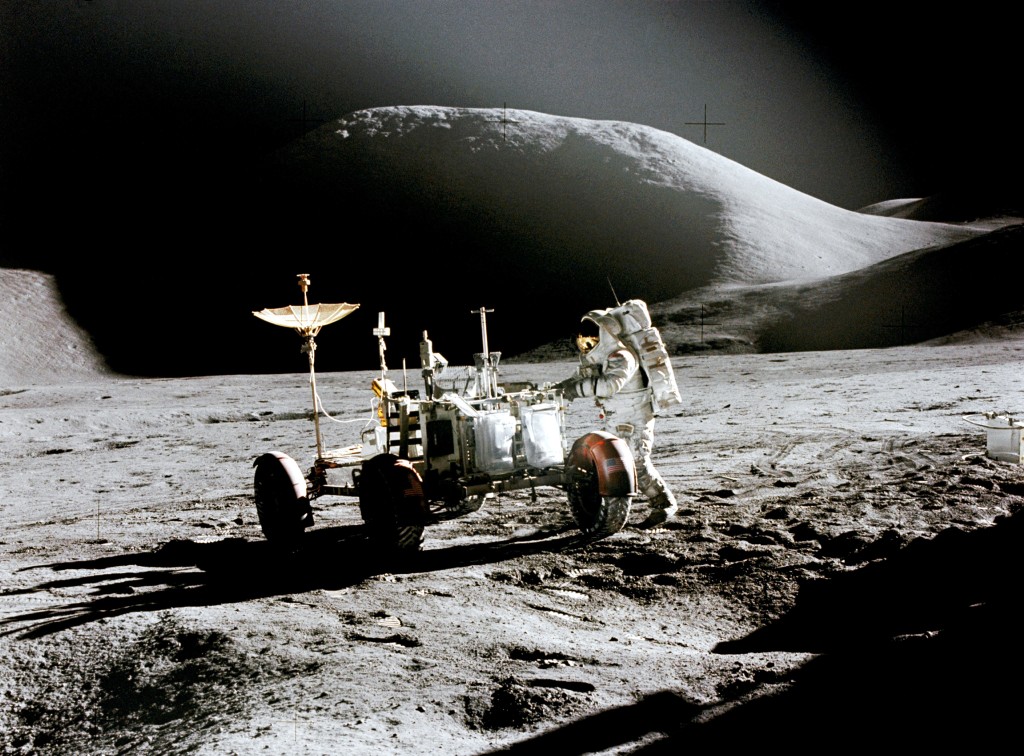
The Silent Sentinel: Why Did NASA Really Leave a Billion-Dollar Buggy on the Moon?
It sits there right now. Frozen in time.
Silent. Dust-covered. A billion-dollar dune buggy abandoned in the most desolate parking lot in the known universe. For over half a century, the Apollo 15 Lunar Roving Vehicle has waited, its mission long over, its drivers long gone. They tell us it’s a monument to exploration, a relic of mankind’s greatest adventure. A museum piece on a dead world.
But is that all it is?
What if it’s more than that? What if this incredible machine wasn’t just for picking up rocks? What if the first car on the Moon was part of a secret objective, a desperate hunt for something hidden in the lunar dust, something that fundamentally changed our understanding of our place in the cosmos?
Forget the grainy TV footage and the flag-waving. Forget the sanitized mission reports. Let’s look at what really happened up there, in the deep, haunting silence of the Hadley Rille. The story of Apollo 15 and its incredible rover is far stranger, and far more mysterious, than you’ve ever been told.
The Official Story Just Doesn’t Add Up
On paper, Apollo 15, which launched in the summer of 1971, was a “J-Mission.” That was NASA’s code for a major scientific upgrade. The first few Moon landings were about getting there. Sticking the landing. Planting a flag and getting home in one piece. They were incredible, yes. But they were baby steps.
Apollo 15 was different. This was the real deal. They were going to stay longer, walk further, and carry more equipment. And the crown jewel of this new mission profile was the Lunar Roving Vehicle (LRV). A car. On the Moon.
The justification was simple: geology. With a rover, astronauts David Scott and James Irwin could travel miles from their Lunar Module, the “Falcon.” They could cover more ground, investigate more diverse geological sites, and collect a wider variety of samples. It was a scientist’s dream. But it was also an incredible risk. The landing site itself, a narrow plain squeezed between the towering Apennine Mountains and a canyon deeper than the Grand Canyon, was the most dangerous and ambitious target yet. Why the sudden push into the unknown? Why the urgent need to go so far, so fast?
Deep Dive: The Cosmic Origami Car
You have to understand, the LRV wasn’t just a car. It was a work of pure genius, bordering on magic. Built by Boeing with help from General Motors’ Delco division, this was a machine designed to operate in an environment more hostile than anything on Earth. It had to survive temperature swings of 500 degrees Fahrenheit, from scorching sunlight to the freezing cold of shadow. It had to work in a vacuum, with no air to cool its electronics.
And the craziest part? It had to fold.
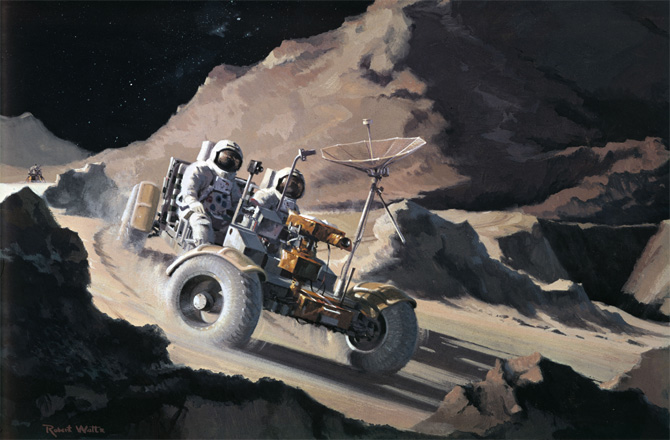
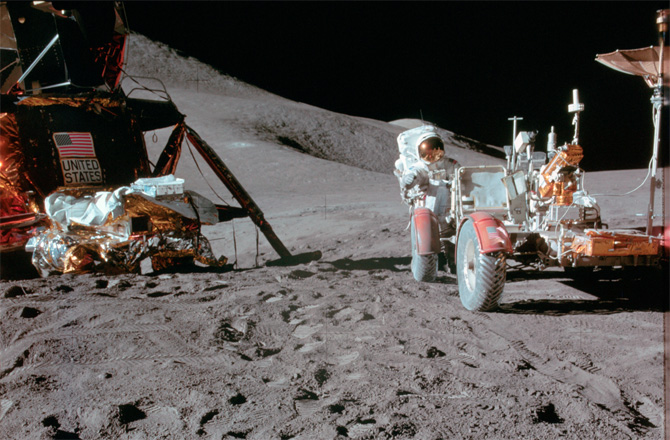
The rover was packed into a tiny, wedge-shaped compartment on the side of the Lunar Module. It was a marvel of engineering, collapsing down like some kind of high-tech origami. To deploy it, the astronauts simply pulled on a series of ropes and lanyards, and the entire vehicle unfolded itself, locking its chassis and wheels into place under the gentle tug of lunar gravity.
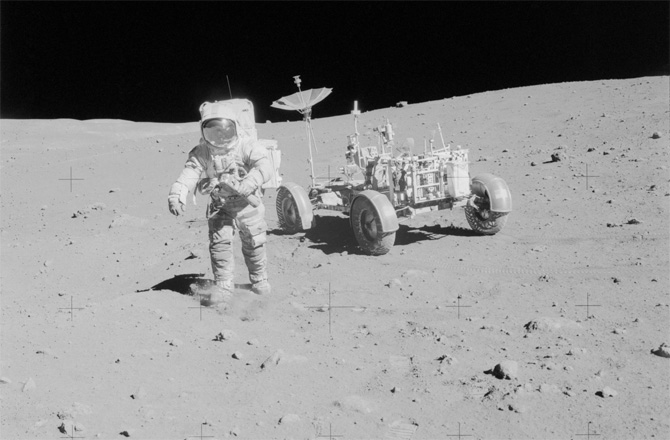
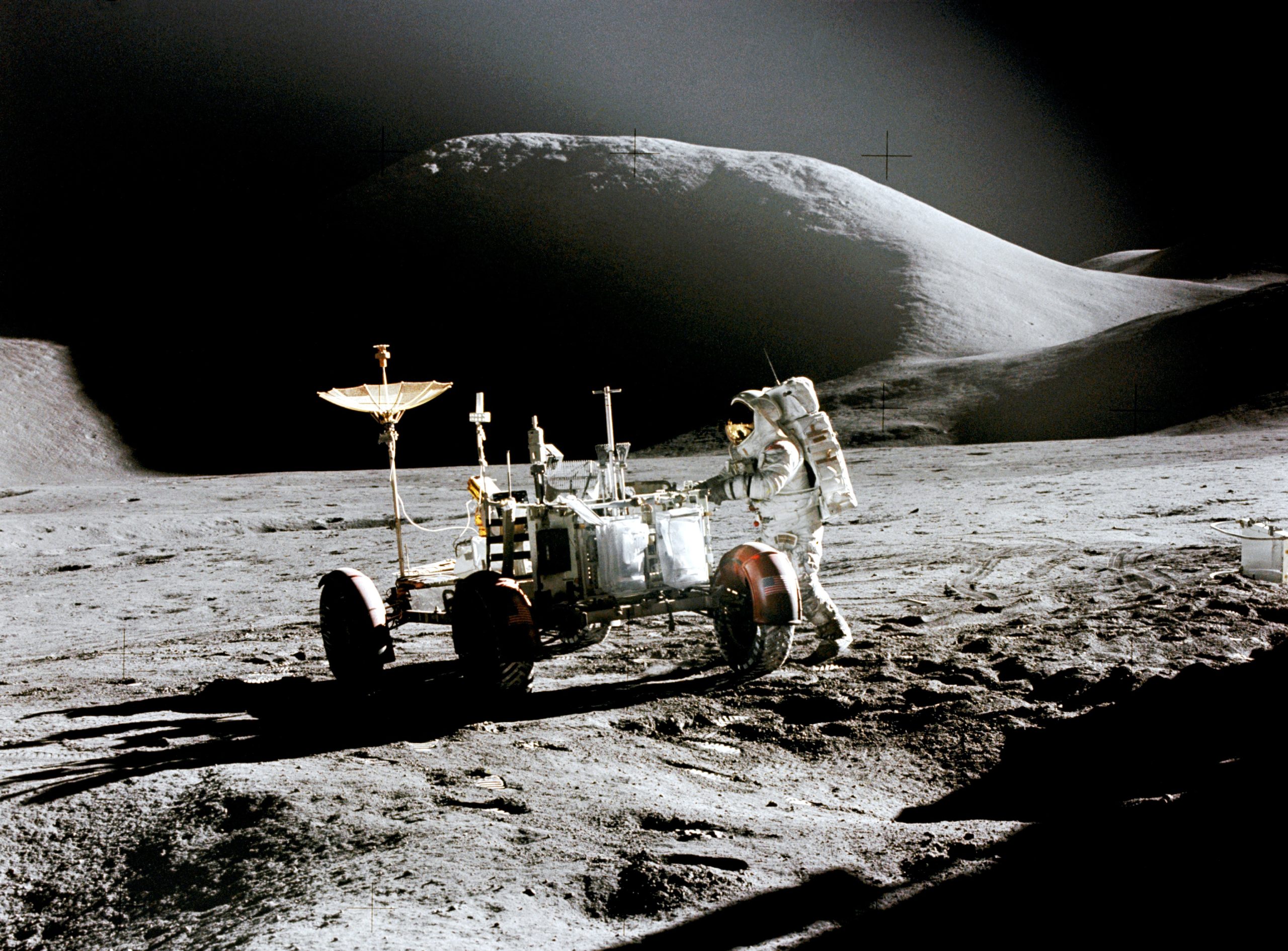
Its wheels weren’t rubber. They couldn’t be. Rubber would freeze solid in the lunar night and vaporize in the sun. Instead, they were flexible mesh creations, woven from zinc-coated piano wire and fitted with titanium treads. The whole thing was electric, powered by two silver-zinc potassium hydroxide batteries. It had a top speed of about 8 miles per hour, but on the bumpy, cratered surface of the Moon, it must have felt like a Formula 1 race.
They built a technological miracle. But the question that echoes through the decades is… why? Why go to all this trouble? Why spend millions on a vehicle that would only be used for three days? Was it really just to give a couple of geologists a ride?
The Grand Lunar Road Trip Begins
After a tense and perfect landing, Commander Dave Scott and Lunar Module Pilot Jim Irwin got to work. Unpacking the rover was a heart-stopping procedure. One wrong move, one jammed hinge, and the entire surface portion of their multi-billion dollar mission could be a failure. But it worked. It unfolded perfectly.
Imagine that moment. The first time human beings had wheels on another world. The sheer freedom of it. Previous Apollo crews were like dogs on a leash, able to wander only a few hundred yards from their lander. Scott and Irwin were unleashed. They could drive over the horizon. They could explore the mountains. They could peer into the great, winding canyon of Hadley Rille.
They were free to go anywhere. Or were they free to go to one very specific place?

Their three moonwalks, or EVAs, became legendary. They drove a total of 17.5 miles, venturing farther from their lander than anyone had ever dreamed possible. They ascended the slope of the Apennine Front, getting a breathtaking view of the lunar landscape. They hammered core tubes into the ancient soil and deployed a suite of scientific instruments.
And they found the “Genesis Rock.”
This was the prize. The big one. A chunk of anorthosite, a type of rock believed to be part of the Moon’s original, primordial crust. It was ancient. Billions of years old. A piece of the birth of the solar system, right there in their hands. It was a stunning discovery, one that rewrote the textbooks. And for the public back on Earth, it was the perfect justification for the entire mission.
Case closed, right? Not even close.
Whispers from the Dark Side: The Apollo 15 Anomalies
When you start digging into the mission transcripts, the audio recordings, and the thousands of photos, a different picture starts to emerge. A picture filled with strange gaps, coded language, and moments that the official narrative conveniently skips over.
What Did Alfred Worden See From Orbit?
While Scott and Irwin were driving around on the surface, Command Module Pilot Alfred Worden was orbiting 60 miles above them. Alone. For three days, he was the most isolated human being in history. His job was to operate a massive bay of scientific cameras and sensors, mapping the Moon in unprecedented detail.
But internet forums and deep-web researchers have pointed to strange parts of his solo journey. Worden himself, a man not given to wild fantasy, reported seeing things he couldn’t explain. During one pass over the far side of the Moon, out of radio contact with Earth, he described seeing flashes of light and unusual concentrations of what he called “Cinder Cones” in craters—features that seemed out of place. Officially, these are explained away as sunlight glinting off rock or normal geological formations.
But others have a different theory. Was he seeing evidence of something non-natural? Something active? While the world’s attention was focused on the two men on the ground, was the real discovery being made from high orbit?

The Unspoken Target of Hadley Rille
Let’s talk about the rille itself. A massive, winding channel carved into the lunar surface. The official explanation is that it was a collapsed lava tube from the Moon’s volcanic past. But it’s the perfect place to hide something. A deep, protected channel, shielded from the harsh radiation of space and hidden from easy view from orbit.
What if the Genesis Rock was just a happy accident? What if the real target was something inside, or on the edge of, that rille? The rover’s total range was carefully calculated based on the oxygen and battery life of the spacesuits and the vehicle. It had just enough range to get to specific points of interest along the rille and get back with only a razor-thin margin of safety. Was this a coincidence? Or was the entire mission planned around reaching a single, non-negotiable coordinate?
Some researchers have spent years poring over the high-resolution photographs taken by the astronauts. They point to shapes that seem unnatural. Symmetrical objects casting long shadows. Strange glints of light from inside craters where no light should be. Are these just tricks of light and shadow on an alien world our brains struggle to comprehend? Or did Scott and Irwin photograph something they weren’t supposed to see, anomalies that were later dismissed as “lens flare” or “camera artifacts”?
The Final Parking Spot: A Camera Left Behind
The mission’s final moments on the surface are perhaps the most telling. After three incredible days, Scott and Irwin packed up their gear, loaded their priceless rock samples, and prepared to leave the Moon forever.
But Dave Scott did something very specific. He drove the LRV a final time, parking it about 300 feet east of the Lunar Module. He didn’t just park it randomly. He positioned it carefully. He then aimed the rover’s TV camera directly at the “Falcon” lander.
Why?
The official reason is one of the coolest moments in space history: so that the camera could film their liftoff from the Moon. And it did. Mission Control remotely operated the camera, tilting it up to follow the ascent stage as it blasted off the surface, a breathtaking and historic piece of footage.
But think about that from a different angle. You are leaving a fully-functional, remote-controlled camera behind. A camera with a live feed. You are leaving a silent observer, a sentinel, to watch over the landing site after you’ve gone. The camera continued to operate for a time after their departure, before its batteries finally died from the extreme cold of the lunar night. What did it see in those final, lonely hours? What was it left to guard?

The Ghost Tracks of Apollo 15
For decades, this story was just memory and speculation. But now, we have eyes in the sky. NASA’s Lunar Reconnaissance Orbiter (LRO) has been circling the Moon since 2009, taking incredibly detailed, high-resolution photographs of the surface. And it has found them all. The Apollo landing sites, frozen in time.
You can see the dark smudge of the “Falcon’s” descent stage. You can see the tiny dot of the science package. You can even see the faint, ghostly trails of the astronauts’ footprints.
And you can see the Lunar Rover. It’s right where Dave Scott parked it.
Even more amazing, you can see its tracks. The twin parallel lines etched into the grey dust are still there, perfectly preserved in the airless environment. They are a permanent map of where Scott and Irwin drove. The official mission maps show their routes, and for the most part, the tracks seen by the LRO match them perfectly.
But online analysts claim to have found discrepancies. Small detours not mentioned in the public logs. Unexplained stops where the rover sat idle for minutes at a time. Tracks that lead to the very edge of a crater, pause, and then turn back. What were they looking at? What required them to go “off-road” from their carefully planned mission?
The rover of Apollo 15 wasn’t just a vehicle. It was a key. It unlocked the Moon, allowing humanity to explore vast new territories. But what doors did it open that were meant to remain sealed? Its journey marked a turning point in our exploration of space, but it also sits at the center of a deep and persistent mystery.
It remains there today, in the Sea of Rains, a silent testament to one of history’s greatest achievements. Or perhaps, a silent guardian of a secret we were never meant to know. The truth is out there, waiting in the dust of Hadley Rille. And maybe, just maybe, it’s waiting for us to come back and ask the right questions.