Home Weird World Space NASA proposes $10bn moon base within 6 years

NASA proposes $10bn moon base within 6 years

0
60

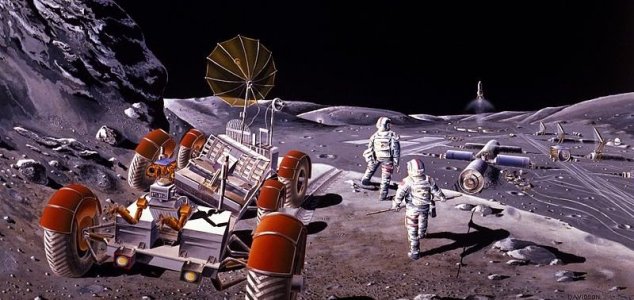
Future Moon Base Concept Art

Is it really possible to build a moon base on the cheap?

They told us it was too expensive. They told us the budget wasn’t there. For decades, the narrative has been exactly the same: “We’d love to go back, but the economy just can’t handle it.”

That was the lie.

The US space agency has suggested that it would be possible to build a ‘cheap’ moon base. And when they say cheap, they don’t mean affordable for you and me. They mean pocket change for the military-industrial complex. We are talking about a price tag that shatters every excuse NASA has fed the public since 1972.

Hot on the heels of ESA director general Johann-Dietrich Worner’s vision of a ‘moon village’ by 2030, scientists at NASA have been crunching the numbers. They’ve been calculating how much it would actually cost to build a permanent lunar outpost within the next few years. The result? It is a lot less than you might expect. In fact, it’s suspiciously low.

The $10 Billion Bombshell

Let’s look at the history. Back in the 1960s, the US spent the equivalent of $170 billion in today’s money on the historic Apollo program. That was a brute-force effort. We were throwing cash at the problem to beat the Soviets. It was a race for survival and dominance.

Because of that staggering figure, we’ve been conditioned to believe that returning to the Moon requires a similar financial sacrifice. A price that would seem to be but a pittance compared to that of building a moon base.

Yet, researchers investigating the feasibility of such a project believe that setting up a lunar outpost could cost as little as $10 billion. That is a fraction of the cost of putting the first humans on the moon. To put that in perspective, the US military spent roughly $13 billion on a single aircraft carrier, the USS Gerald R. Ford.

Think about that. For less than the price of one boat, we could have had a permanent, manned fortress on the surface of another world. If the price is that low, why haven’t we done it? Why has the Moon sat empty for fifty years? Unless, of course, it isn’t empty.

The “Moon Village” Agenda

The European Space Agency (ESA) isn’t talking about a flag-planting mission. They aren’t interested in dusty boots and a few photos. Johann-Dietrich Worner has been pushing the concept of a “Moon Village.”

This sounds nice, doesn’t it? A village. It sounds peaceful. Cooperative. But strip away the PR gloss, and look at the strategy. This is about colonization. It’s about In-Situ Resource Utilization (ISRU). That’s the fancy technical term for “living off the land.”

The plan relies on 3D printing structures using lunar soil (regolith). We wouldn’t need to haul concrete from Earth. We send robots first. They print the shell. Humans arrive later and inflate the habitats inside the printed shields. It’s brilliant. It’s efficient. And it makes the $10 billion price tag realistic.

Why the sudden rush?

“For a variety of very good reasons, it is time to go back to the moon, this time to stay, and funding is no longer the main hurdle,” said NASA astrobiologist Chris McKay.

Read that again. Funding is no longer the main hurdle.

If money isn’t the problem, what is? Politics? Technology? Or is there something else? For years, conspiracy theorists have whispered that we were “warned off” the Moon. That the Apollo astronauts saw things they shouldn’t have. Huge structures on the dark side. Lights in the craters. If funding is no longer the issue, then the only thing stopping us is fear. Or a blockade.

The Economic Loophole: Private Spaceflight

“When the cost of a short stay on the Moon drops into the tens of millions of dollars per person, it starts to tap into the same market that has given us private spaceflight participants to the International Space Station,” McKay explained.

This is where the billionaire tycoons enter the chat. Musk. Bezos. They are building the railroads of the 21st century. The drastic drop in launch costs—thanks to reusable rockets like the Falcon 9 and the heavy-lift Starship—has changed the physics of the economy. We don’t need to build a new rocket for every launch. We fly them, land them, refuel them, and fly them again.

This creates a new paradigm. “The presence of a government base is also the presence of a customer on the Moon – a factor that can stimulate the development of services, supplies, and technology to the benefit of all.”


Government as a customer. That’s the key. NASA sets up the outpost. SpaceX runs the supply trucks. Mining companies extract the water ice and Helium-3. It becomes a self-sustaining economy. A gold rush in the sky.

What Are We Really After? (The Helium-3 Theory)

Why build a base now? The original report mentioned 2022. Obviously, we missed that deadline. Or did we? Just because we haven’t seen a public landing doesn’t mean the infrastructure isn’t being laid.

The real prize isn’t rocks. It’s energy. Helium-3.

The Moon is bombarded by solar winds that deposit Helium-3 into the soil. It’s rare on Earth but abundant up there. This isotope is the holy grail for nuclear fusion. Clean, infinite energy without the radioactive nightmare of current nuclear power. A few shuttle loads of Helium-3 could power the entire Earth for a year.

China knows this. Their Chang’e missions are targeting these resources aggressively. The rush for a “cheap” moon base isn’t about exploration. It is a resource war. The first nation to secure the mining rights to the prime lunar real estate controls the energy market of the future.

The Dark Side: What Are They Hiding?

Let’s get deeper into the weeds. If a base costs only $10 billion, and the benefits are infinite energy and military supremacy, the fact that we haven’t publicly done it yet is the biggest mystery of all.

Could it be that the base already exists? Gary McKinnon, the Scottish hacker who breached NASA and Pentagon computers in the early 2000s, claimed he found Excel spreadsheets listing “non-terrestrial officers.” He saw fleet manifests for ships that don’t exist in the US Navy.

If the technology to go back “on the cheap” has existed for years, maybe the budget was moved into the “Black Budget”—the classified spending that doesn’t appear on congressional reports. Maybe the $10 billion figure is just a way to launder the money into a project that has been active since the 1980s.

The Lava Tube Hideouts

One of the most compelling aspects of the modern moon base proposals is where they plan to put it. They aren’t building domes on the surface like in old 1950s comics. That’s suicide. The radiation would cook you. The micrometeoroids would shred you.

The plan is to go underground. Into the Lava Tubes.

The Moon is riddled with massive, hollow tunnels formed by ancient volcanic activity. Some of these caverns are large enough to fit an entire city inside. They provide natural shielding from cosmic rays. They are temperature controlled. They are the perfect hiding spot.

If you wanted to build a secret base, you wouldn’t put it where a backyard astronomer with a telescope could see it. You’d put it in a hole. You’d build it inside the Moon, not on it.

The 2022 Prediction: A Missed Target or a Cover-Up?

The original report cited 2022 as a feasible date. We are past that now. The Artemis program—NASA’s current public face for returning to the Moon—has been plagued by delays and “budget overruns,” despite these studies saying it should be cheap.

Why the disconnect? Why do the scientists say “it can be done for $10 billion in 6 years,” while the bureaucrats take 15 years and spend $50 billion?

There are two possibilities:

  • Option A: Traditional government incompetence and contractor greed. Old aerospace companies (Boeing, Lockheed) want to milk the cow for as long as possible, keeping the price artificially high.
  • Option B: The public program is a distraction. The Artemis rocket (SLS) uses old Shuttle technology. It’s a dinosaur. Meanwhile, the real progress is happening in the dark, or via private companies that don’t have to answer to the Freedom of Information Act.

The Military High Ground

We cannot ignore the strategic angle. Whoever controls the Moon controls the space between the Earth and the Moon (cislunar space). From the Moon, you can monitor every satellite in Earth orbit. You can launch weapons that strike Earth with the force of a meteor, simply by dropping a tungsten rod down the gravity well.

The US Space Force wasn’t created to fight aliens. It was created to protect assets in this domain. A “cheap” moon base is the ultimate forward operating base. It is the “Death Star” position. If China builds their village first, they hold the high ground. The US cannot allow that.

Conclusion: The Gate is Open

The numbers don’t lie. The technology is here. The cost is negligible in the grand scheme of global economics. $10 billion is a rounding error for the Pentagon.

So, we are going back. Whether it’s a public “Moon Village” led by the ESA, a commercial mining town run by SpaceX, or a classified outpost that’s been there for twenty years, the Moon is about to get crowded.

The barriers are down. The excuses are gone. The only question left is: When they finally let us see what’s up there, will we be ready for the truth?

Stay watching the skies.

Originally posted 2016-03-30 22:15:46. Republished by Blog Post Promoter