Friday, April 10, 2026
HomeWeird WorldStrange StoriesWhat happened to Secret Base Bin Laden ?

What happened to Secret Base Bin Laden ?

Bin Laden

The Super-Villain Myth: Fact vs. Fantasy

Close your eyes for a second. Go back to late 2001. What did you see when you thought of the Enemy? If you were watching the news, you probably imagined a Bond villain. A mastermind sitting in a high-tech leather chair, deep inside a hollowed-out volcano, stroking a white cat while plotting global domination. We were sold a narrative.

And boy, did we buy it.

The story of Osama Bin Laden’s architecture is one of the strangest, most overlooked chapters of the War on Terror. It’s a story about perception, propaganda, and the bizarre reality of a civil engineer who turned the world upside down. But here is the kicker. The reality? It was nothing like the movies. It was messier. Grittier. And in the end, his own obsession with building walls is exactly what tore them down.

Let’s rewind. Let’s look at the blueprints of terror.

The Legend of Tora Bora: The Fortress That Never Was

You remember Tora Bora, right? The name itself sounds ominous. Rough translation: “Black Dust.” In December 2001, the world’s eyes were fixed on this patch of jagged peaks in eastern Afghanistan. The White Mountains.

The press went wild. They didn’t just report; they invented. According to major media outlets at the time, this wasn’t just a cave complex. This was the Death Star buried in rock.

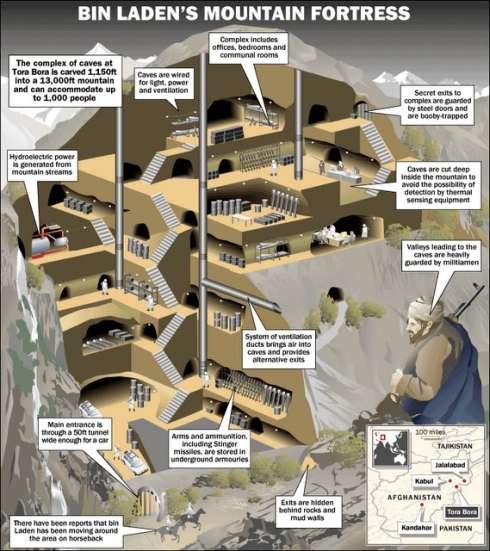
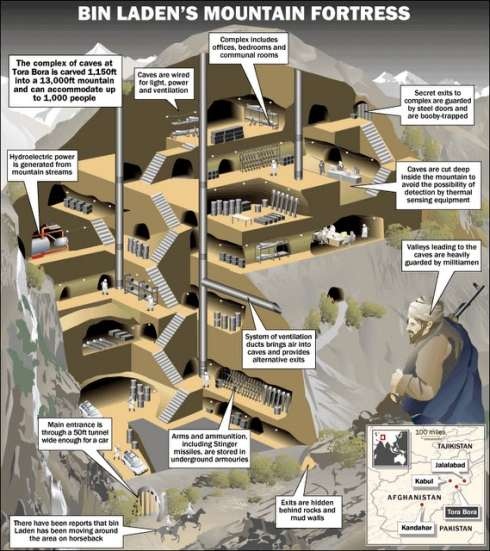
The Independent published a description shortly after 9/11 that read like science fiction. They painted a picture of an impregnable base built so deep inside the mountain that nuclear weapons couldn’t touch it. But it was The Times that really jumped the shark. They printed a cross-section diagram of “Bin Laden’s Underground Fortress” that is now legendary for its absurdity.

According to this diagram, the cave complex featured:

  • Full-scale hospitals with surgery wards.
  • Executive offices for high-ranking Al-Qaeda officials.
  • Dormitory bedrooms for thousands of fighters.
  • A massive hydroelectric power supply system generated from underground rivers.
  • Ventilation shafts sophisticated enough to filter out chemical attacks.
  • And—get this—roads paved and wide enough to drive a main battle tank into the heart of the mountain.

A tank! In a cave!

It was preposterous. It was impossible. But the United States government did absolutely nothing to pop this balloon. In fact, they pumped more air into it. When Donald Rumsfeld, the Secretary of Defense, was shown this fantasy schematic on Meet the Press, he didn’t laugh. He didn’t say, “Well, that’s a bit of a stretch.”

No. He looked the camera dead in the eye and said: “There’s not one of those, there are many of those.”

Why? Fear works. If the enemy is a technological genius with a subterranean city, you need a massive budget to fight him. You need endless war. It turned a man in a dirty cave into a mythical monster.

The CIA’s Irony: Who Built the Caves?

Here is where the history books get uncomfortable. Let’s dig into the dirt. Bin Laden didn’t just stumble into Tora Bora and find a hotel lobby waiting for him. He built it. Or rather, he helped upgrade it.

Bin Laden wasn’t a soldier by trade. He was a builder. His family owned the Saudi Binladin Group, a construction conglomerate that built mosques and palaces. He knew concrete. He knew logistics. He knew how to move earth.

Reports suggest Bin Laden did actually fit some caves with ventilation systems and small-scale hydroelectric power (using car alternators and mountain streams, not massive turbines). He used his civil engineering know-how to make the caves livable during the Soviet-Afghan war.

But who paid for the cement?

The CIA. During the 1980s, the Mujahideen were the “freedom fighters” battling the Soviets. Operation Cyclone funneled billions of dollars to these groups. The United States government effectively paid for the construction of the very bunkers that they would spend months bombing two decades later. We bought the shovel, and then they hit us with it.

Historical irony doesn’t get much darker than that. But who knows what might have happened had the US not bombed him out of there? Would he have expanded? Would the fantasy of the underground city have eventually become a reality?

The Reality Check

When US Special Forces finally cleared Tora Bora, do you know what they found? No hospitals. No tank roads. No golden toilets.

They found damp, cold, miserable holes in the ground. They found ammo crates and stale bread. The “Fortress of Doom” was a myth. It was a rugged, primitive defensive position, effective because of the geography, not the technology. The disconnect between the Rumsfeld narrative and the ground truth was staggering.

Dictator Chic: The Lost Mansions

Bin Laden was a man caught between two worlds. He preached asceticism—living simply, suffering for the cause. But the man grew up a billionaire. Old habits die hard. He couldn’t help himself.

Before he was running for his life, he was flirting with what we can only call “Dictator Chic.” Most of his homes were pulverized by US air raids (JDAMs tend to ruin the feng shui), but we have records of what they looked like.

Take his half-built house in Kandahar. This wasn’t a bunker. It was a statement. Intelligence reports and local accounts describe a property that included:

  • A private mosque.
  • 15 bedrooms (he had a large family, after all).
  • Western-style bathtubs (a luxury in that region).
  • Intricate, hand-carved wooden window frames.
  • Pastel-colored conference rooms for planning attacks.

He was trying to build a legacy in brick and mortar. He wanted the comfort of the West while waging war against it. It’s a psychological contradiction that defines his entire life.

The Art of Terror

It gets weirder. The wreckage of his life became… art? In 2002, British artists Langlands and Bell, who were nominated for the prestigious Turner Prize, traveled to Afghanistan. They didn’t go to paint sunsets. They went to hunt ghosts.

They found one of Bin Laden’s bombed-out residences in Jalalabad. Instead of just photographing it, they scanned it. They turned the terrorist’s home into a digital interactive art piece. You could “walk” through the ruins in a virtual reality environment. It stripped away the fear and left only the geometry of destruction. It showed the banality of evil—just walls, rubble, and empty space where a monster used to sleep.

The Abbottabad Anomaly: Hiding in Plain Sight

Fast forward. Tora Bora is history. The trail has gone cold. For years, the world assumes he is in a cave, shivering in the tribal regions of Pakistan.

Wrong again.

He was in the suburbs. Abbottabad, Pakistan. A military town. It’s the equivalent of a terrorist hiding out in a nice house in Virginia Beach or San Diego, right down the road from the Navy SEALs. It was audacious. It was insane. And for five years, it worked.

This brings us to his final architectural project. The compound.

In his final Pakistan abode, Bin Laden was cornered into the architecture of anonymity. But was it anonymous? Not really. And that is where the story pivots.

Despite spending roughly a million dollars on this bespoke compound (land acquisition plus construction), the goal was to be invisible. But Bin Laden’s ego—or perhaps his paranoia—got in the way. He built a trap for himself.

The Mansion of Mediocrity

Let’s look at the specs of the place where the world’s most wanted man met his end. It wasn’t a palace. It was a prison of his own making.

The frustrated fugitive still harbored ambitions of grandeur. You can see it in the footprint. The house was roughly eight times larger than any other house in the neighborhood. Imagine a quiet street of small, one-story cottages, and then suddenly, right in the middle, there’s a three-story concrete behemoth.

It screams, “Look at me! I have money! I have secrets!”

And then there were the walls. Oh, the walls. They were the biggest red flag of all. Literally and figuratively.

The compound was surrounded by an ostentatious security wall, rising 18 feet high in some places. To put that in perspective, a standard privacy fence is 6 feet. The Berlin Wall was roughly 12 feet. Bin Laden built a wall significantly higher than the Berlin Wall around a house in a quiet suburb.

If you are trying to blend in, you don’t build a fortress. You build a normal house. You buy curtains.

The Architectural Own Goal

This was the fatal error. It was a massive “own goal” in the anonymity department. It drew attention. Locals called it the “Waziristan Haveli” (the Waziristan Mansion). They knew something was up. You don’t build 18-foot walls topped with barbed wire just to keep stray dogs out.

The CIA noticed. When satellites swept over Abbottabad, the anomaly lit up like a Christmas tree. It didn’t fit the pattern of the neighborhood.

A White House spokesman later stated: “Intelligence analysts concluded that this compound was custom-built to hide someone of significance.”

They didn’t know it was him. Not for sure. But the architecture gave them the lead. The building itself was a fingerprint. Here is what the analysts saw that made them say, “We need to raid this place”:

  1. The Trash Burning: Everyone else in the neighborhood put their trash out for collection. The occupants of this house burned theirs inside the walls. Why? To destroy documents. To hide DNA.
  2. The Third Floor: The top floor had a privacy wall around the balcony that was 7 feet high. Why? So someone tall could stand outside and get fresh air without anyone from the street—or a satellite—seeing his face. Bin Laden was roughly 6’4″. It was custom-built for a tall ghost.
  3. No Internet or Phone: A million-dollar house with no telephone lines and no internet connection? In 2010? Suspicious. It meant the owner was terrified of electronic surveillance.

The Paradox of Power

When it came down to it, Bin Laden just couldn’t rein his architectural ambition in. He needed to be the master of his domain, even if that domain was a concrete box in Pakistan.

Think about the psychology of that last house. He lived there with three wives and a dozen children and grandchildren. It was cramped. It was hot—reports say they barely used air conditioning to avoid thermal signatures. It was a miserable existence.

He was a prisoner long before the SEALs kicked down the door. He built his own jail cell. He walled himself in, cutting off the outside world to stay safe, but in doing so, he created the very target that the US military would eventually destroy.

The Aftermath: Bulldozing History

So, where is this compound now? Is it a museum? A dark tourist attraction?

No. It’s gone. Vanished.

Shortly after the raid, the Pakistani government came in with heavy machinery. They didn’t just knock it down; they erased it. They pulverized the concrete and hauled it away. Why? They didn’t want it to become a shrine for extremists. They didn’t want a physical reminder of their embarrassment—that the world’s most wanted terrorist had been living comfortably under their noses for half a decade.

Today, kids play cricket on the empty lot. The 18-foot walls are dust. The secret rooms are gone. The only thing left is the story.

Deep Dive: What If?

Let’s play a game of “What If.” What if Bin Laden had been a little less arrogant with his blueprints? What if he had bought a modest, single-story house in Karachi? What if he hadn’t built the 18-foot wall?

He might still be alive today. He might still be releasing grainy audio tapes. His architectural hubris was his undoing. He couldn’t resist the urge to build a “compound.” He needed the physical manifestation of his importance.

It’s a lesson for the history books. You can hide from satellites. You can hide from spies. But you can’t hide from your own nature. In the end, the engineer built a structure that pointed a giant neon arrow right at his head.

The Tora Bora caves were a myth created by the media. The Abbottabad compound was a reality created by a narcissist. And somewhere in the middle, between the mountain fantasy and the suburban reality, lies the truth of modern warfare. It’s not about laser beams and tanks in tunnels. It’s about trash burning, high walls, and knowing that if something looks like a fortress, there’s probably a king hiding inside.

And kings always fall.

Amit Ghosh
Amit Ghoshhttps://coolinterestingnews.com
Aloha, I'm Amit Ghosh, a web entrepreneur and avid blogger. Bitten by entrepreneurial bug, I got kicked out from college and ended up being millionaire and running a digital media company named Aeron7 headquartered at Lithuania.
RELATED ARTICLES

1 COMMENT

- Advertisment -

Most Popular

Recent Comments

Warren Pan Abbott on The legend of the Devil Monkey !
chris davies on The McPherson Tape Mystery
Reed Reedly on ET has Internet!
Bea Houseoffashion on Proof Of Time Travellers – Gallery
Marcus2012 on ET has Internet!
Reed Reedly on ET has Internet!
LaughsAtConspiracyNuts on The 9/11 Conspiracy – Myths and Facts
Alex Sliverman on Did the ancients fly?
Doctor Wholigan on Time Traveler in 1938 film
chris davies on The McPherson Tape Mystery
Archie1954 on 10 secret UFO hideouts
chris davies on Ghosts of flight 401
Marcus2012 on ET has Internet!
jason Macdonald on Proof of Time Travel? – China
chris davies on Long-Lost Pyramids Found?
Reed Reedly on ET has Internet!
Milkman on Connected Universe
Tenmiles on Baigong Pipes Mystery
Simon Foster on Sirius – The Documentary
From the 1st April on 2013 – Alien Contact date ?
SkyWatcher on Is ET ignoring us?
I Come From The Future on Obama to make UFO Alien disclouser soon ?
ÛñK?øWn on 2013 – Alien Contact date ?
Just another person on 2013 – Alien Contact date ?
Malcolm Windowcleaner on The strange case of Rudolph Fentz
Mason Servio on Strange Things on Mars
Marke Wisdom Seeker on What will we find as arctic melts?
Andrea A Elisabeth Levyne on Aliens Captured in Varginha, Brazil
Mitch Grouyeki on Amazing Space Shuttle pictures