That Time a ‘Meteor’ Punched a Hole in the Moon – And Why the Official Story Feels… Thin
It happened in a flash.
One moment, the Moon was its usual, silent self—a pale, pockmarked guardian hanging in the blackness of space. The next, a brilliant spark of light erupted on its surface. A searing, white-hot pinpoint of fury that, for a breathtaking second, outshone the brightest stars around it.
This wasn’t science fiction. This was real. On March 17, 2013, something hit the Moon. Hard.
So hard, in fact, that NASA claimed the explosion was visible to the naked eye for anyone on Earth who happened to be looking up at the right time. A cosmic firework display, free of charge. A once-in-a-decade event. But as the dust settled, both literally on the lunar surface and figuratively here on Earth, the questions began to pile up. The official story is neat. Tidy. Almost *too* simple.
They told us it was a rock. A boulder. A random piece of cosmic debris meeting a violent end. But the more you look at the evidence, the more you listen to the silence that followed, the more you have to wonder…
What really hit the Moon that night?

NASA’s Official Story: A Cosmic Fender-Bender?
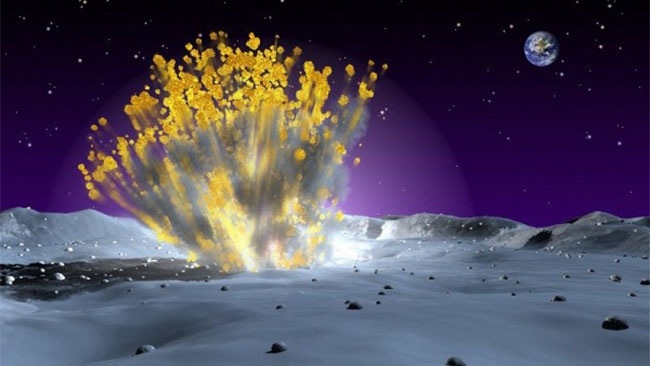
Let’s start with what the powers-that-be want us to believe. The story goes like this: on St. Patrick’s Day 2013, a meteoroid, estimated to be about the size of a small boulder—maybe a meter or so across—came screaming through space at an astonishing 56,000 miles per hour. It weighed about 88 pounds. Its target: the lunar region known as Mare Imbrium, or the “Sea of Rains.”
There was no atmosphere to slow it down. No friction to burn it up into a harmless shooting star. It was a pure, kinetic strike. A cosmic bullet.
The resulting explosion, captured by the ever-watchful eyes of NASA’s Meteoroid Environment Office, was the brightest they had ever recorded in the eight years their lunar monitoring program had been active. In fact, it was an order of magnitude brighter than anything else they had seen. A total showstopper. The agency quickly released a video, showing a tiny dot on a grainy black-and-white feed that suddenly blossoms into a ferocious point of light before fading away.
Case closed, right? A rock hit the Moon. It made a big flash. End of story. Move along, nothing to see here.
But that’s just not how we do things. When the official explanation feels like a flimsy cover on a deep, dark hole, we start digging.
Deep Dive: The Numbers Are Mind-Boggling
To understand the scale of what happened, you have to appreciate the physics. We’re not talking about a pebble skipping across a pond. We’re talking about an object hitting another object at over 25 kilometers per *second*. At that speed, the energy released is almost beyond comprehension.
NASA scientists calculated the energy of the impact flash. What did they find?
The explosion was equivalent to approximately 5 tons of TNT. Think about that. A rock you could barely wrap your arms around, hitting with the force of a military-grade bomb. The flash burned at thousands of degrees, likely vaporizing the meteoroid and tons of lunar rock in a fraction of a second. Scientists later used the Lunar Reconnaissance Orbiter (LRO) to find the crater. They spotted a fresh scar, about 18 meters (60 feet) wide. A brand new pockmark on the face of the Man in the Moon.
For eight years, the monitoring program had logged around 300 impacts. Most were tiny, barely registerable pops of light. This one… this one was different. This was the heavyweight champion. The main event. And it raises the first, most obvious question: why was *this* one so different? Was it just a fluke of size and speed? A one-in-a-million shot?
Or was it something else entirely?
But Wait… Was It REALLY Just a Rock?
Here’s where the smooth, clean narrative from the space agency starts to get a little… bumpy. The “random boulder” theory is the simplest explanation. And Occam’s Razor suggests the simplest explanation is often the right one. But the universe is under no obligation to be simple.
Let’s challenge the premise. What if the object that struck the Moon wasn’t just a dense piece of nickel-iron from the asteroid belt? What if its composition was different? What if it carried a payload that amplified the explosion?
The internet, of course, went wild. Forum threads on Above Top Secret and Reddit’s r/conspiracy lit up. People started analyzing the low-resolution video frame by frame. They pointed out the perfect, almost *artificial* symmetry of the initial flash. They questioned the duration of the glow. It seemed to hang in the void just a little too long for a simple kinetic impact.
Could the object have been something manufactured? A piece of lost space junk from a classified mission? That’s a possibility. But that doesn’t explain the unprecedented energy release. A defunct satellite, mostly aluminum and delicate electronics, wouldn’t pack the same punch as a solid iron meteoroid. Unless, of course, it wasn’t just *any* piece of tech.
The Problem with the “Naked-Eye” Sighting
This is the part of the official story that truly unravels for me. NASA made a point of saying the flash was so bright it could have been seen from Earth without a telescope. A magnitude 4 event, they said. That’s about as bright as the star Polaris. You can absolutely see that with your own eyes, even from a light-polluted suburb.
So, where are the witnesses?
March 17, 2013. The impact happened at 03:50:54 UT. That’s late evening for the East Coast of the United States. A clear night. Millions of people, including thousands of amateur astronomers with their telescopes pointed skyward, were in a position to see it. It was a weekend night, no less.
Yet, the reports are… strangely quiet. A few scattered accounts surfaced after NASA’s announcement, but there was no massive, global flood of “Hey, I saw a flash on the Moon!” reports that you’d expect from such a unique event. Why? Were people just not looking? Or was the flash somehow localized? Or… were the reports that *did* exist quietly scrubbed or dismissed?
It’s an unsettling silence. It’s one thing for a government agency to report an event. It’s another thing for them to claim it was publicly visible, when the public, for the most part, seems to have missed it. It feels less like a public service announcement and more like an alibi. Establishing a public “fact” that can’t be easily verified by the public itself.
Theory #1: A Secret Weapon Test in Our Backyard
Let’s walk down a darker path. What if the impactor wasn’t from deep space, but from low Earth orbit? For decades, military strategists have dreamed of “Rods from God”—kinetic bombardment weapons. The concept is simple: drop a dense, heavy projectile from orbit. It builds up incredible speed and hits its target with the force of a tactical nuke, but with no fallout.
It’s the ultimate stealth weapon. Where would you test such a system without causing an international incident? You can’t just drop a tungsten rod in the middle of the Pacific; the seismic signature and satellite observation would give you away instantly.
But the Moon… the Moon is the perfect target range. It’s empty. It’s non-political. It’s constantly being bombarded by small objects anyway, providing perfect cover for your test. A small, hyper-dense, aerodynamically guided projectile could easily produce an outsized explosive signature compared to a porous, irregularly shaped “boulder.”
Think about it. The object hits at 56,000 mph. That is blisteringly fast, even for a meteoroid. It’s right at the upper end of the velocity scale for objects in our solar system. It’s a speed more easily achieved by a purpose-built weapon system than a random rock tumbling through space.
Was this a clandestine test by the US, China, or Russia? A demonstration of a terrifying new power, conducted on a celestial stage where they thought no one was paying close enough attention? NASA’s monitoring program might have accidentally caught a glimpse of a secret war game being played out on our doorstep.
Theory #2: An Alien Probe Says “Goodbye”
Alright, let’s put on our tinfoil hats, because this is where it gets really interesting. For seventy years, we’ve heard stories of strange objects in our skies. What if they aren’t just visiting Earth? The Moon is the perfect observation post. No weather. No atmosphere. A stable, close-up view of our entire planet. It’s the ultimate high ground.
What if the object that hit Mare Imbrium wasn’t a meteor, but a piece of non-human technology? It could be one of several things:
- A Malfunctioning Probe: An alien reconnaissance drone that had been observing Earth for years, maybe decades, finally suffered a critical failure. Its orbit decayed, and it slammed into the lunar surface. Its power source—perhaps something far beyond our understanding—could have detonated on impact, explaining the unusually bright flash.
- A Self-Destruct Sequence: Perhaps the probe’s mission was over. Or perhaps it detected an imminent risk of discovery (like the LRO mapping the surface in high detail). To prevent its technology from falling into human hands, it initiated a self-destruct protocol, targeting a geologically uninteresting part of the Moon and vaporizing itself in a brilliant burst of energy.
- A Warning Shot: This is the most chilling possibility. What if the impact was deliberate and the brightness was the entire point? A message. A shot across the bow. A demonstration of capability from an intelligence that can hit our Moon with pinpoint accuracy and incredible force. It’s a way of saying, “We’re here. We see you. And we can touch you whenever we want.” The fact that no one was hurt was the essence of the message.
Connecting the Dots: The Moon’s Secret History of Strange Flashes
This 2013 event didn’t happen in a vacuum. It’s part of a much larger, much older mystery: the phenomenon of Transient Lunar Phenomena, or TLPs.
For centuries, long before we had sophisticated monitoring programs, astronomers have reported strange things on the Moon. Sudden, brief flashes of light. Patches of surface that inexplicably glow red or change color. Misty hazes that appear in craters and then vanish.
As far back as 1178, monks in Canterbury reported seeing the upper horn of the new moon split in two, with “a flaming torch springing up from it.” In the 18th century, the great astronomer William Herschel reported seeing what he thought were active volcanoes on the Moon. Even Apollo astronauts reported strange glows and “fireflies.”
What Are TLPs?
The conventional explanation is that TLPs are caused by outgassing—pockets of gas beneath the lunar surface being released and stirred up by solar radiation. Another theory is that they are simply small, unrecorded meteor impacts.
But these explanations have never fully satisfied researchers. The glows often seem too localized, the flashes too bright. The March 2013 impact fits the pattern of a TLP, but on a scale never before witnessed. Could it be that what we call TLPs are not all natural? Could they be evidence of activity on the Moon? The glint of sunlight off a metallic structure? The energy discharge from a hidden base? The exhaust from a landing or departing craft?
By framing the 2013 impact as just a “big meteor strike,” the official narrative conveniently disconnects it from this centuries-old pattern of high strangeness. But when you place it back into that context, it looks less like a random event and more like a dramatic exclamation point in a long, ongoing conversation we are only just beginning to overhear.
The Silence is Deafening
Perhaps the most compelling piece of evidence that something is amiss is what happened *after* the impact. Or rather, what didn’t happen.
This was the brightest, most powerful impact on the Moon ever recorded by modern instruments. It created a brand new, 60-foot crater in a well-mapped area. It was an unprecedented scientific opportunity. A chance to study a fresh impact site, to analyze the ejecta, to learn more about the object that caused it.
So where was the follow-up? Where were the high-resolution spectral analyses of the crater to determine the composition of the impactor? Where were the press conferences detailing the new science learned from this incredible event?
There was a brief flurry of news when the event was announced, a couple of months after it happened. Then… crickets. The story just… died. It was filed away under “cool space facts” and forgotten by the mainstream.
Why the lack of scientific curiosity? Why let the biggest lunar explosion in a decade become nothing more than a footnote? Unless, of course, they already knew exactly what it was. And they knew that the less they said, the better. If it was a secret weapons test, they would want to bury the story. If it was a potential extraterrestrial object, they would want to classify the data so deeply it would never see the light of day.
The story of the March 2013 Moon impact is a perfect example of a modern mystery. It’s a story with a simple, plausible, official explanation that just doesn’t quite sit right. It’s a story with tantalizing loose ends, unsettling silences, and just enough weirdness to make you wonder what’s really going on up there, right above our heads.
They tell us it was a rock. And maybe it was.
But in the silent, cold theater of space, a flash of light that bright demands a better explanation. It was a cosmic event, a piece of high drama. And we may have only been shown the first, very simple, very sanitized act.
Originally posted 2013-05-18 16:45:11. Republished by Blog Post Promoter
![20130518-184226[1]](https://coolinterestingnews.com/wp-content/uploads/2013/05/20130518-1842261.webp)