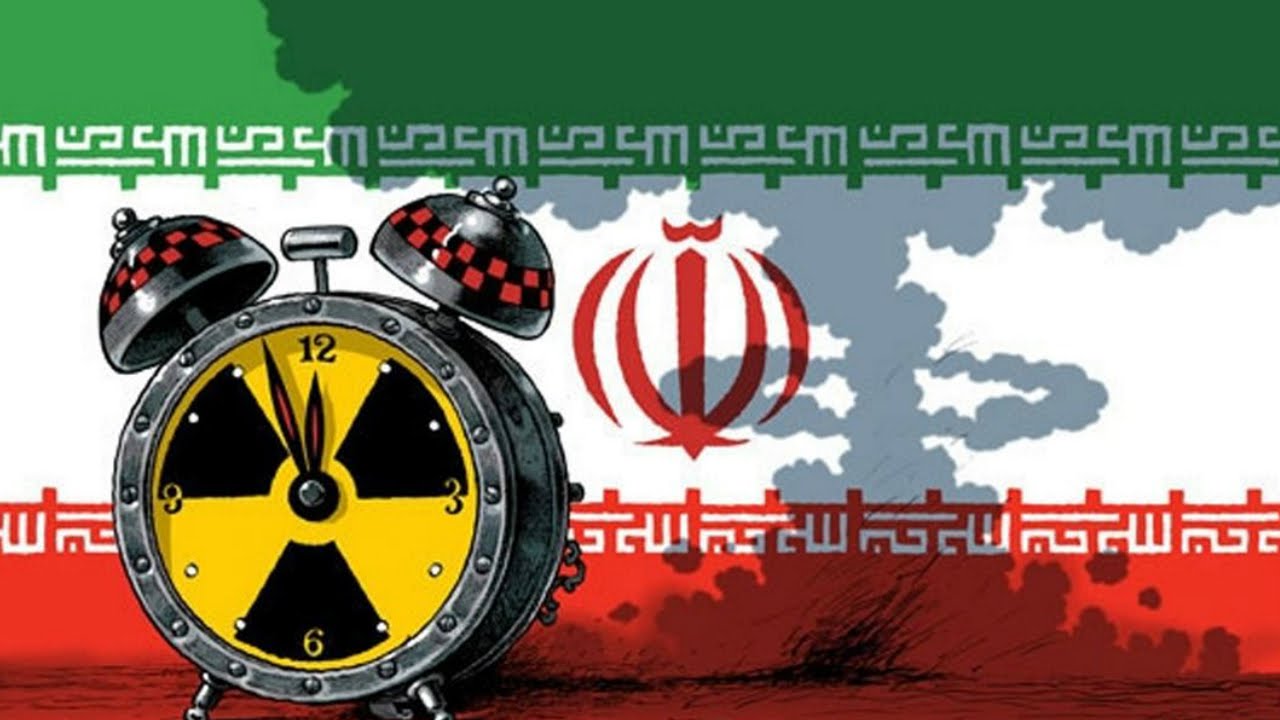
Iran is rarely out of the news. Is Iran actually seeking nuclear weapons capability and does it represent a threat to the world? Here we address some of the misinformation surrounding the Iranian nuclear issue to counter some of the media coverage that suggests that Iran is less than a clear and present danger, not only to Israel but to the world.
The Iranian threat to the world
Iranian support for global terror
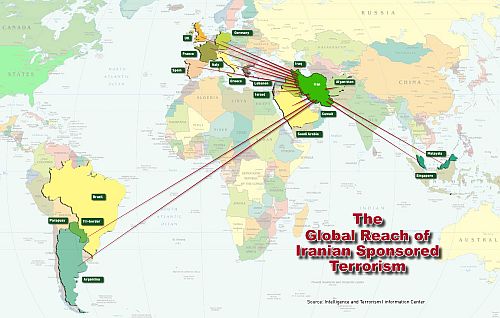
Iran is widely recognized as the world’s leading state sponsor of international terrorism. Both directly and indirectly, Iran funds, trains and arms groups that share the regime’s stated goal of destroying Israel and the West, as well as overthrowing regimes in Muslim countries such as Egypt and Saudi Arabia. These groups include Al Qaeda, Hezbollah, Palestinian Islamic Jihad and Hamas. Iran also provides support to insurgent groups in Lebanon, Iraq and Afghanistan which have inflicted casualties on American, British, Australian and other multinational forces.
Iran is expanding its terror network beyond the Middle East, using Hezbollah and splinter groups of Iran’s Revolutionary Guard to recruit and train sleeper cells in foreign countries. The terror network that Iran has created and continues to sustain, combined with the regime’s determination to become a nuclear power, is a serious international security issue and a growing global concern. FBI officials have also noted that Hezbollah has a sizeable presence in the United States, and suspects that Hezbollah may be planning to activate sleeper cells in the New York City area.
Iran poses different threats to nations and regions across the globe.
Middle East
The terrorist group Hezbollah, which operates primarily out of Lebanon, is one of Tehran’s primary weapons against Israel and Western interests in the region. Iran helped found, organize and train Hezbollah and gives the group over $200 million a year, in addition to an estimated $300 million after the war with Israel in 2006. It also continues to provide arms to the group, despite the demands of U.N. Security Council Resolution 1701.
Since Israel’s defensive war against Hezbollah in 2006, Iran has replenished Hezbollah’s arsenal of artillery rockets, and has supplied more advanced anti-tank weapons and surface-to-air missiles. At least 4,500 Hezbollah operatives have received intensive training from Iran. In August 2009, Egypt intercepted a group of Hezbollah militant cells planning the assassination of Israel’s ambassador to Egypt, as well as its link to another group planning on targeting Israeli tourists to Jordan. That same month, Egypt was hit by a barrage of mortars launched by militant Islamic groups in Gaza.
Iran also supports Palestinian terror groups opposed to a peaceful solution to the Palestinian-Israeli conflict. From 1993-2006, Iran provided approximately $30 million in annual subsidies to Hamas. Since Hamas’ electoral victory in 2006, Iran has transferred several hundred million dollars annually to Hamas. The Iranian Revolutionary Guard has trained approximately 950 Hamas terrorists in rocket and bomb construction, tactical warfare, weapons operation and sniper tactics.
Iran also provides the vast majority of Hamas’ weaponry. Since Israel’s defensive Operation Cast Lead in Gaza, Iran has supplied Hamas with advanced weaponry, including dozens of Iranian-produced 122mm Grad rockets which have significantly increased the range of Hamas’ rocket arsenal. During the operation, the Iranians claimed that more than 70,000 Iranian college students from universities throughout Iran volunteered to serve as suicide bombers to carry out attacks against Israel. The rush of volunteerism came after Iranian Supreme Leader Ayatollah Ali Khamenei delivered a religious decree stating that anyone who carried out an attack against Israel on behalf of Palestinians in Gaza would be considered a martyr.
In 2002, the Israeli Navy intercepted “Karin A,” a ship carrying 50 tons of advanced weaponry and rockets supplied by Iran and Hezbollah that was bound for Palestinian terrorist groups through Gaza’s waterway.
Iraq
In Iraq, Iran has fomented violence by giving insurgents about $3 million monthly and providing arms and training for them. Iranian-supplied explosively formed penetrators (EFP’s) are a serious concern for U.S. soldiers; the weapons were responsible for 18 percent of U.S. combat deaths in the last quarter of 2006, and 30 percent in -dominated areas. In July 2007, Iran planned an operation that killed five American servicemen, according to the U.S. Army. Shia groups now use Fajr-3 rockets bearing the markings of Iran’s Revolutionary Guard dated 2007, and Hezbollah also uses the Fajr-3. Attacks on U.S. bases have included the use of these rockets as well. Iran has sought to provoke sectarian violence in Iraq, and to that end, arms Sunni groups as well. Iran has sent revolutionary guard units to Iraq to train Shia militia fighters, and sent explosive-laden motorcycles across the border.
Afghanistan
Iran arms the Taliban’s campaign against NATO forces and civilians in Afghanistan even as it publicly supports Hamid Karzai’s government. Iran provides the Taliban with 107mm mortars, rocket-propelled grenades, C-4 explosives and small arms. Iran also gave the Taliban surface-to-air missiles, which they use against British troops. Iran is the main supporter of Hekmatyar, a major warlord and drug trafficker.
Europe and beyond
Europe serves as a popular location for Hezbollah operatives to conduct fundraising activities, accruing an estimated $198 million a year. E.U. officials have identified 900 Hezbollah terrorists residing in Germany and sleeper cells in 20 E.U. nations. Hezbollah cells are using key European capitals as intelligence-gathering centers. In 2008, evidence suggested Hezbollah had planned terrorist attacks in Rome and Paris, as well as the kidnapping of major figures.
Iran has worked directly and through proxies, including small groups linked to the Iranian Revolutionary Guard, to recruit potential suicide bombers to attack Israel, Europe and the United States. Iranian President Mahmoud Ahmadinejad has praised martyrdom as an “eternal art.” The Committee for the Commemoration of Martyrs of the Global Islamic Campaign, backed by the regime and linked to the Iranian Revolutionary Guard, has reportedly enlisted 40,000 people to carry out suicide attacks. Iran maintains terrorist training camps within its borders and abroad.
Iran’s Islamic Revolutionary Guard Quds Force, an extra-territorial arm of the Iranian Revolutionary Guard, operates 20 known terrorist training camps and centers. Hamas, Hezbollah and groups in Iraq send fighters to camps in Iran for months and even years of intensive training. Through Hezbollah, Iran trains insurgents in Iraq. During the 1990s, Iran sent arms to the Muslim-led Bosnian government, a move violating a United Nations embargo on all sides of the civil war. Additionally, between 2004 and 2007 it was reported that over 300 Iranian operatives had entered Bosnia-Herzegovina.
Latin and South America
Hezbollah also carried out terrorist attacks in Argentina, and killed 241 Americans in the 1983 suicide bombing of the Marine barracks in Beirut. On Aug. 21, Iranian President Ahmadinejad nominated Ahmad Vahidi, wanted for his part in planning the 1994 Argentinean attack that killed 85 at a Jewish community center, as defense minister.
Hezbollah is very active in Venezuela, Bolivia and Uruguay, as well as other Latin American countries, seeking to plan new attacks against Israeli or Jewish targets in the continent. In 2009, the anti-American Hugo Chavez of Venezuela continued to strengthen his ties with Iran. Additionally, Hezbollah has been using Mexican smuggling routes, to smuggle drugs and people into the United States, in order to bring in money to finance terrorist operations.
Attacks on U.S. and British citizens
In 1988, an Iran-backed terrorist organization was responsible for the kidnapping, torture and murder of Col. William Higgins, a U.S. Marine officer serving under a UN mandate in Lebanon. Additionally, Iran has placed a death warrant on British author Salman Rushdie, attempted to assassinate him in 1989 and has kept a $2.5 million bounty on him.
Asia
North Korea and Iran have maintained strong ties. In 2007, the two countries signed a cultural and scientific exchange plan. Additionally, North Korea has shared its nuclear technology know-how with Iran and North Korea has provided arms and training to Hezbollah through this relationship. Such ties have also involved rocket experiments; in May 2009, a Scud missile reportedly tested by North Korea, Syria and Iran killed more than 20 people in a Syrian market. Source: The Israel Project
Iranian pursuit of nuclear weapons capability
Some apologists for the Iranian regime would have you believe this:
there is no hard evidence that Iran is in possession of nuclear weapons or working on a nuclear weapons programme. The Iranian government insists that its enrichment of uranium is for domestic energy only. – Mehdi Hasan, New Statesman, 11 November 2011
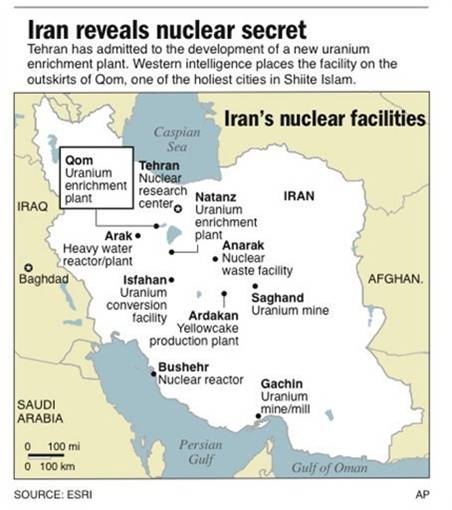
In reality however: Iran’s nuclear program is clearly intended to develop a nuclear weapons capability. For eighteen years, it was kept secret, even though international assistance would have been available to a civilian program. In 2002, Iran’s covert program was exposed. Since then, the International Atomic Energy Agency (IAEA) has repeatedly said that it cannot consider Iran’s nuclear program as entirely civilian, and on November 8, 2011 it released a report stating there is “credible” evidence that “Iran has carried out activities relevant to the development of a nuclear device.” Western intelligence agencies discovered, and Iran admitted to, another secret facility in Qom that is designed for approximately 3,000 centrifuges to enrich uranium. President Obama commented that the “configuration” of the Qom facility is “not consistent with a peaceful nuclear program.”
Three thousand centrifuges are sufficient for producing quantities of highly enriched uranium for nuclear weapons, but not for fuel for nuclear power plants. Iran has announced that it has begun moving centrifuges into the Qom facility, which is even deeper underground than the enrichment facility at Natanz. Additionally, it is suspected that the Parchin military base, located 20 miles from Tehran, serves as a major research and testing facility for the weapons component of the Iranian nuclear program.
Parchin has a number of fortified tunnels and bunkers which, according to the IAEA report, Iran has used to conduct simulated explosion experiments, possibly in association with nuclear materials. On November 8, 2011, the IAEA released their most comprehensive and damning report to date on Iran’s nuclear program. The report is based on intelligence received from more than 10 different countries, interviews with foreign scientists who helped Iran develop their program, and the IAEA’s own investigations and analyses. In unambiguous terms, the report states that Iran is engaged in “activities relevant to the development of a nuclear device.” These activities include:
- Research on uranium cores and detonators for nuclear weapons
- Acquiring nuclear weapons development information and documentation from a clandestine supply network
- Developing an indigenous nuclear weapons design and testing of the components
- Computer modeling of nuclear explosions and logistics for nuclear testing
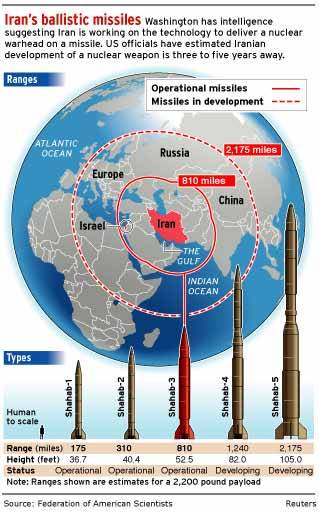
- Engineering studies to adapt missiles for nuclear warheads
This latest report unequivocally confirms Iran’s intentions to develop the capacity to build nuclear weapons and notes that Iran currently has enough low-enriched uranium to produce weapons-grade uranium for at least four nuclear bombs. (Source: ADL)
The Iranian threat to Israel
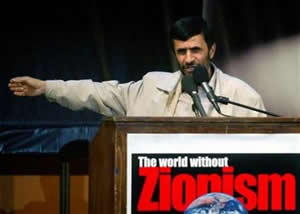
Israel must be wiped off the map … The establishment of a Zionist regime was a move by the world oppressor against the Islamic world . . . The skirmishes in the occupied land are part of the war of destiny. The outcome of hundreds of years of war will be defined in Palestinian land.
(In an address to 4,000 students at a program titled, ‘The World Without Zionism’, October 26, 2005)
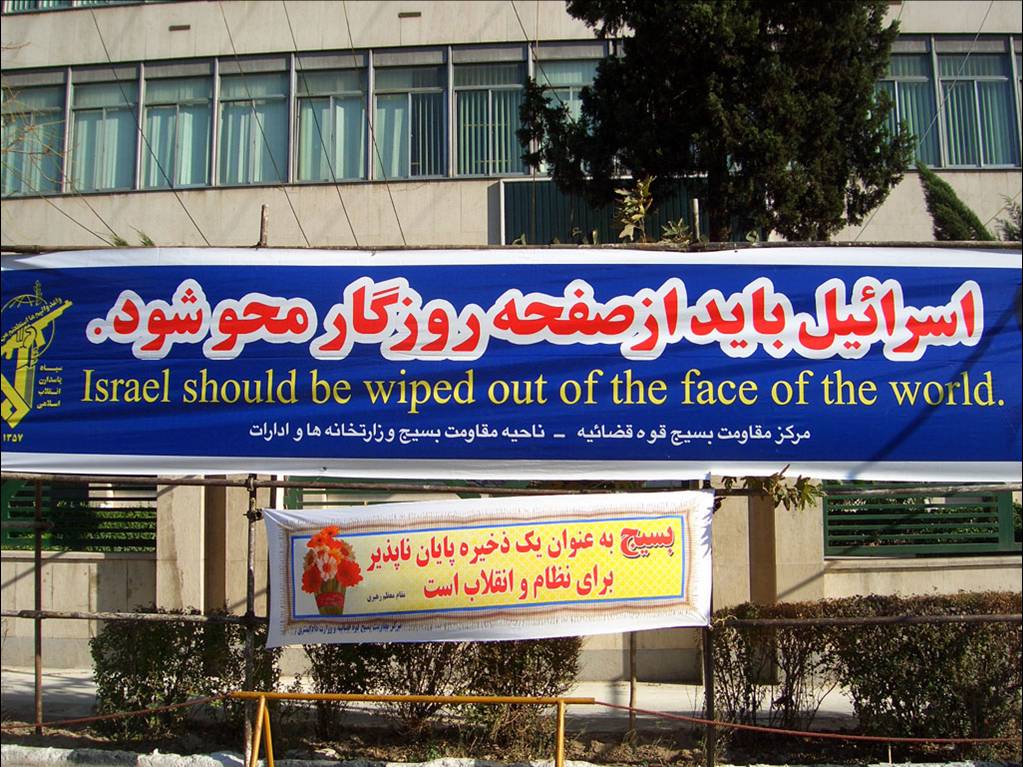
 Over the past several years, Iranian leaders – most prominently, Iranian President Mahmoud Ahmadinejad – have made numerous statements calling for the destruction ofIsraeland the Jewish people. While certain experts have interpreted these statements to be simple expressions of dissatisfaction with the current Israeli government and its policies, in reality, the intent behind Ahmadinejad’s language and that of others is clear.
- What emerges from a comprehensive analysis of what Ahmadinejad actually said – and how it has been interpreted inIran– is that the Iranian president was not just calling for “regime change” inJerusalem, but rather the actual physical destruction of the State of Israel. When Ahmadinejad punctuates his speech with “Death toIsrael” (marg bar Esraiil), this is no longer open to various interpretations.
- A common motif of genocide incitement is the dehumanization of the target population. The Nazi weekly Der Stürmer portrayed Jews as parasites and locusts.
- Ahmadinejad said in a speech on Febr uary 20, 2008: “In theMiddle East, they [the global powers] have created a black and filthy microbe called the Zionist regime.”
- Supreme Leader Ayatollah Ali Khamenei, who succeeded Ayatollah Khomeini in 1989, has made statements aboutIsraelsimilar to Ahmadinejad. On December 15, 2000, he declared on Iranian TV: “Iran’s position, which was first expressed by the Imam [Khomeini] and stated several times by those responsible, is that the cancerous tumor calledIsraelmust be uprooted from the region.”
- Michael Axworthy, who served as the Head of the Iran Section of Britain’s Foreign and Commonwealth Office, notes that when the slogan “Israelmust be wiped off the map” appeared “draped over missiles in military parades, that meaning was pretty clear.”
Iran: An Abuser of Human Rights
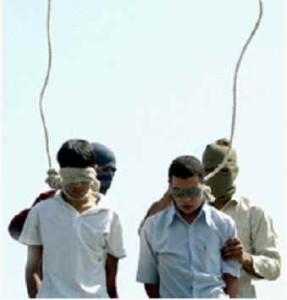
Execution of homosexual Iranian youths – July 2005
According to the US State Department’s 2010 Human Rights Report on Iran:
- The government severely limited citizens’ right to peacefully change their government through free and fair elections, and it continued a campaign of post-election violence and intimidation.
- The government committed extrajudicial killings and executed persons for criminal convictions as juveniles and through unfair trials, sometimes in group executions.
- Security forces under the government’s control committed acts of politically motivated violence and repression, including torture, beatings, and rape.
- The government administered severe officially sanctioned punishments, including amputation and flogging. Vigilante groups with ties to the government, such as Basij militia, also committed acts of violence.
- Security forces arbitrarily arrested and detained individuals, often holding them incommunicado. Authorities held political prisoners and continued to crack down on women’s rights activists, ethnic minority rights activists, student activists, and religious minorities.
- There was little judicial independence and few fair public trials.
-
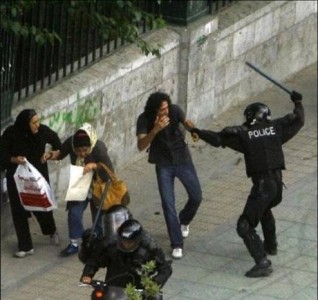
Violent suppression of demonstrations – June 2009
The government severely restricted the right to privacy and civil liberties including freedoms of speech and the press, assembly, association, and movement; it placed severe restrictions on freedom of religion.
- Authorities denied admission to or expelled hundreds of university students and professors whose views were deemed unacceptable by the regime.
- Official corruption and a lack of government transparency persisted.
- Violence and legal and societal discrimination against women, children, ethnic and religious minorities, and lesbian, gay, bisexual, and transgender persons were extant.
- Trafficking in persons and incitement to anti-Semitism remained problems.
- The government severely restricted workers’ rights and arrested numerous union leaders.
- Child labor remained a serious problem.
Summary
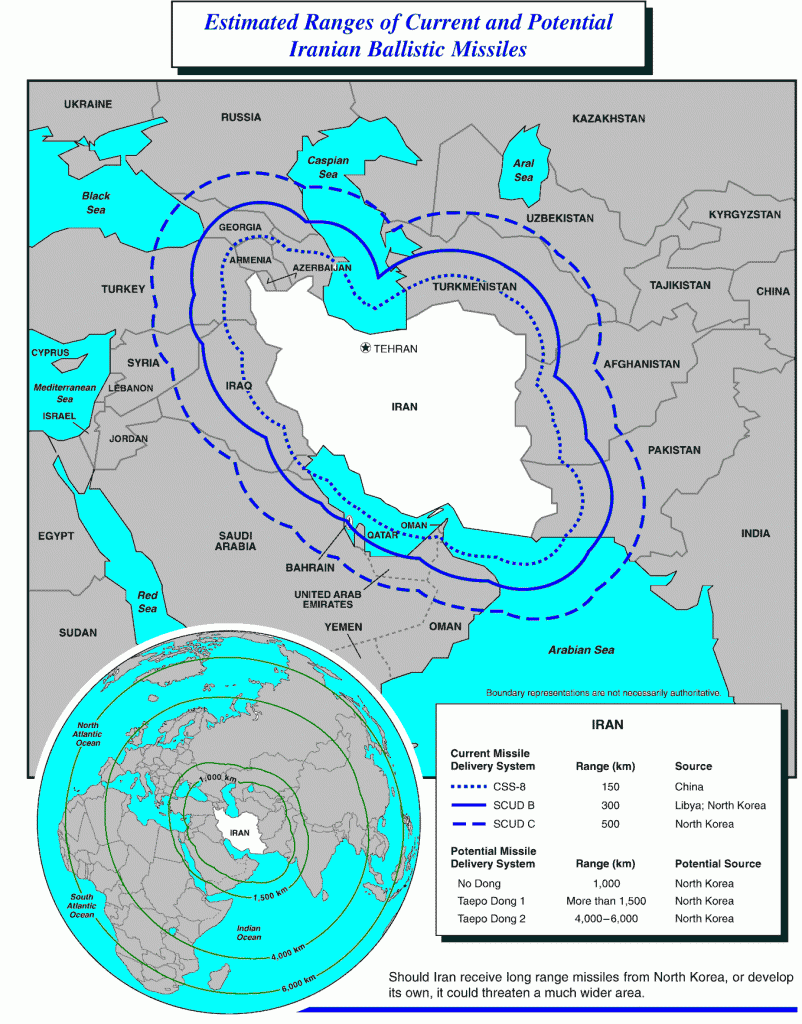
- Iran has relentlessly striven to achieve regional hegemony and global influence through terror, subversion, deception, support for terrorist activity worldwide, wars through proxies, and through an intensive military program to develop long-range missiles and nuclear weapons. Iran’s activity threatens the political and economic stability in one of the world’s most strategic regions.
- Iran has consistently demonstrated a total lack of respect for international norms and has systematically violated its commitments in international treaties and agreements. It has also brutally suppressed its civilian population, openly violating international and universal codes of behavior and human rights.
- Iran has launched a totally unprovoked attack against Israel and has openly and constantly called for its destruction. This attack is ideologically motivated against Israel and Jews as a whole.