Wednesday, May 6, 2026
HomeWeird WorldSpaceNASA – Mars mystery solved, NASA to reveal all!

NASA – Mars mystery solved, NASA to reveal all!

The Mars Bombshell: What NASA’s “Mystery Solved” Announcement Really Meant for Alien Life

It was a Monday. September 28th, 2015. The kind of day that usually fades into the background. But not this one.

NASA sent out a press release that sent the internet into an absolute frenzy. The title? “Mars Mystery Solved.”

Just three words. That’s all it took.

Speculation exploded. Had they found a monolith? An alien structure? A fossil? For decades, humanity has stared at that cold red dot in the sky and asked one single, profound question: Are we alone? And for a frantic few days, the world held its breath, wondering if this was it. The moment we got our answer.

The space agency promised a “major science finding” that would be revealed live to the world. The panel of speakers was announced, and internet sleuths immediately got to work. Their focus zeroed in on one name, a name that didn’t belong with the senior NASA officials. Lujendra Ojha. A PhD student at Georgia Tech. Why was a grad student on the panel for one of the biggest announcements in modern space exploration? The answer, it turned out, was everything.

The Big Reveal: Water on Mars… But Not How You Think

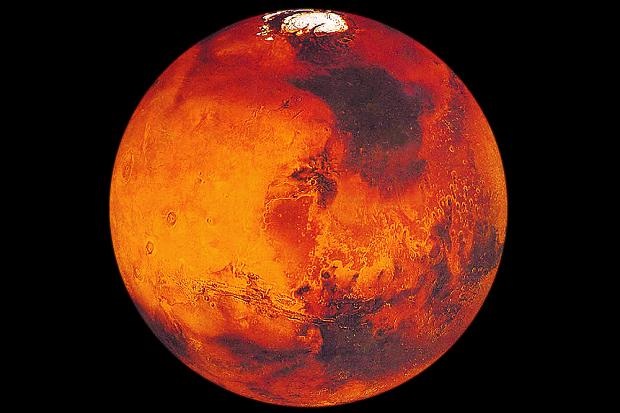
When the press conference went live, the announcement dropped. NASA had confirmed the presence of liquid water on the surface of present-day Mars.

Let that sink in. Not ancient, long-evaporated oceans. Not frozen ice caps. Liquid. Water. Flowing. Now.

But the images they showed weren’t of rushing rivers or placid lakes. They were strange, dark streaks staining the sides of Martian craters and cliffs. They called them Recurring Slope Lineae, or RSL. These dark fingers would appear on sun-facing slopes during the Martian summer when temperatures could climb above freezing, and then they would fade away as winter returned. They were seasonal. They were dynamic. They were, for all intents and purposes, wet.

Free flowing water on Mars could mean Alien life!

This wasn’t just a guess. Using spectrometers on the Mars Reconnaissance Orbiter (MRO), scientists had analyzed the light reflecting off these streaks. And they found the distinct chemical signature of hydrated salts. Specifically, perchlorates.

What does that mean in plain English? Think about how we salt our roads in the winter. The salt mixes with ice and lowers its freezing point, turning solid ice into a messy, watery slush even when the air is bitterly cold. That’s exactly what’s happening on Mars. These perchlorate salts are so powerful that they can keep water in a liquid, briny state at temperatures as low as minus 94 degrees Fahrenheit (minus 70 Celsius). This wasn’t fresh, drinkable water. It was a super-salty, toxic brine seeping just below the surface.

A mystery was solved, but an even bigger one was just beginning.

A “Lucky Accident” by a Grad Student Changes Everything

The story of this discovery doesn’t start in a sterile, billion-dollar NASA lab. It starts with a college student and what he called a “lucky accident.”

Back in 2011, Lujendra Ojha was just an undergraduate at the University of Arizona. He was working with planetary scientist Alfred McEwen (another name on that 2015 press conference panel) studying images of Martian gullies. His task was to use a computer algorithm to compare photos of the same slopes taken at different times, digitally removing things like shadows and glare to get a clearer picture of the geology.

He was just cleaning up the data. Routine work.

But then he saw them. In the “after” pictures, there were dark, finger-like stains that weren’t there in the “before” pictures. They snaked down the crater walls, branching out and growing over time. He checked his algorithm. He checked the original images. It wasn’t a glitch. The streaks were real. They were moving. And they were behaving in a way that nothing but liquid could explain.

Ojha had no idea what he was looking at. But he knew it was important. He and McEwen published a paper on the findings, suggesting these streaks could be flowing briny water. It was a stunning hypothesis, but they lacked the definitive proof. For four long years, the scientific community debated and researched. Ojha went on to graduate school at Georgia Tech, where he, along with Mary Beth Wilhelm (also on the NASA panel), continued to hunt for the smoking gun.

That gun was the chemical signature of those hydrated salts. And in 2015, they finally found it. The grad student who accidentally stumbled upon a planetary secret was now on the world stage, helping NASA announce that Mars was, in a sense, alive.

Deep Dive: The Orbital Eye That Saw the Water

How is it even possible to spot some damp soil from over 100 million miles away? The credit goes to one of the most incredible pieces of technology humanity has ever sent to another world: the Mars Reconnaissance Orbiter (MRO).

MRO is a NASA workhorse that’s been circling Mars since 2006. Onboard is an arsenal of instruments, but the star of this show is the High Resolution Imaging Science Experiment, better known as HiRISE. Think of HiRISE as a monstrous telescopic camera. It orbits Mars at an altitude of about 186 miles (300 km) and can take pictures of the surface with such shocking detail that it can spot objects as small as a dinner table.

It was HiRISE that captured the images Ojha was studying. It took pictures of the same locations over and over again across the Martian seasons, creating a time-lapse movie of the planet’s surface. This allowed scientists to see the RSL appear, grow, and then vanish. But seeing isn’t enough. To prove it was water, they needed another MRO instrument: CRISM, the Compact Reconnaissance Imaging Spectrometer for Mars. CRISM doesn’t see shapes; it sees chemistry. It analyzes the spectrum of light reflecting off the surface, and different minerals and chemicals absorb and reflect light in unique ways, creating a sort of “light fingerprint.” When they aimed CRISM at the dark streaks, it found the unmistakable fingerprint of water molecules bound to perchlorate salts. The case was closed.

The Burning Question: Did They Find Martian Life?

Let’s be blunt. The moment NASA said “liquid water,” the world heard “alien life.” Is it that simple? Is the presence of this salty brine a guarantee that something is squirming around in the Martian soil?

The answer is a tantalizing “maybe.”

The Case For Life

Here on Earth, life is tenacious. It’s stubborn. We have found it in places that seem completely inhospitable. We have “extremophiles”—organisms that thrive in extreme conditions. There are microbes that live in the bone-dry Atacama Desert in Chile, one of the best Mars analogs on Earth. There are bacteria that live deep under Antarctic ice, in water far saltier and colder than the ocean. There are even organisms that live in nuclear reactors, feasting on radiation.

The mantra for astrobiologists has always been “follow the water.” If you have liquid water, even if it’s super salty and super cold, you have a chance for life. The Martian RSL provide a potential habitat. Shielded just under the surface from the worst of the sun’s radiation, these seeps could be a niche where Martian microbes, if they exist, could survive.

The discovery was a game-changer because it meant a potential habitat for life exists on Mars *right now*, not billions of years ago.

The Skeptic’s Corner

But hold on. Mars is not Earth. The challenges for life there are immense. First, that water is incredibly briny. While some Earth life can handle salt, the concentration in the RSL might be so high that it would suck the water out of any known cell through osmosis, effectively killing it. Second, the Martian atmosphere is razor-thin, less than 1% of Earth’s. This means the surface is bombarded by deadly cosmic rays and solar radiation that sterilizes the top layer of soil. Any life would have to be buried. Finally, there’s the question of how much water is even there. We’re not talking about a flowing stream; we’re talking about damp soil, perhaps with the water activity of a piece of stale bread. It’s a tough place to make a living.

The Plot Twist: The Water Mystery Is Far From Over

Here’s where the story, which seemed so clear in 2015, takes a sharp and unexpected turn. In the years since the big announcement, the beautiful, simple story of flowing briny water has gotten… complicated.

New research and analysis have thrown cold water on the water theory. Or, more accurately, they’ve proposed a *dry* theory.

Some scientists now believe these dark streaks have nothing to do with subsurface water seeping out. Instead, they think the RSL are simply flows of sand and dust. They argue that the seasonal changes in air pressure and temperature on Mars could trigger granular flows, like tiny avalanches, that look exactly like the streaks seen from orbit. This theory neatly explains why the streaks only appear on very steep slopes—the angle needed for sand to start sliding.

So where do the hydrated salts that NASA detected fit in? The “dry flow” theory has an answer for that, too. They suggest the salts are already present in the Martian soil and are hygroscopic—meaning they can pull moisture directly out of the thin Martian atmosphere. The small amount of water they absorb could make the sand grains a bit stickier, changing how they flow and darken, but it wouldn’t mean a flowing underground source.

Did NASA jump the gun? Was the “Mars Mystery Solved” announcement a mistake? Not exactly. Science is a process. The data was real—the streaks are there, the hydrated salts are there. But the interpretation has evolved. The mystery, far from being solved, has actually deepened.

What If the Real Ocean is Hidden?

The debate over the surface streaks is fascinating, but it might be a complete distraction from the real prize. While scientists argue about damp soil on the surface, other instruments have been peering deep beneath it. And they may have found the Martian ocean we’ve all been dreaming of.

In 2018, using a ground-penetrating radar instrument called MARSIS on the European Space Agency’s Mars Express orbiter, scientists found something astounding. Buried a mile beneath the ice of Mars’s southern pole was a massive anomaly. The radar signals bounced back in a way that strongly suggested a huge body of stable, liquid water. A subsurface lake, nearly 12 miles across.

Subsequent studies have suggested there may be not just one lake, but a whole network of them, kept from freezing by the immense pressure of the ice above them and a high concentration of salts. Just like the RSL, but on a mind-bogglingly vaster scale.

Now, this is a habitat. Shielded from all surface radiation. Stable for potentially billions of years. Cold, dark, and salty, yes. But here on Earth, we have Lake Vostok in Antarctica, a similar subglacial lake that has been sealed off from the world for millions of years, and it is teeming with microbial life.

Could a hidden, dark biosphere exist on Mars? A world of life completely independent from the sun, powered by chemical reactions in the dark? It’s no longer just science fiction.

The 2015 announcement got the world excited about a little bit of salty slush. It cracked the door open. But the discoveries since then have blown the door off its hinges. The surface of Mars may be a dead, irradiated wasteland. The dark streaks might just be sand. But the real secret of Mars, the answer to that ultimate question, might be locked away a mile under the ice. Waiting.

Arindam Mukherjee
Arindam Mukherjee
Arindam loves aliens, mysteries and pursing his interest in the area of hacking as a technical writer at 'Planet wank'. You can catch him at his social profiles anytime.
RELATED ARTICLES
- Advertisment -

Most Popular

Recent Comments

Warren Pan Abbott on The legend of the Devil Monkey !
chris davies on The McPherson Tape Mystery
Reed Reedly on ET has Internet!
Bea Houseoffashion on Proof Of Time Travellers – Gallery
Marcus2012 on ET has Internet!
Reed Reedly on ET has Internet!
LaughsAtConspiracyNuts on The 9/11 Conspiracy – Myths and Facts
Alex Sliverman on Did the ancients fly?
Doctor Wholigan on Time Traveler in 1938 film
chris davies on The McPherson Tape Mystery
Archie1954 on 10 secret UFO hideouts
chris davies on Ghosts of flight 401
Marcus2012 on ET has Internet!
jason Macdonald on Proof of Time Travel? – China
chris davies on Long-Lost Pyramids Found?
Reed Reedly on ET has Internet!
Milkman on Connected Universe
Tenmiles on Baigong Pipes Mystery
Simon Foster on Sirius – The Documentary
From the 1st April on 2013 – Alien Contact date ?
SkyWatcher on Is ET ignoring us?
I Come From The Future on Obama to make UFO Alien disclouser soon ?
Just another person on 2013 – Alien Contact date ?
Malcolm Windowcleaner on The strange case of Rudolph Fentz
Mason Servio on Strange Things on Mars
Marke Wisdom Seeker on What will we find as arctic melts?
Andrea A Elisabeth Levyne on Aliens Captured in Varginha, Brazil
Mitch Grouyeki on Amazing Space Shuttle pictures